


Bringing home a tiny, wobbly eight-week-old and wondering what on earth happens next? Most new owners do. One week the puppy can barely climb the couch, and the next it’s teething on the table leg and ignoring every command it knew yesterday. Understanding puppy growth stages takes the guesswork out of it, so a normal growth spurt doesn’t send anyone into a panic, and a real red flag doesn’t get missed.
This week-by-week development timeline walks through every phase from birth to full-grown adult, including the milestones breeders watch for and the ones first-time owners almost always trip over.
Table of Contents
The Five Main Puppy Growth Stages at a Glance
Before the week-by-week breakdown, here’s the big picture. Puppies move through five recognized developmental periods, and every reputable source, from Purina to Best Friends Animal Society, follows roughly the same map:
- Neonatal stage (birth–2 weeks): blind, deaf, fully dependent on mom
- Transitional stage (2–4 weeks): senses switch on, first steps, first wags
- Socialization period (3–16 weeks): the most important window of a dog’s life
- Juvenile/ranking period (3–6 months): teething, testing limits, big growth
- Adolescence to adulthood (6 months–2 years): sexual and mental maturity
The catch? These phases don’t run on a fixed clock. A Chihuahua and a Great Dane hit them at very different speeds, which is exactly why a single number on a chart rarely fits a real puppy.
Curious where your own pup lands right now? You can match its current age and weight to an adult-size estimate before reading on.
“Predict My Puppy’s Adult Size” check our free dog calculators
Dog years to human years
Convert your dog’s age accurately
Puppy Growth Stages Quick-Reference Table
Here’s the entire timeline in one scannable view. Bookmark this, it’s the section most owners come back to.
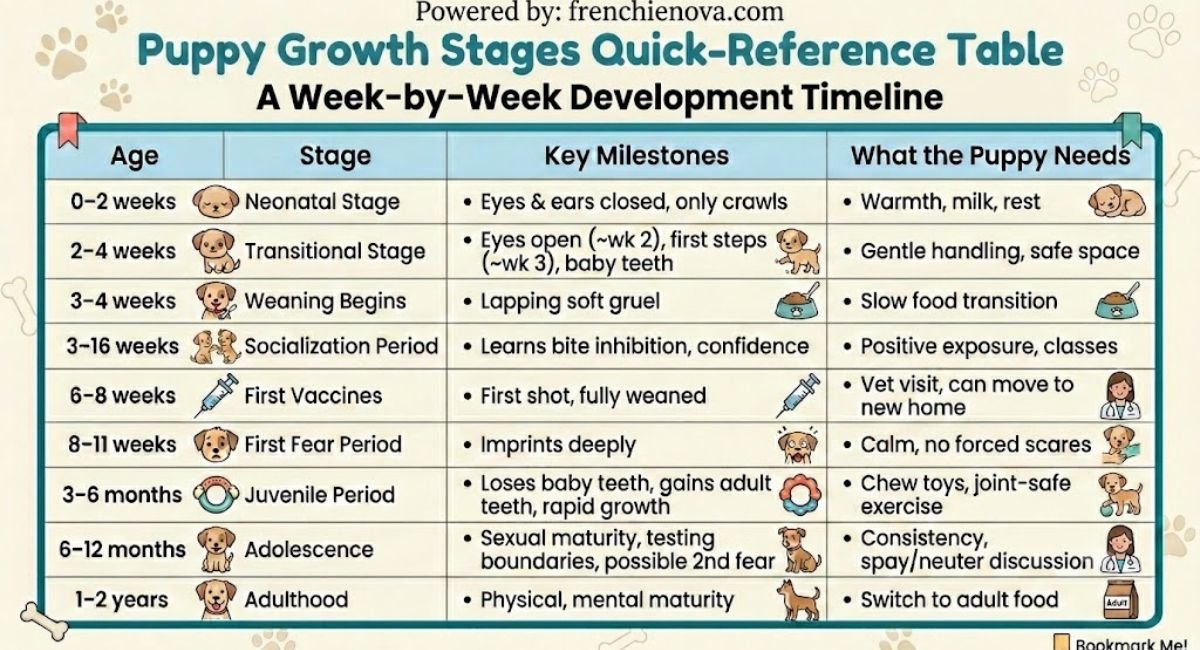
| Age | Stage | Key Milestones | What the Puppy Needs |
| 0–2 weeks | Neonatal | Eyes & ears closed, no teeth, only crawls, can’t regulate temperature | Warmth, mom’s milk, quiet rest |
| 2–4 weeks | Transitional | Eyes open (~week 2), first steps (~week 3), baby teeth, first barks & wags | Gentle handling, warm safe space |
| 3–4 weeks | Weaning begins | Starts lapping soft gruel, moving off milk | Slow transition to puppy food |
| 3–16 weeks | Socialization | Learns what’s safe, bite inhibition, confidence forms | Positive exposure, puppy classes |
| 6–8 weeks | First vaccines | First DAPP/DHPP shot, fully weaned | Vet visit, can go to new home at 8 wks |
| 8–11 weeks | First fear period | Experiences imprint deeply | Calm, positive, no forced scares |
| 3–6 months | Juvenile | Loses 28 baby teeth, gains 42 adult teeth, rapid growth | Chew toys, joint-safe exercise |
| 6–12 months | Adolescence | Sexual maturity, boundary-testing, possible 2nd fear period | Consistency, spay/neuter discussion |
| 1–2 years | Adulthood | Physical, sexual & mental maturity align | Switch to adult food |
Puppy Growth Stages Week By Week Development
Weeks 0–2: The Neonatal Stage
Newborn puppies arrive almost completely sealed off from the world. Their eyes and ears are closed, they have no teeth, and they can’t regulate their own body temperature. At this point, a puppy can do exactly three things: smell, suckle, and crawl toward the warmth of its mother.
Sleep and food are the whole job here. Neonatal puppies spend nearly all day pressed against mom and their littermates, and that closeness isn’t just cute, it’s survival. Interestingly, research shared through Harvard’s Canine Brains Project suggests even a few minutes of gentle daily handling at this stage can support healthy development down the line.
Weeks 2–4: The Transitional Stage
This is the fortnight everything switches on. A puppy’s eyes open during the second week, not with a dramatic pop, but as a slow peek through a tiny gap in the eyelids that widens over a day or two. Hearing follows close behind, and by the end of week three most pups are standing and taking their first clumsy, tottering steps.
Baby teeth start pushing through, the first real barks and woofs appear, and tails begin to wag. The puppy also learns to eliminate without its mother’s prompting. It’s a short window, but the change from a sleepy potato to a recognizable little dog is dramatic.
Weeks 3–4: Weaning and First Tastes of Solid Food
Around week four, puppies begin the slow shift from mother’s milk to solid food. Breeders usually start with a soft gruel, puppy food softened with warm water or a milk replacer, and gradually thicken it over the following weeks. Full weaning is typically complete by six to seven weeks. Pushing this too fast can upset a young digestive system, so patience wins here.
Weeks 3–16: The Socialization Period (The Most Important Window)
If there’s one stage to get right, it’s this one. The socialization period runs from about three weeks to sixteen weeks, and it’s when a puppy’s brain is wide open to deciding what’s safe and what’s scary for the rest of its life. Dogs that meet plenty of friendly people, calm dogs, surfaces, sounds, and everyday situations during this window tend to grow into confident, easygoing adults. Those that don’t often become nervous or reactive, and fixing that later is far harder than preventing it.
This is also where bite inhibition gets learned. Through play with littermates and corrections from mom, puppies discover that biting too hard ends the fun. It’s why pulling a pup from its litter too early, before eight weeks, so often backfires.
There’s a wrinkle, though: the immunity gap. Somewhere between four and twelve weeks, the antibodies a puppy got from its mother’s colostrum fade before its own vaccine-built immunity fully kicks in. That leaves a vulnerable stretch where parvovirus and distemper are real threats.
The practical fix most vets recommend is socializing carefully, friends’ healthy vaccinated dogs, carried trips to new places, puppy classes that require vaccination, rather than skipping socialization entirely or heading to a public dog park too soon.
When does the socialization window close?
The prime window starts narrowing around twelve weeks and is mostly shut by about sixteen weeks, or roughly three to four months old. After that, puppies grow noticeably more cautious of unfamiliar people and experiences, so the heavy lifting of socialization should happen before then.
Weeks 6–8: First Vaccines and Going Home
By six to eight weeks, puppies are fully weaned and eating several small solid meals a day. This is also when the first round of core vaccinations begins. The standard combination, often labeled DAPP or DHPP, protects against distemper, adenovirus (hepatitis), parvovirus, and parainfluenza, and it’s repeated every two to four weeks until the puppy is about sixteen weeks old.
According to guidance from the American Animal Hospital Association (AAHA), starting earlier than six weeks doesn’t help much, because lingering maternal antibodies block the vaccine from working.
Eight weeks is also the earliest most puppies should leave for a new home, old enough to be independent, but having had just enough time with mom and siblings to learn canine manners.
Weeks 8–12: The First Fear Period
Right as a puppy settles into its new home, it often hits a strange phase: the first fear period. Around eight to eleven weeks, experiences can leave a deep, lasting impression, good or bad. A frightening trip to the vet or a harsh scare can imprint in a way that’s tough to undo. The goal during these weeks is to keep new experiences positive and low-pressure: let the puppy approach things at its own pace, pair scary novelties with treats, and never force an interaction.
3 to 6 Months: Teething, Growth Spurts, and Testing Limits
Welcome to the gangly teenager phase. Between three and six months, puppies lose their 28 baby teeth and grow in 42 adult ones, which means a powerful urge to chew everything in sight, furniture, shoes, fingers. Plenty of appropriate chew toys save both your belongings and your sanity.
This is also a window of rapid physical growth, especially in large and giant breeds. Bones are lengthening, and cartilage is hardening into solid bone, which makes this clumsy, goofy stage also a slightly fragile one. Over-exercising a large-breed puppy or letting it leap off high furniture can stress developing joints, so moderate, low-impact activity is the safer bet. Most owners find biting starts fading by around five months with consistent training, and stops by roughly six.
Feeding the right amount during these growth spurts matters more than people think, too much too fast can push joints to develop unhealthily, particularly in big breeds.
“Check If My Puppy’s Weight Is On Track”
Puppy growth tracker
Predict your puppy’s adult weight
6 to 12 Months: Adolescence and Sexual Maturity
By six months, the puppy looks almost grown, but the brain hasn’t caught up to the body. This adolescent stretch is when many dogs seem to “forget” their training, push boundaries, and act generally wild. It’s normal, and it passes. Consistency through this phase is what separates a well-mannered adult from a frustrated owner.
Sexual maturity also arrives now. Female puppies usually have their first heat cycle somewhere between six and nine months, though it can come later. Males start showing interest around the same time. Both can reproduce well before they’re physically or mentally mature, which is why this is the stage most vets discuss spaying or neutering. Many dogs also go through a second fear period between six and eight months, a brief return to spookiness that simply needs patient, reassuring handling.
1 to 2 Years: Reaching Full Adulthood
Three things have to line up before a dog is truly grown: physical maturity, sexual maturity, and mental maturity, and they rarely finish at the same time. Small breeds often reach full size by around ten to twelve months. Large and giant breeds keep filling out until eighteen to twenty-four months. Mental maturity is usually last to arrive; plenty of dogs stay playful and a little silly well into their second year.
As a rough rule, dogs under twelve months are puppies, but breed size shifts the finish line. Once bones, joints, organs, and cognitive skills are all fully developed, the dog can transition to adult food and be considered grown.
When Do Puppies Stop Growing? Growth Chart by Breed Size
This is one of the most-searched puppy questions, and the honest answer is: it depends on size. The bigger the dog, the longer it grows. Here’s how the timeline shifts across breed sizes:
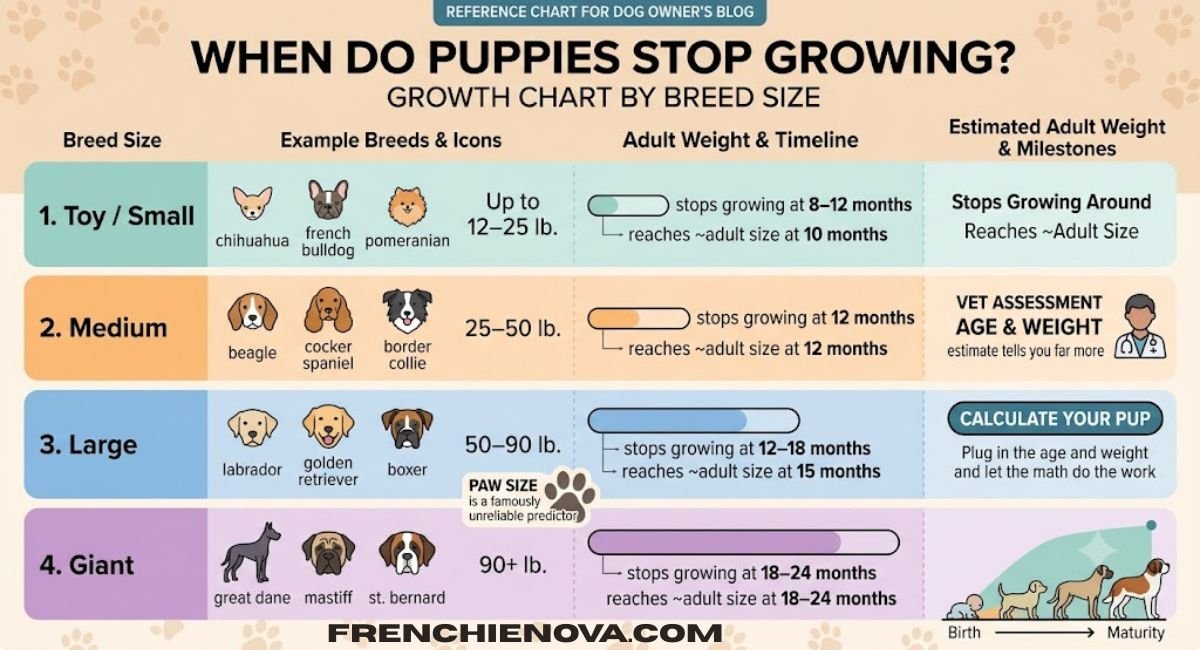
| Breed Size | Example Breeds | Adult Weight (approx.) | Stops Growing Around | Reaches ~Adult Size |
| Toy / Small | Chihuahua, French Bulldog, Pomeranian | Up to 12–25 lb | 8–12 months | ~10 months |
| Medium | Beagle, Cocker Spaniel, Border Collie | 25–50 lb | 12 months | ~12 months |
| Large | Labrador, Golden Retriever, Boxer | 50–90 lb | 12–18 months | ~15 months |
| Giant | Great Dane, Mastiff, St. Bernard | 90+ lb | 18–24 months | ~18–24 months |
Paw size, by the way, is a famously unreliable predictor of adult size, a vet’s growth assessment or an age-and-weight estimate tells you far more.
Want a number tailored to your specific pup instead of a breed-size range? Plug in the age and weight and let the math do the work.
“Estimate My Dog’s Full-Grown Size”
Dog years to human years
Convert your dog’s age accurately
When do puppies open their eyes?
Most puppies open their eyes during the second week of life, usually between days 10 and 14. The eyes open gradually, and sight stays blurry for a while before sharpening up around five weeks.
At what age do puppies start walking?
Puppies take their first wobbly steps by the end of the third week. Steady, confident walking follows over the next week or two as their back legs catch up to the front.
When do puppies stop biting?
With consistent training and plenty of chew toys, most puppies bite noticeably less by around five months and stop the hard mouthing by about six months. Biting is normal play and teething behavior, it needs to be actively redirected, not just waited out.
When can a puppy leave its mother?
Eight weeks is the earliest a puppy should go to a new home. Leaving before then often means missing key lessons in bite inhibition and canine social skills learned from mom and littermates.
The Bottom Line on Puppy Growth Stages
Every puppy moves through the same five growth stages, neonatal, transitional, socialization, juvenile, and adolescence, but the timeline stretches or shrinks depending on breed and size. The two non-negotiables for raising a confident, healthy dog are nailing the socialization window before sixteen weeks and keeping growth steady rather than rushed, especially in bigger breeds. Track the milestones, lean on your vet for the health checkpoints, and enjoy the ride, puppyhood is short, even when the chewing phase feels endless.
This guide is for general educational purposes. For vaccinations, growth concerns, or any health questions specific to your puppy, always consult a licensed veterinarian.
Dog years to human years
Convert your dog’s age accurately
Puppy growth tracker
Predict your puppy’s adult weight
Find your match
Find the right breed for your lifestyle

Auston is the founder of Frenchie Nova and a longtime French Bulldog owner. He writes practical, research-backed guides on Frenchie care, feeding, and health. Not a veterinarian — always consult your vet for medical concerns.