


A Frenchie owner can do everything right, same kibble, same scoop, same walks, and still watch their dog quietly pack on two pounds in the three months after neuter surgery. The food bowl hadn’t changed. The dog had. According to the Purina Institute, caloric intake should be reduced by around 30% after spay or neuter surgery to match the drop in energy needs. Most owners never get that memo.
This guide breaks down exactly why neutered and spayed dogs need fewer calories, when the drop kicks in, and how to recalculate the daily total before weight gain sets in.
Table of Contents
The Short Answer: Neutered Dogs Need 20–30% Fewer Calories
After spaying or neutering, a dog’s calorie needs drop by 20 to 30%, and the change is permanent.
The surgery itself doesn’t cause weight gain. The hormone loss that follows does. Estrogen, which normally suppresses appetite in females, drops to near zero after spaying. Testosterone, which helps males maintain lean muscle and a higher metabolic rate, disappears after neutering. The result is a smaller engine running on the same fuel, and the leftover fuel becomes fat.
Research from the University of Florida Health shows the metabolic shift can start as early as three days post-surgery, with appetite spiking by up to 60% at the same time. Veterinary nutritionists call this combination the “neutered trap”, a dog that needs less food but wants more of it.
According to data published in the Journal of the American Veterinary Medical Association, neutered dogs are roughly twice as likely to become obese as intact dogs. For brachycephalic breeds like French Bulldogs, Pugs, and Boston Terriers, that risk compounds an already-existing problem.
What Actually Changes Hormonally (The Real Mechanism)
Most articles stop at “metabolism slows.” That’s not wrong, it’s just thin. The actual mechanism is more interesting, and understanding it makes the feeding fix easier to follow.
Loss of Estrogen (Spayed Females)
Estrogen acts as a natural appetite suppressant in the central nervous system. It also works alongside leptin, the hormone that signals “I’m full”, to control how much a dog eats in a sitting. Once estrogen is removed:
- Voluntary food intake increases, per Bermingham et al. (2014)
- The sense of satiety weakens
- The brain receives less “full” signaling per meal
A spayed female fed the same portions she ate before surgery will, on average, want more, and store more of what she eats as fat.
Loss of Testosterone (Neutered Males)
Testosterone supports lean muscle mass and a slightly higher resting metabolic rate. After neutering:
- Muscle mass gradually decreases
- Resting metabolic rate drops
- Activity often declines naturally as testosterone-driven roaming, marking, and play behavior fade
Because muscle burns more calories at rest than fat does, less muscle means a lower daily calorie burn, even before the dog moves a paw.
The Other Hormones Nobody Talks About (Neutered and Spayed Dogs)
Diamond Pet Foods points out that leptin (appetite control) and insulin (blood sugar regulation) both shift after surgery too. That’s why “just feed less” feels harder for neutered dogs, their hormones are actively pushing back, increasing hunger drive while slowing the metabolic rate.
When the Calorie Drop Actually Happens
There’s a lot of contradiction about timing. Some sources say “immediately.” Others say “8 to 12 weeks.” The truth is both, they’re describing different windows.
Days 0 to 14 (Recovery phase)
A dog may eat less during these first two weeks because of post-anesthesia nausea, the cone, or general post-surgical discomfort. This is not the metabolic drop. Don’t reduce portions yet, the body is healing.
Days 3 to 8 weeks (Hormone washout)
This is the real window. Sex hormones gradually drop. Metabolic rate falls. Appetite climbs. Most of the silent weight gain begins here, exactly when owners assume nothing has changed.
Weeks 8 to 12 (New baseline)
Metabolic rate stabilizes at its new, lower level. The studies cited in JAVMA and the Journal of Nutritional Science measure their 20–30% calorie reduction around this point. By the end of week 12, the new feeding routine should already be running.
Month 4 onward
Permanent. Calorie needs stay reduced for the rest of the dog’s life unless activity changes dramatically.
The practical move: start adjusting portions around week 2 to 3, not on day one, and not after the scale has already moved.
Daily calorie needs
How many calories does your dog need?
The Math: How to Recalculate Calories After Spay or Neuter
The formula used by veterinary nutritionists, including the team at the Ohio State University College of Veterinary Medicine, is the Resting Energy Requirement (RER) equation:
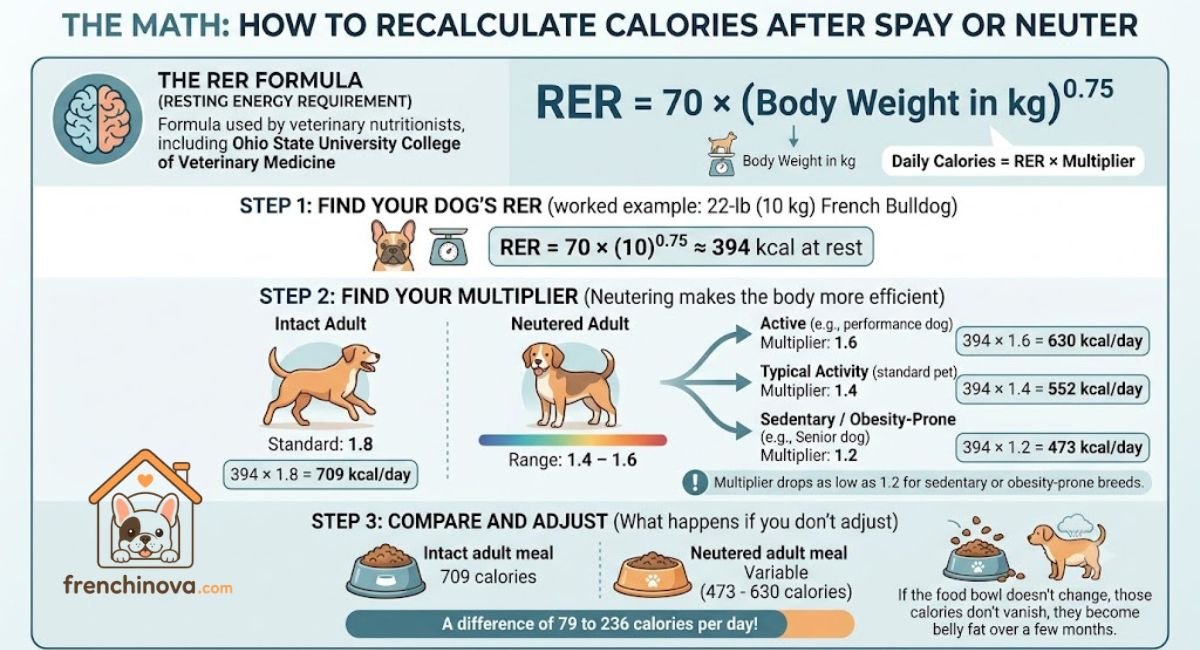
Daily Calories = RER × Multiplier where RER = 70 × (body weight in kg)^0.75
For neutered dogs, the multiplier drops from the intact-adult standard of 1.8 down to a neutered-adult range of 1.4 to 1.6, and as low as 1.2 for sedentary or obesity-prone breeds.
Worked example: a 22-lb (10 kg) French Bulldog
- RER = 70 × (10)^0.75 = 394 kcal at rest
- Intact adult Frenchie: 394 × 1.8 = 709 kcal/day
- Neutered, active: 394 × 1.6 = 630 kcal/day
- Neutered, typical activity: 394 × 1.4 = 552 kcal/day
- Neutered, sedentary/weight-prone: 394 × 1.2 = 473 kcal/day
For the same Frenchie, the difference between intact and neutered ranges from 79 to 236 calories per day. If the food bowl doesn’t change, those calories don’t vanish, they become belly fat over a few months.
Male vs Female: Are the Adjustments Different?
Most owners assume male and female adjustments mirror each other. They don’t quite, though both end up close to the same daily target.
Spayed females:
- Driver: loss of estrogen’s appetite suppression
- Appetite increase: noticeable, sometimes dramatic
- Recommended reduction: around 30% of pre-spay calories
Neutered males:
- Driver: loss of testosterone and lean muscle
- Activity often drops (less roaming, less mating-driven energy)
- Recommended reduction: around 20 to 25% of pre-neuter calories
Both sexes typically land in the 1.4–1.6 × RER range post-surgery. The reasoning differs, but the daily calorie target lands close.
A note worth flagging: older research said female dogs gain more weight after spaying than males do after neutering. Newer veterinary nutrition data suggests the opposite may be true, male dogs may be slightly more prone to post-surgery weight gain because of the bigger muscle-mass loss. Either way, both need a reduction.
How Much Should You Feed a Dog After Spaying or Neutering?
Most spayed or neutered adult dogs need 20 to 30% less food than they ate before surgery. For a 22-lb dog previously eating 700 calories daily, that means a new target of roughly 490 to 560 calories per day, depending on activity level. The exact number depends on breed, body condition score, and how active the dog is, but starting with a 25% cut and adjusting from there is the safest baseline.
Raw feeding made easy
Calculate raw food portions for your dog
What Doesn’t Work (Common Mistakes)
These are the strategies most owners try first. Each one backfires differently.
Mistake 1: “Just Feed Less of the Same Food”
The most intuitive move, cut the daily scoop by 25–30% and call it done. The trap: standard adult dog food is formulated to deliver complete nutrition at the full recommended volume. Cutting the portion by 30% also cuts protein, vitamins, and minerals by 30%.
The dog ends up undernourished, loses lean muscle (which slows metabolism even more), and the coat and immune system start to suffer.
Mistake 2: Switching to a Generic “Light” Diet
Light or weight-control kibbles do reduce calorie density, usually by replacing protein and fat with fiber filler. Calories drop, but so does protein. The dog feels full from fiber but loses muscle over time. That’s a losing trade for a neutered dog whose metabolism already favors fat over muscle.
Mistake 3: Free-Feeding (Leaving Food Out All Day)
Ad libitum feeding is one of the worst habits for a sterilized pet. The Spay Neuter Vets team flags it specifically: with elevated appetite and zero portion control, a neutered dog will almost always overeat. Set meals at set times. The bowl goes down, the bowl gets emptied, the bowl goes away.
Mistake 4: Forgetting to Recalculate the Treat Budget
Pre-neuter, a 700-calorie Frenchie has a 70-calorie treat budget at the standard 10% rule. Post-neuter, with the daily total now at 550, that budget shrinks to 55 calories. Most owners keep handing out the same treats and quietly overshoot the daily total by 15 calories every day, which adds up to over a pound of fat a year.
Mistake 5: Adding Food to “Satisfy” the New Hunger
A spayed dog who acts hungrier is not actually hungry in a survival sense. It’s a hormonal signal, leptin and estrogen have shifted. Adding more food doesn’t satisfy it. Higher protein, higher fiber, or both at the same calorie count actually works.
The Protein-Sparing Strategy (What Actually Works)
The approach backed by current veterinary nutrition research is called protein sparing, reducing calories while keeping protein density high or even increasing it.
A study published in the Journal of Nutritional Science found that dogs fed around 94 grams of protein per 1,000 calories maintained their body composition and metabolic rate after neutering. Dogs on lower-protein diets gained fat mass even when their scale weight stayed flat.
The principle is simple: lean muscle burns more calories at rest than fat does. Protect the muscle, and the metabolism holds. The Virbac veterinary nutrition team puts it this way, appropriate spay/neuter diets should be moderate in caloric density, high in protein, and high in fiber to address the unique needs of altered dogs.
Practical application:
- Switch to a higher-protein adult formula (28–32% protein by dry matter)
- Look for lean protein sources, turkey, chicken, white fish, as the first ingredient
- Choose diets with 8–12% fiber for satiety without extra calories
- Specialized formulas worth knowing: Virbac Veterinary HPM Spay & Neuter, Royal Canin Neutered Adult, and Hill’s Science Diet Perfect Weight are all built around this principle
A high-protein, high-fiber diet at the right calorie target outperforms any low-fat “light” diet at fixing the post-neuter equation.
The “Fat Blindness” Problem, How to Monitor for Weight Gain
One of the most counterintuitive findings in canine obesity research: most owners can’t accurately tell when their dog is overweight. The phenomenon is sometimes called fat blindness, and it’s the reason so many neutered dogs slide into obesity without anyone noticing.
The fix is a structured weekly check, not casual visual observation.
Every week:
- Weigh the dog on the same scale at the same time of day
- Run the hand-on-rib test
- Check whether collars and harnesses still fit the same
Every month:
- Run a full Body Condition Score (BCS) check, a 4 to 5 out of 9 is the target per the Purina Body Condition System
- Compare against last month’s photo from above and from the side
- Adjust portions by 5–10% if weight is drifting
Any swing of more than 5% body weight in either direction within a month is the threshold to act on.
Body condition score
Check your Frenchie’s body condition
Frenchie-Specific Considerations (And Other Brachycephalic Breeds)
For French Bulldogs, Pugs, Bulldogs, and Boston Terriers, the post-neuter calorie adjustment matters more than for most breeds.
- Brachycephalic anatomy means these dogs can’t safely exercise their way out of extra calories, they can’t run, hike, or swim hard enough to compensate
- BOAS (Brachycephalic Obstructive Airway Syndrome) gets worse with even small weight gains, making breathing harder
- Joint stress on short, stocky limbs amplifies under extra weight
- Frenchies sit in the top 10 most obesity-prone breeds per the Association for Pet Obesity Prevention, neuter status piles risk on top of risk
A realistic post-neuter multiplier for most Frenchies is 1.2 to 1.4 × RER, not 1.6. A typical 22-lb neutered Frenchie likely needs 475 to 555 calories per day, not 600+.
Do neutered dogs need fewer calories than spayed dogs?
Both need roughly the same total reduction, around 20 to 30%, but for different reasons. Spayed females need it because estrogen no longer suppresses appetite. Neutered males need it because testosterone no longer maintains muscle and metabolic rate.
Can a neutered dog stay lean without changing food?
Only if activity increases enough to burn the same calories the slower metabolism no longer burns at rest. For most pet dogs, that’s not realistic, feeding adjustment is the easier and more reliable lever.
Does the calorie drop apply to all neutered dogs forever?
Yes. The metabolic and hormonal changes are permanent. Calorie needs stay reduced for the rest of the dog’s life unless activity rises significantly or pregnancy/illness changes the equation.
The Bottom Line
Spaying and neutering permanently change a dog’s metabolism within the first 8 to 12 weeks after surgery, sometimes within days. Calorie needs drop by 20 to 30%, appetite climbs, and weight gain becomes the default outcome unless feeding is recalibrated.
The fix isn’t just “feed less.” It’s feed less of higher-quality, higher-protein food, recalculate the daily total with a lower RER multiplier, watch the treat budget, and monitor weekly so small changes never get the chance to compound. Done right, neutering doesn’t have to mean weight gain. Done by default, it almost always does.
Daily calorie needs
How many calories does your dog need?
Body condition score
Check your Frenchie’s body condition
Raw feeding made easy
Calculate raw food portions for your dog
This guide draws on hands-on French Bulldog ownership and references the Purina Institute, Diamond Pet Foods, Virbac Veterinary HPM, the Journal of the American Veterinary Medical Association, the Journal of Nutritional Science, the Ohio State University College of Veterinary Medicine, Bermingham et al. (2014), Salt et al. (2019), and the 2021 AAHA Nutrition and Weight Management Guidelines. Always consult a veterinarian before changing a dog’s diet after spay or neuter surgery, especially during the first 8 to 12 weeks of recovery.

Auston is the founder of Frenchie Nova and a longtime French Bulldog owner. He writes practical, research-backed guides on Frenchie care, feeding, and health. Not a veterinarian — always consult your vet for medical concerns.