

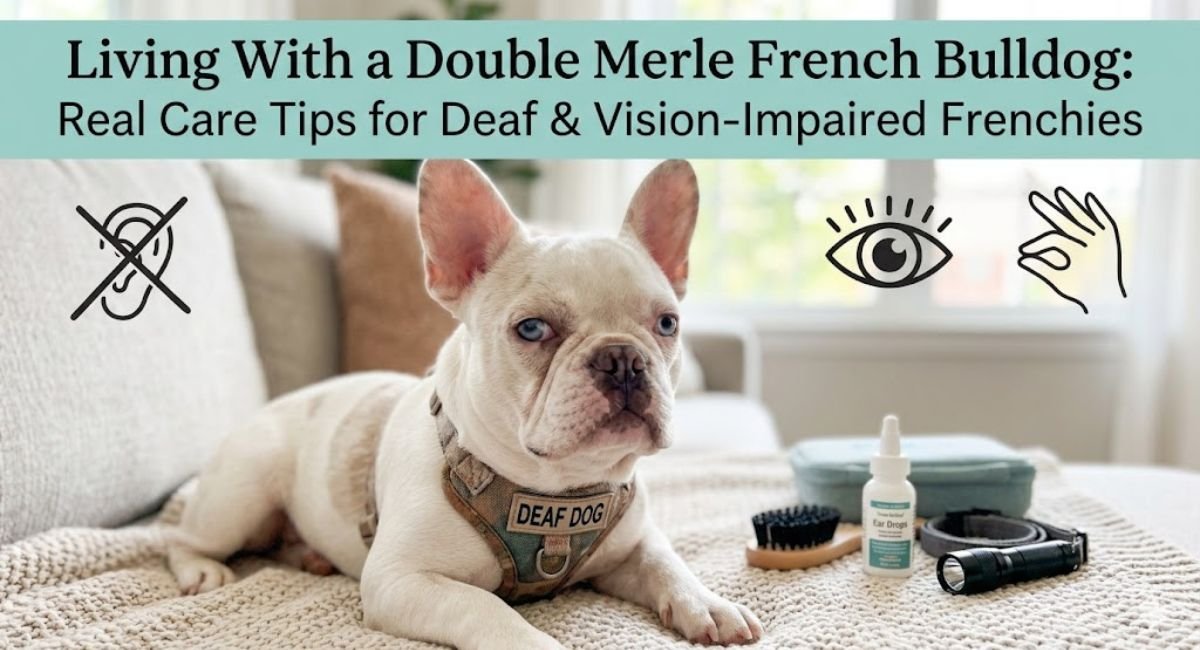
If you’ve found this article, you’re either already living with a double merle French Bulldog, or something made you stop and ask harder questions before committing. Either way, the right place has been landed on. The double merle Frenchie is one of the most misunderstood dogs in the breed world, not because the information isn’t out there, but because most of it stops at “don’t breed two merles together” and leaves actual owners completely on their own.
Table of Contents
What Exactly Is a Double Merle French Bulldog?
A double merle French Bulldog, also called a homozygous merle or MM dog, is produced when two merle-gene carriers are bred together. Each parent passes one copy of the merle allele, and the puppy inherits both. The scientific notation is M/M, compared to a single merle’s M/m.
The coat is the most visible indicator. Double merles are predominantly white, often with irregular patches of diluted color. The striking all-white or near-white appearance is what leads many buyers to unknowingly purchase one, sometimes marketed as “rare white Frenchies” by sellers who either don’t know or don’t disclose what they’re selling.
The merle gene doesn’t just affect coat pigmentation. It interferes with melanocyte development, the cells responsible for pigment in the eyes, inner ear structures, and skin. When two copies are present, that interference becomes significantly more severe.
The Health Reality: What a Double Merle Frenchie Actually Faces
This isn’t a section designed to alarm you. It’s here so you can plan, advocate, and provide properly.
Deafness
Deafness is the most common outcome. It can be unilateral (one ear) or bilateral (both ears). The BAER test, Brainstem Auditory Evoked Response, is the only reliable way to confirm hearing status, and it’s recommended by veterinary neurologists for any dog suspected of being a double merle. A BAER test is performed by a veterinary specialist, takes under an hour, and gives a definitive result per ear. If your Frenchie was purchased without this test being done, it’s worth requesting one at your next vet visit.
Vision impairment
Vision impairment ranges from mild sensitivity to complete blindness. Microphthalmia, abnormally small eyes, is a common finding and can lead to a life of limited or no vision. Routine ophthalmology exams are recommended at least annually for double merles.
Skin sensitivity
Skin sensitivity is frequently overlooked. The reduced melanin in predominantly white dogs means the skin has less natural sun protection. Prolonged sun exposure carries a real risk of sunburn and increases the likelihood of sun-induced skin conditions over time. This is covered more practically in the care section below.
Immune considerations
Immune considerations are less discussed but documented. Double merle dogs have been associated with higher susceptibility to infections and certain autoimmune conditions. Regular vet check-ins, not just annual wellness visits, are genuinely beneficial here.
And then there’s the standard French Bulldog health picture, which exists on top of all of this. BOAS (brachycephalic obstructive airway syndrome), spinal issues, knee problems, and heat intolerance are already part of the Frenchie package. In a double merle, those concerns don’t disappear; they layer.
Training a Deaf Double Merle: What Actually Works
This is the section that’s missing from almost every article written about double merle French Bulldogs, and it’s the one owners need most.
Hand signals replace verbal commands entirely.
The good news is that dogs learn hand signals as naturally as spoken cues, sometimes faster, because the visual channel is always “on.” A standard hand signal library can be taught using the same positive reinforcement methods used in spoken-command training. The only difference is consistency: every person in the household needs to use the same signal for the same behavior.
Some signals that are commonly established by owners of deaf Frenchies:
- Sit: flat hand pressed downward, palm facing the floor
- Stay: open palm held toward the dog, fingers up
- Come: arm sweep inward toward the body
- Good dog: thumbs up, or a specific pat on the chest
- No: index finger wagged side to side (at the dog’s eye level)
Vibration-based check-ins
Vibration-based check-ins work well for getting attention. A gentle tap on the floor near the dog, a light stomp, or a vibrating collar (not shock, vibration only) can be used to redirect attention when a verbal recall isn’t possible. Many deaf dog owners report that their dogs become highly attuned to floor vibrations and respond reliably once the association is built.
Eye contact training
Eye contact training is foundational. A deaf Frenchie’s safety depends on their responsiveness to visual cues, and eye contact is the gateway to all of them. Short sessions, rewarding the dog for looking at your face, using high-value treats, build the habit quickly. Five minutes, three times a day, gets results within two weeks for most dogs.
Leash safety is non-negotiable.
A deaf dog cannot hear a car, a bicycle, another dog approaching, or a call from across a yard. Reliable fencing, long-line recall training (using hand signals), and a leash policy in unfenced areas are the baseline non-negotiables for a double merle’s safety outdoors.
Daily Care Adjustments That Actually Make a Difference
Sun protection isn’t optional for a predominantly white double merle. Short sun sessions are fine, but prolonged outdoor exposure in direct sun, especially between 10 AM and 3 PM, should be limited. Dog-safe sunscreen (zinc-free, formulated for animals) can be applied to exposed skin: the nose, ear tips, and any pink or lightly pigmented areas. This is not excessive, it’s basic welfare for a low-pigment dog.
Eye care requires more attention than a standard Frenchie. Discharge, squinting, pawing at the eye, or reluctance to enter bright light are all signals worth acting on promptly. French Bulldogs already have prominent eyes that are prone to ulcers and infections, and in a double merle with potential structural eye abnormalities, those risks are amplified. Keeping the eye area clean and scheduling ophthalmology check-ins annually is a standard expectation of double merle ownership.
Routine consistency matters more for deaf and vision-impaired dogs than for neurotypical dogs. Routines are processed through the senses a dog still has reliably, and a consistent daily rhythm reduces anxiety significantly. Same feeding times, same walk routes, same sleep arrangement. Changes should be introduced gradually and with visual or tactile cues where possible.
Household safety deserves a walkthrough. Stairs, pool access, and balconies are hazards that a vision-impaired dog can’t self-manage. Baby gates, pool fences, and non-slip flooring in high-traffic areas are practical adjustments made by experienced double merle owners.
Red Flags When Buying or Rescuing: Spotting Unethical Double Merle Situations
The double merle phenomenon exists almost entirely because of profit-driven breeding. Knowing what to look for protects you and discourages the practice.
Phrases that should cause immediate caution:
- “Rare all-white Frenchie” with no genetic disclosure
- “Ghost merle” or “cryptic merle” without documentation of parent testing
- Two merle parents are listed without acknowledgment of the health risk
- No mention of BAER testing or ophthalmology clearance for the puppy
- High price presented as proof of quality rather than documentation
What a responsible disclosure actually looks like: a breeder who is transparent will proactively explain the genetic makeup of both parents, confirm that at least one parent is non-merle, provide written results of any health screening, and answer questions about hearing and vision without defensiveness.
Rescue is a real path. Double merle Frenchies are relinquished more frequently than the general French Bulldog population, often because owners were unprepared for the care requirements. Breed-specific rescue organizations, French Bulldog rescue networks in the US and UK, periodically have double merles available. Asking specifically about deaf or vision-impaired Frenchies when contacting a rescue is a reasonable starting point.
What Life With a Double Merle Frenchie Is Actually Like
I’d be lying if I said it wasn’t harder than I expected at first. The learning curve around deaf dog training is real. The extra vet appointments cost real money. The daily vigilance, sun, stairs, leash, and eye checks become a habit, but it takes time to build.
What was also discovered: the bond that forms with a deaf or vision-impaired dog is unlike anything else. The eye contact that’s trained for recall purposes ends up becoming something deeper. You learn to read each other more carefully. The dog is tuned into your body language in a way most pet owners never experience.
A double merle French Bulldog is not a tragic dog. It’s a dog that needs an owner who came prepared. If that’s you, or if you’re willing to become that person, the experience is one of the most rewarding in the world of companion dog ownership.
A Note on Veterinary Care
All medical decisions for a double merle Frenchie should be made with the guidance of a veterinarian familiar with the breed and with special-needs dogs. BAER testing is performed by veterinary neurologists and dermatology or ophthalmology referrals may be warranted depending on your dog’s presentation. This article is informational; it is not a substitute for professional veterinary advice, and every dog’s health profile is individual.

Auston is the founder of Frenchie Nova and a longtime French Bulldog owner. He writes practical, research-backed guides on Frenchie care, feeding, and health. Not a veterinarian — always consult your vet for medical concerns.