


Anyone shopping for a flat-faced breed has probably landed on a chart that lumps French Bulldog vs Pug vs Boston Terrier into the same “small dog” bucket and called it a day. That’s not wrong, exactly, but it’s not precise enough to order a collar from, either. These three breeds are constantly compared for temperament and health, yet almost nothing online compares them on something as basic as neck size.
Here’s how they actually stack up, from puppyhood to adulthood, and why the differences matter more than the similarities.
Table of Contents
CANINE COLLAR SIZE GUIDE: A COMPREHENSIVE COMPARISON.
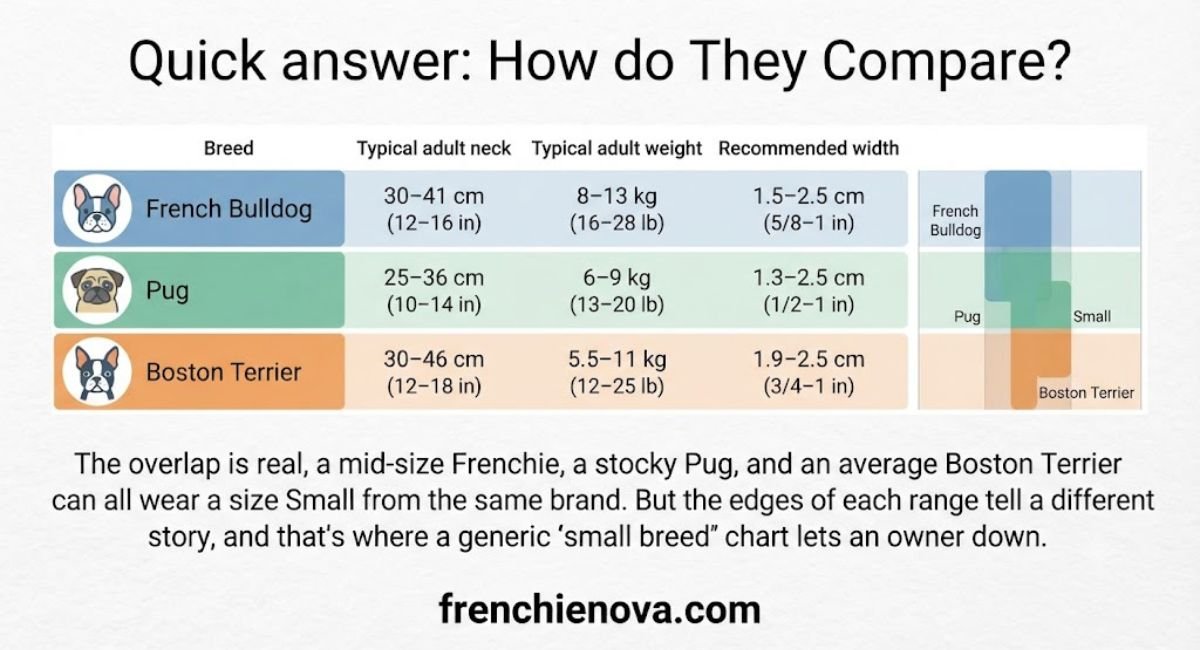
| Breed | Typical adult neck | Typical adult weight | Recommended width |
| French Bulldog | 30–41 cm (12–16 in) | 8–13 kg (16–28 lb) | 1.5–2.5 cm (5/8–1 in) |
| Pug | 25–36 cm (10–14 in) | 6–9 kg (13–20 lb) | 1.3–2.5 cm (1/2–1 in) |
| Boston Terrier | 30–46 cm (12–18 in) | 5.5–11 kg (12–25 lb) | 1.9–2.5 cm (3/4–1 in) |
The overlap is real, a mid-size Frenchie, a stocky Pug, and an average Boston Terrier can all wear a size Small from the same brand. But the edges of each range tell a different story, and that’s where a generic “small breed” chart lets an owner down.
Read Our Guide Collar vs Harness for French Bulldogs
French Bulldog vs. Pug vs. Boston Terrier Collar Size
French Bulldog: Short, Thick, and Dense
The Frenchie has the thickest neck relative to its height of the three. Its whole build is compact and heavily muscled, so even a moderately sized dog can measure at the top of the “small” range. This is the breed most likely to need a wider collar simply to keep pressure off the neck, and the one where a snug puppy collar turns tight the fastest. Most of a Frenchie’s growth occurs between 8 weeks and 6 months, so neck size changes quickly during that period.
Pug: Compact but Genuinely Smaller
Pugs run smaller overall than most people assume once they’re on a tape measure rather than a couch cushion. Their necks sit at the low end of this trio’s range, and their collars should generally be sized closer to the “toy-to-small” boundary than to a French Bulldog’s. Because Pugs are also prone to slipping collars over their heads thanks to a rounder skull shape, many owners find that a martingale style or a well-fitted harness solves the escape risk better than a flat buckle collar alone.
Boston Terrier: The Tallest, Most Variable Range
Of the three, the Boston Terrier has the widest spread, a small, lightly built female and a stocky 25-pound male can differ by several inches of neck. Bostons are also leaner and less densely muscled through the neck than Frenchies, so a collar sized purely off weight can run too loose. Measuring is non-negotiable here more than with the other two, since “average Boston Terrier” covers a genuinely wide range.
Puppy stage: Three Different Growth Curves
Adult ranges only tell half the story, since all three breeds start closer together than they end up.
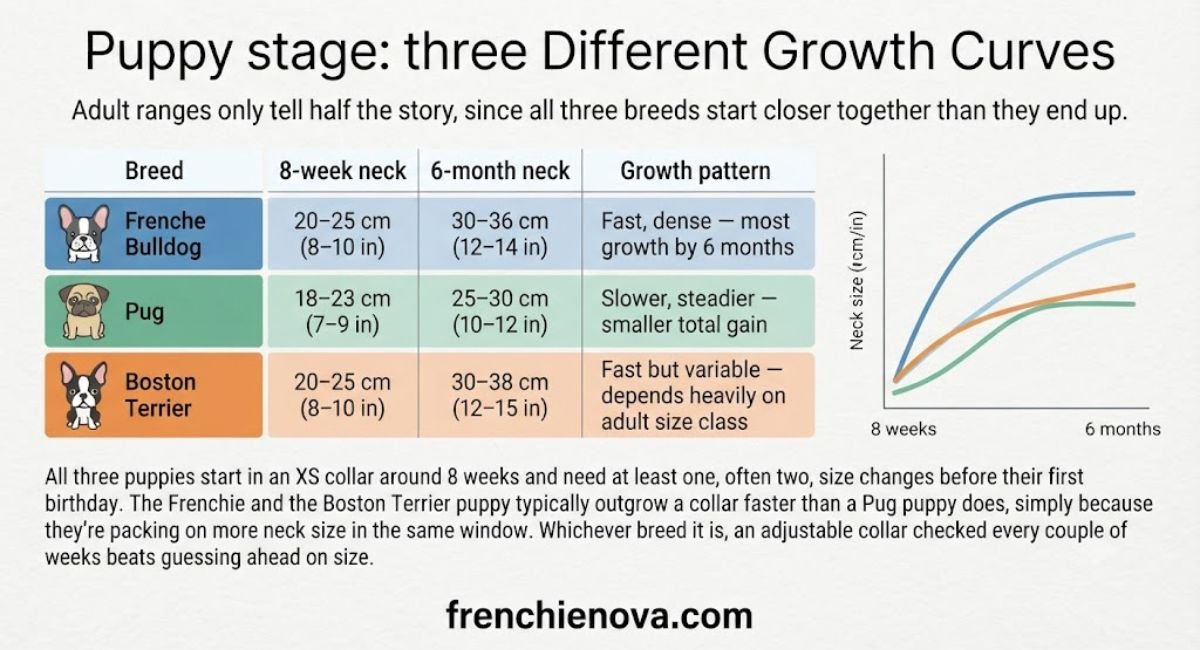
| Breed | 8-week neck | 6-month neck | Growth pattern |
| French Bulldog | 20–25 cm (8–10 in) | 30–36 cm (12–14 in) | Fast, dense — most growth by 6 months |
| Pug | 18–23 cm (7–9 in) | 25–30 cm (10–12 in) | Slower, steadier — smaller total gain |
| Boston Terrier | 20–25 cm (8–10 in) | 30–38 cm (12–15 in) | Fast but variable — depends heavily on adult size class |
All three puppies start in an XS collar around 8 weeks and need at least one, often two, size changes before their first birthday. The Frenchie and the Boston Terrier puppy typically outgrow a collar faster than a Pug puppy does, simply because they’re packing on more neck size in the same window. Whichever breed it is, an adjustable collar checked every couple of weeks beats guessing ahead on size.
French Bulldog, Pug, and Boston Terrier: Harness sizing compared
Collars aren’t the only gear that differs by breed. Chest girth, the measurement around the widest part of the ribcage, drives harness sizing, and the same build differences that show up in the neck carry over to the chest.
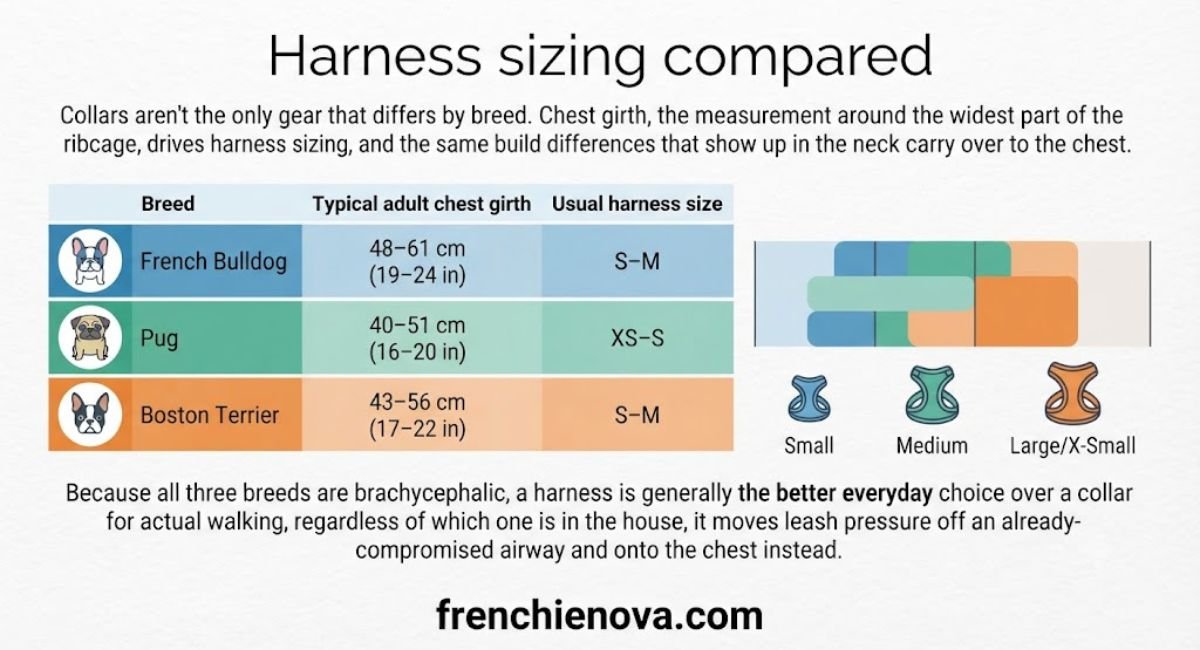
| Breed | Typical adult chest girth | Usual harness size |
| French Bulldog | 48–61 cm (19–24 in) | S–M |
| Pug | 40–51 cm (16–20 in) | XS–S |
| Boston Terrier | 43–56 cm (17–22 in) | S–M |
Because all three breeds are brachycephalic, a harness is generally the better everyday choice over a collar for actual walking, regardless of which one is in the house, it moves leash pressure off an already-compromised airway and onto the chest instead.
Weight to Neck: A Quick Cross Check
Weight alone shouldn’t replace a tape measure, but it’s a useful sanity check once a measurement is in hand, and it’s another spot where these breeds diverge even at similar weights.
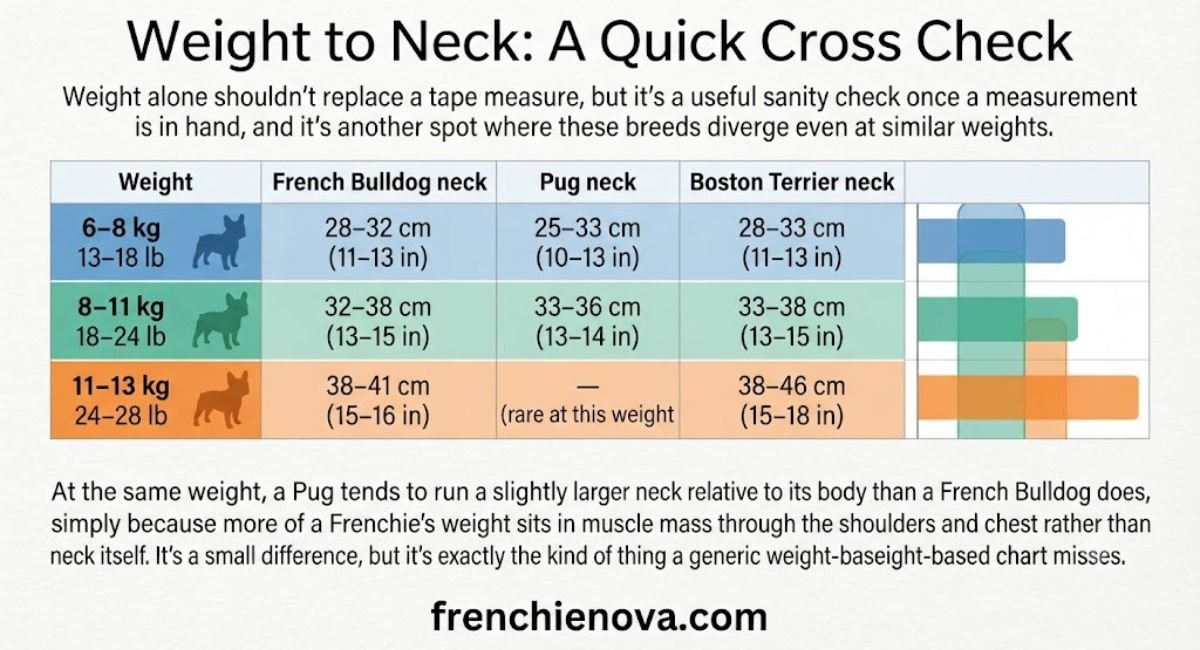
| Weight | French Bulldog neck | Pug neck | Boston Terrier neck |
| 6–8 kg (13–18 lb) | 28–32 cm (11–13 in) | 25–33 cm (10–13 in) | 28–33 cm (11–13 in) |
| 8–11 kg (18–24 lb) | 32–38 cm (13–15 in) | 33–36 cm (13–14 in) | 33–38 cm (13–15 in) |
| 11–13 kg (24–28 lb) | 38–41 cm (15–16 in) | — (rare at this weight) | 38–46 cm (15–18 in) |
At the same weight, a Pug tends to run a slightly larger neck relative to its body than a French Bulldog does, simply because more of a Frenchie’s weight sits in muscle mass through the shoulders and chest rather than the neck itself. It’s a small difference, but it’s exactly the kind of thing a generic weight-based chart misses.
Material and Style Notes by Breed
- French Bulldog: Nylon or biothane holds shape well against a thick, muscular neck; leather works too, but will stretch slightly over time, so buy it fitted rather than loose.
- Pug: Softer, lighter materials suit the smaller frame, and a rounder skull also makes a martingale a smart pick if slipping out of a flat collar has ever been an issue.
- Boston Terrier: Given the wider size variation in this breed, an adjustable nylon or cotton webbing collar is the safer default until a dog’s adult size is clear, rather than committing to a fixed leather size early.
Why the Overlap Chart is Not Enough
Generic breed-size charts group all three under “Small,” alongside Cavaliers and Mini Schnauzers, because their neck ranges technically intersect. That’s fine as a starting shelf to shop from, but it hides two things that actually change the buying decision:
- Build density. A French Bulldog’s neck is short and heavily muscled; a Boston Terrier’s is longer and leaner. Two dogs with an identical 14-inch measurement can still need different collar widths for comfort.
- Escape risk shape. Pugs and Frenchies both have rounder heads relative to their necks, which makes a properly snug fit (not just the right length) more important than it is for a narrower-skulled breed.
One thing All Three Have in Common
All three are brachycephalic, flat-faced, with airways that are already working harder than a longer-nosed breed’s. That means the general safety advice is the same across the board, regardless of which breed is being fitted: skip choke and prong collars entirely, favor a well-padded flat collar or martingale for identification, and lean on a harness for actual walking so leash pressure lands on the chest instead of the throat. The size numbers differ; the safety logic doesn’t.
How to Measure Any of the Three
The method is identical regardless of breed:
- Wrap a soft fabric tape measure around the base of the neck, where a collar naturally rests, snug but not tight.
- Confirm with the two-finger rule, two fingers should slip under the collar with light resistance.
- For a harness, measure the chest girth around the widest part of the ribcage, just behind the front legs.
Re-measure every few months on a puppy of any of these breeds, and check an adult’s fit at least once or twice a year, since weight and coat can shift the numbers even after growth stops.
Can a Pug Wear a French Bulldog’s Collar?
Only if the individual dogs measure similarly, there’s overlap in the middle of both ranges, but a Pug at the small end of its range would swim in a collar sized for a stocky adult Frenchie. Always match to the measurement, not the breed name.
Which of the three Needs the Widest Collar?
French Bulldogs and larger Boston Terriers most often need the widest strap, since more surface area helps distribute pressure across a thick or heavily muscled neck.
Do all Three Need a Harness Instead of a Collar?
For walking, yes, all three are brachycephalic, so a harness is the safer everyday choice for exercise. A collar still has a place for ID tags and quick, low-pull outings.
Which Breed has the most Unpredictable Adult Collar Size?
The Boston Terrier. Its adult size varies more than the other two, so it’s the one where an early collar purchase is most likely to need replacing.
The Bottom Line
French Bulldogs, Pugs, and Boston Terriers share enough neck-size overlap to sit on the same shelf in a pet store, but they’re not interchangeable when it comes to precise fit. Frenchies trend thick and short, Pugs trend genuinely smaller, and Boston Terriers cover the widest range of the three, a pattern that holds from puppy collars right through to adult harnesses. Whichever breed is in the house, the same rule applies: measure the individual dog, check the width against its build, and let the tape measure, not the breed name on the box, make the final call.

Auston is the founder of Frenchie Nova and a longtime French Bulldog owner. He writes practical, research-backed guides on Frenchie care, feeding, and health. Not a veterinarian — always consult your vet for medical concerns.