


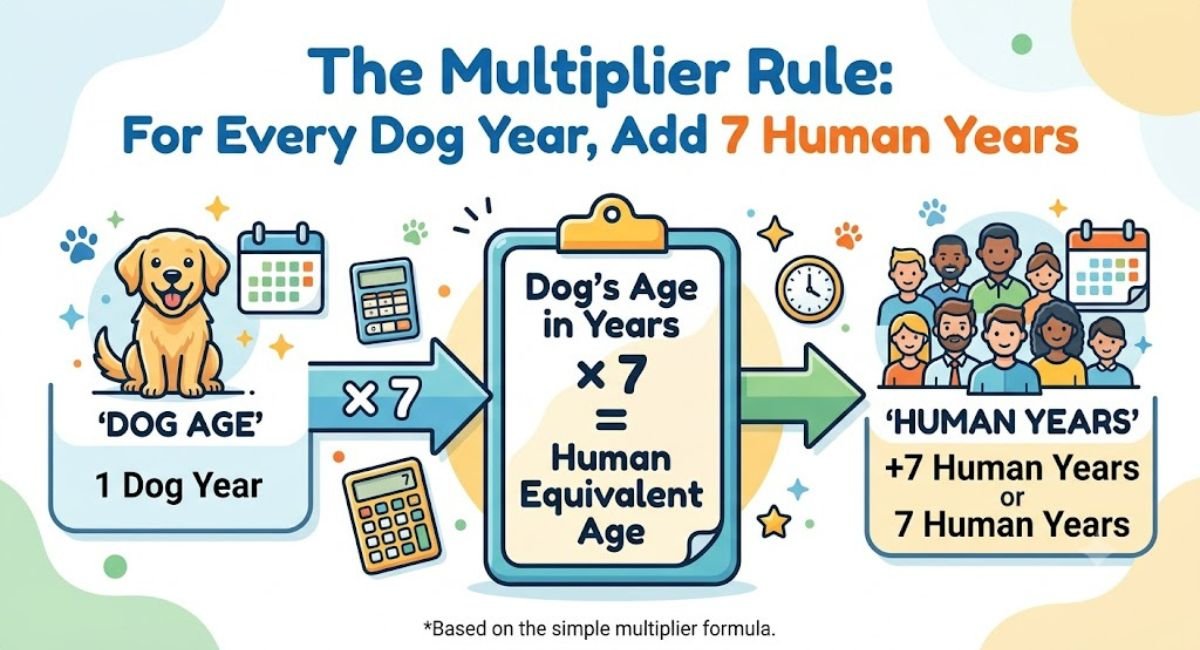
Most dog owners have done the quick mental math: pup turns 5, multiply by 7, and there it is, 35 in “human years.” It’s clean, it’s easy, and it’s been passed around kitchen tables for over 70 years. The only problem? Researchers say it doesn’t hold up. A nine-month-old dog can already have puppies, which means the “multiply by 7” rule for dog age breaks down before a dog even finishes its first year.
The good news is that the real math isn’t scary, and understanding it helps owners give better, age-appropriate care. Here’s where the old rule came from, why scientists threw it out, and what actually works instead.
Table of Contents
Where the ‘Multiply by 7’ Rule Even Came From
This one surprises people. The rule wasn’t built on a single shred of canine biology. The traditional 7:1 ratio was developed in the 1950s as an oversimplification, and the logic behind it was almost laughably simple: humans lived to about 70, dogs lived to about 10, so someone divided one by the other and called it a day.
The University of California, Davis School of Veterinary Medicine confirms the same thing, the “multiply by 7” idea was likely derived from the average worldwide lifespans for dogs and humans, 10 and 70 years. It was a marketing-friendly shortcut, not science. And once a number is that easy to repeat, it sticks around long after the evidence says it shouldn’t.
Why the Rule Falls Apart So Fast
Here’s the core problem: dogs don’t age at one steady speed. They sprint through the early years, then coast.
Think about it. A one-year-old dog isn’t a toddler, it’s closer to a teenager who can already reproduce. When dogs reach 1 year old, they are developmentally similar to a 15-year-old human, and by their second birthday, most dogs are comparable to a fully mature 24-year-old person. The “times 7” rule would call that same one-year-old dog a 7-year-old child. The two pictures don’t match at all.
The rule treats every year identically, year one equals seven, year two equals fourteen, year three equals twenty-one, and so on in a straight line. Real aging isn’t a straight line. It’s a steep curve early, then a gentle slope. That single flaw is why the whole shortcut collapses.
The Science That Replaced It
In 2020, a research team led by geneticists Tina Wang and Trey Ideker at the University of California San Diego published a study in the journal Cell Systems that gave dog owners something better. Instead of guessing, they read the dogs’ DNA.
Their method relies on DNA methylation, chemical tags that attach to DNA over a lifetime. Ideker considers these marks like wrinkles, signals that quietly reveal a genome’s true age. This molecular approach is known as the epigenetic clock, and it’s currently regarded by many scientists as one of the best ways to measure how fast a mammal is aging.
The team studied 104 Labrador Retrievers between the ages of four weeks and 16 years and compared them to methylation profiles of 320 humans from age one to 103. The match-ups were striking. A 7-week-old puppy lined up with a 9-month-old human baby, both right around the time their first teeth come in.
Dog years to human years
Convert your dog’s age accurately
What the Real Formula Actually Is (Multiply by 7′ Rule for Dog Age)
So if it’s not “times 7,” what is it? The researchers landed on a formula that uses a natural logarithm:
human age = 16 × ln(dog age) + 31
Don’t let the “ln” intimidate you. You can compute this using any calculator with an ln function: type your dog’s age, press ln, multiply by 16, then add 31.
Here’s a worked example so it clicks. For a 5-year-old dog: ln(5) is about 1.61. Multiply by 16 to get roughly 25.8, then add 31. A 5-year-old dog works out to about 56.8 in human years. That’s a long way from the 35 the old rule would give you.
A few quick conversions using the formula:
| Dog’s actual age | Human-equivalent age |
| 1 year | ~30 |
| 2 years | ~42 |
| 5 years | ~57 |
| 9 years | ~66 |
| 12 years | ~71 |
One honest caveat: the study included just a single breed, so your own dog’s “human age” based on this formula may not quite match up. Which leads straight to the factor the formula leaves out, size.
Does Dog Size Affect Aging?
Yes, and it’s the biggest variable the epigenetic formula skips. Size changes everything about how a dog ages.
Here’s the counterintuitive part: bigger dogs age faster, not slower. Larger breeds grow faster during puppyhood, and that accelerated growth appears to drive faster cellular aging throughout life. It’s the opposite of what happens across most of the animal kingdom, where larger animals usually live longer.
The real-world gap is huge. Small dogs live 12 to 16 years on average, while giant breeds typically reach only 6 to 10 years. So a 10-year-old Chihuahua and a 10-year-old Great Dane are nowhere near the same “age.” This is exactly why veterinary groups like the American Kennel Club (AKC) and the American Animal Hospital Association (AAHA) lean on size-based charts instead of one universal multiplier.
A More Practical Method: The Vet Guideline
Not everyone wants to pull out a scientific calculator. For a quick, reliable estimate, the American Veterinary Medical Association (AVMA) offers a simple rule of thumb for a medium-sized dog: the first year of a dog’s life equals about 15 human years, the second year equals about 9 more, and after that every year equals roughly 4 to 5 human years.
Run a 4-year-old medium dog through that: 15 + 9 + 5 + 5 = 34. It’s not as precise as the methylation formula, but it captures the most important truth the old rule missed — that the early years count for far more.
When Is a Dog Actually a Senior?
This is where the size difference gets practical, and it matters for healthcare. The AVMA considers small dogs “senior” beginning at 7 years of age, whereas larger breeds are considered “senior” at 5 or 6 years of age.
The AAHA frames it through six life stages, Puppy, Junior, Adult, Mature, Senior, and Geriatric, and a dog hits each stage at a different chronological age depending on its size. A 7-year-old Saint Bernard is solidly a senior, while a 7-year-old Chihuahua may still be cruising through middle age. Knowing which stage a dog is in helps owners and vets stay ahead of issues like arthritis, weight management, and changes in hearing or vision.
Dog years to human years
Convert your dog’s age accurately
The Bottom Line
The “multiply by 7” rule for dog age survived this long because it was easy, not because it was right. Dogs race through their first two years, then aging slows — a curve no single multiplier can capture. The 2020 UCSD epigenetic formula (16 × ln(age) + 31) gives a far better picture, and pairing it with breed-size guidelines from the AKC and AVMA gets owners closest to the truth. The real takeaway is simple: your dog is probably older than you thought, and that’s all the more reason to make their vet visits count.
This article is for general informational purposes. Aging varies with breed, size, health, and spay/neuter status, always consult your veterinarian for guidance specific to your dog.
Daily calorie needs
How many calories does your dog need?
Raw feeding made easy
Calculate raw food portions for your dog

Auston is the founder of Frenchie Nova and a longtime French Bulldog owner. He writes practical, research-backed guides on Frenchie care, feeding, and health. Not a veterinarian — always consult your vet for medical concerns.