

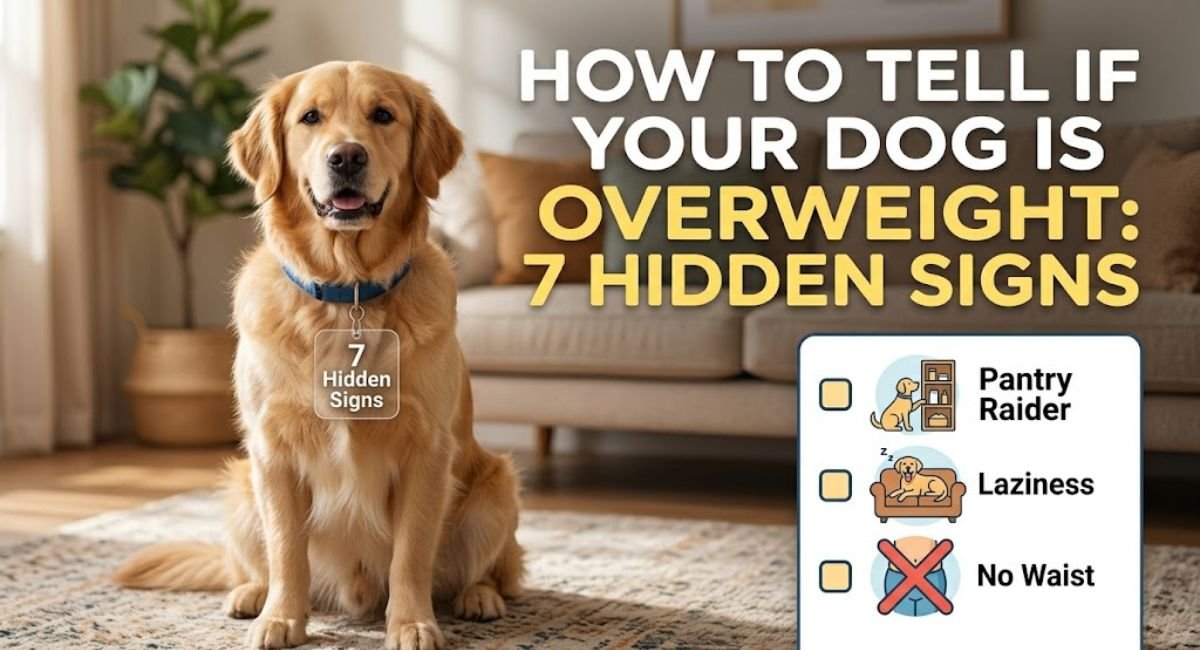
About 84% of dog owners look at their dog and think the weight is fine. Veterinarians, looking at the same dog, classify roughly 59% of those dogs as overweight or obese. That’s not a small gap. The Association for Pet Obesity Prevention calls it the “fat pet gap”, and it’s the reason most weight problems in dogs go unnoticed for months or years.
The good news: spotting an overweight dog at home doesn’t take a scale or a vet appointment. It takes about 90 seconds, the right signs to watch for, and a willingness to actually feel for the ribs instead of trusting the eye alone.
This guide walks through the 7 signs most owners miss, the 5 real health risks of letting weight gain slide, and the fixes that actually work.
Table of Contents
The Short Answer: How to Tell If Your Dog Is Overweight
A dog is overweight when:
- The ribs cannot be felt without pressing firmly
- The waist is no longer visible when viewed from above
- The belly tuck is gone or sagging when viewed from the side
- Their actual weight is more than 10% above their breed’s healthy range
That 10% threshold is the one Hill’s Pet and most veterinary nutritionists use as the medical line. Being as little as 10% overweight can greatly increase the risks associated with serious health conditions, such as diabetes mellitus, arthritis, urinary stones, or heart disease.
For a complete frame-specific assessment, the Body Condition Score (BCS) is the gold standard. See the Body Condition Score Chart for Dogs pillar guide for the full 1–9 breakdown.
Body condition score
Check your Frenchie’s body condition
Why So Many Owners Miss It: The Fat Pet Gap
In a 2023 APOP survey, 84% of dog owners and 94% of cat owners believed pet obesity is a significant health issue. Yet only 43% reported that “their veterinarian annually discusses their pet’s optimal weight or body condition”. In other words: most owners agree obesity is a big problem, for other people’s dogs.
Dr. Ernie Ward, founder of APOP, puts it bluntly: “I see people coming in constantly with 90-pound Labs and they say, ‘she looks great,'” says Dr. Ernie Ward, DVM, CVFT, and founder of the Association for Pet Obesity Prevention (APOP). “Well, actually, that dog is 15 pounds overweight.” That mismatch, between what owners see and what’s actually happening, is the gap this article is built to close.
A few reasons the gap is so wide:
- Visual habituation. Owners see their dog every day. Gradual weight gain disappears into “they’ve always looked like that.”
- Euphemisms. APOP’s 2024 survey found owners often hear words like “chonky,” “fluffy,” and “well-fed” instead of “overweight” or “obese”, softer language that blurs the medical reality.
- Breed assumptions. “Stocky,” “thick,” and “big-boned” get used to explain away weight that’s actually fat.
- Comparing to other dogs. When most dogs in the neighborhood are overweight, “normal” gets recalibrated downward.
The fix isn’t shame. It’s switching from the eye to the hands.
7 Signs Your Dog Is Overweight (Most Owners Miss the First Three)
These are ranked from earliest and most subtle to latest and most obvious.
1. The Waistline Has Disappeared
Stand directly over the dog and look down. A healthy dog shows a clear narrowing behind the ribcage, an hourglass shape. When that narrowing flattens into a straight line or bulges outward, fat is being stored along the flanks.
This is typically the first visible sign of overfeeding, appearing weeks before the dog looks obviously fat. A collar getting tighter despite no adjustment is another early signal worth taking seriously.
2. The Ribs Can’t Be Felt With Light Pressure
Place both hands flat on either side of the ribcage, just behind the front legs. Use very light pressure, about what’s needed to brush flour off a counter.
- Ideal weight: Ribs are felt easily under a thin layer of fat. Like running fingers over the back of a flat hand: knuckles felt clearly with thin padding.
- Overweight: Ribs require firm pressure to feel, like running fingers over the palm of a hand.
- Obese: Ribs cannot be felt at all, even with firm pressure.
This is the single most reliable sign and the one most owners skip entirely. Place your hands on their side, and if their ribs are hard to feel or even impossible to feel, they’re likely overweight.
3. The Belly Tuck Is Gone
Kneel beside the dog while they’re standing. A healthy dog’s belly should slope upward from the chest toward the hind legs, a clear tummy tuck.
Warning signs:
- A horizontal, straight-line belly = overweight
- A sagging, downward-curving belly = obese
- Visible fat deposits hanging below the chest line = severely obese
Note for deep-chested breeds like Great Danes, Doberman Pinschers, and German Shepherds: the natural chest depth can create the illusion of a tucked waist even when fat is being carried. Rely on the rib check, not just the profile.
4. Heavier Breathing on Normal Activity
Dogs that have gained weight breathe harder for the same effort. Watch for:
- Heavy panting after walks that used to be easy
- Snoring that’s gotten louder over months (especially in brachycephalic breeds)
- Recovery from short play taking noticeably longer
- Reluctance to exercise in warm weather
For flat-faced breeds, Pugs, Bulldogs, French Bulldogs, Boston Terriers, this sign matters more than for any other group. Extra weight makes BOAS (Brachycephalic Obstructive Airway Syndrome) dramatically worse, and overweight brachycephalic dogs are far more likely to suffer heatstroke.
5. Reluctance to Move, Jump, or Climb Stairs
A dog carrying extra weight feels it in every step. Hesitation before stairs, refusal to jump onto the couch, or shorter play sessions all point to weight discomfort. Overweight dogs have a lot of extra weight to lug around, and if they are too heavy, then they may not want to climb stairs, jump, or play like they used to.
This sign is easy to misread as aging or laziness. The honest question to ask: has activity dropped compared to this dog’s own baseline from six months ago, not the breed average?
6. Visible Fat Rolls or Deposits
Once fat is clearly visible, rolls around the neck, a thick “saddle” along the spine, sagging skin on the belly, or fat pads at the tail base, the dog has crossed from overweight into obese. At this stage, the score is typically 7–9 on the 9-point BCS scale.
7. Inability to Self-Groom or Scratch Properly
A severely overweight dog loses the flexibility to scratch certain spots or reach for grooming. This is one of the latest signs and usually means significant weight loss is needed, and a vet visit, not a home fix.
What Does an Overweight Dog Look Like by the Numbers?
The math for “over ideal” is simple:
(Current weight − Ideal weight) ÷ Ideal weight × 100 = % over ideal
Example: A Labrador whose ideal weight is 65 lbs but who currently weighs 75 lbs is (10 ÷ 65) × 100 = 15% over ideal, clearly overweight.
The general veterinary thresholds:
- Up to 5% over: borderline, easy to fix with portion adjustment
- 5–10% over: overweight, worth addressing now
- 10–20% over: medically overweight, vet conversation recommended
- More than 20% over: clinically obese, structured plan needed
For a Labrador Retriever, ideal weight typically lands at 55–80 lbs depending on frame and sex. For a small breed like a Pomeranian, ideal weight might be 3–7 lbs. The percentage matters far more than the raw pounds.
5 Real Health Risks of Letting Weight Gain Slide
These aren’t theoretical. Each one is documented in current veterinary research.
Risk 1: Shortened Lifespan (Up to 1.8 Years)
The 14-year Purina Life Span Study, led by Dr. Richard Kealy and published in the Journal of the American Veterinary Medical Association in 2002, followed 48 Labrador Retrievers from puppyhood to end of life. The lean-fed group lived a median of 13 years; the control group lived 11.2 years. Median life span was extended by 1.8 years or 15%.
The mean lifespan for lean-fed dogs was 13 years compared to 11.2 years for control-fed dogs. That study remains the strongest evidence that body condition directly affects how long dogs live.
Risk 2: Joint Disease and Osteoarthritis
Excess weight accelerates joint breakdown across every joint that bears the load, hips, knees, spine, elbows. According to data from the American Animal Hospital Association, obesity predisposes dogs to developing Orthopedic disease, including osteoarthritis (degenerative joint disease). The Kealy study also documented that lean-fed dogs developed arthritis roughly 1.5 years later than overweight ones.
Risk 3: Diabetes, Heart Disease, and Insulin Resistance
Adipose tissue isn’t passive padding, it’s hormonally active and produces inflammatory cytokines. That low-grade chronic inflammation drives type II diabetes, cardiovascular disease, hypertension, and mitral valve disease in dogs the same way it does in humans. Excess weight also significantly raises anesthesia risk for any surgical procedure.
Risk 4: Breathing Difficulty (Especially in Flat-Faced Breeds)
For brachycephalic breeds, Pugs, French Bulldogs, English Bulldogs, Boston Terriers, Boxers, excess weight compresses the chest cavity, adds fat around already-narrow airways, and dramatically reduces heat tolerance. Most flat-faced dogs that suffer heatstroke are overweight.
Risk 5: Cancer and Reduced Immune Function
Bloomberg Intelligence’s 2024 Global Pet Economy report notes a documented link between excess weight and elevated cancer risk in dogs, along with diabetes and heart disease. The mechanism is the same chronic inflammation that drives joint and cardiac disease, and it shortens healthy lifespan, not just total lifespan.
What to Do If Your Dog Is Overweight
Crash diets, drastic exercise increases, and “miracle” weight loss products don’t work in dogs and often cause harm. The proven method is slower, methodical, and works.
Step 1: Confirm With BCS and a Vet Visit
Before changing anything, run a complete BCS check at home and schedule a vet visit. The vet can:
- Confirm the score
- Rule out underlying causes, hypothyroidism, Cushing’s disease, metabolic issues
- Set a realistic target weight
- Recommend a specific calorie target
For the at-home BCS process, see the Body Condition Score Chart for Dogs guide.
Step 2: Calculate the Real Calorie Target
Veterinary nutritionists generally use about 25 calories per pound of ideal body weight (not current weight) for sedentary adult dogs. For a 60-lb dog at ideal weight, that’s 1,500 calories per day at maintenance.
Reduce by 10–15% for active weight loss. Active or working dogs need more; senior or spayed/neutered dogs need less.
Daily calorie needs
How many calories does your dog need?
Step 3: Weigh Food, Don’t Eyeball It
A 1/2-cup scoop can vary by 15–20% in actual food weight depending on kibble size, shape, and how packed the scoop is. The APOP 2024 survey found 54 percent of dog owners measure with cups; 16 percent free-feed; 19 percent eyeball; 11 percent weigh food. The weighed-food group has the most predictable results. A $15 kitchen scale fixes this.
Step 4: Track Treats in the Daily Budget
The 10% rule applies: treats should never exceed 10% of daily calories. For a dog on 1,200 calories during weight loss, that’s only 120 treat calories.
Switch to low-calorie options during weight loss:
- Blueberries (about 1 calorie each)
- Cucumber slices (2 calories each)
- Baby carrot pieces (about 5 calories each)
- Plain green beans
- Zuke’s Mini Naturals or other low-calorie training treats
Step 5: Adjust Exercise Gradually
Dogs can’t exercise their way out of obesity the way humans imagine. Diet drives 70–80% of weight loss; exercise supports it. Push a sedentary dog into long workouts, and the result is joint injury, paw pad damage, or, for flat-faced breeds, a respiratory crisis.
The right approach:
- Two 20–30 minute walks daily for most breeds (split morning and evening)
- Activity during cool hours for heat-sensitive dogs
- Avoid stairs, jumping, and high-impact play during weight loss
- Add mental enrichment, puzzle feeders, snuffle mats, scent games, to keep dogs engaged without exhausting them
Step 6: Target 1% Body Weight Loss Per Week
This is the rate cited by veterinary nutritionists and the American Animal Hospital Association as safe and sustainable. For a 60-lb dog, that’s roughly 0.6 lb per week. Faster weight loss (3%+ per week) causes muscle wasting, which actually slows metabolism long-term and makes future weight regain easier. That’s the metabolic adaptation trap that catches many owners trying to speed things up.
Step 7: Weigh Weekly, Recheck BCS Monthly
Weigh on the same scale, at the same time of day, before food. Track in a notebook or phone app. Run a full BCS check monthly to confirm the shape is changing, not just the number.
Realistic timeline: a dog 10% over ideal typically takes 3–4 months of consistent effort to reach goal weight. A dog 20%+ over ideal can take 6–9 months. Anyone promising faster is usually selling something risky.
Puppy growth tracker
Predict your puppy’s adult weight
What Does Not Work (Common Mistakes)
These approaches backfire reliably:
Free-feeding. Leaving food out all day removes all portion control. Switch to two measured meals.
- “Light” diet food at the same portion size. Light foods reduce calories per cup, but if portions don’t shrink, weight loss stalls. Reduce portion and switch food, not just one.
- Switching to “diet” treats without cutting volume. Many diet treats are only marginally lower calorie than regular ones. Whole foods like blueberries work better.
- Drastic exercise increases. Suddenly walking a sedentary dog an hour daily can cause heat collapse, joint injury, or a respiratory crisis in flat-faced breeds. Increase gradually.
- Skipping meals. Calorie restriction works; meal-skipping doesn’t. The metabolism slows and weight loss plateaus.
- Letting other household members sneak treats. One person handing out extras can derail months of effort. Everyone in the household needs to be on board, including kids and visiting family.
When to See the Vet (Beyond Routine Checks)
A vet visit is warranted in any of these situations:
- BCS of 8 or 9 on the 9-point scale
- More than 20% over ideal weight
- Sudden weight gain (more than 5% in a month)
- Weight gain despite proper feeding
- Visible breathing difficulty at rest
- Limping, stiffness, or visible joint discomfort
- Skin fold infections that won’t clear
- Reluctance to walk at all
For severe obesity, a veterinary prescription diet, Hill’s Prescription Diet r/d, Royal Canin Satiety, or Purina OM Overweight Management, may be necessary. These are formulated specifically for medical weight loss and require veterinary oversight. 22 percent of dog owners and 35 percent of cat owners use prescription weight-management diets per APOP’s 2025 survey, and adoption is climbing.
Maintaining a Healthy Weight Long-Term
Once a dog reaches ideal weight, the work shifts from active weight loss to maintenance — which is harder than most owners expect, because dogs will keep eating whatever’s offered.
Maintenance habits that actually hold:
- Weigh weekly, even at ideal weight, to catch drift early
- Run a monthly BCS check
- Keep daily calories at the maintenance level (around 25 cal/lb ideal weight for sedentary dogs)
- Account for every treat and scrap in the daily budget
- Adjust seasonally (most dogs move less in summer heat or harsh winter)
- Recalculate after spay or neuter (calorie needs typically drop 20–30%)
- Recalculate at senior age (around age 7 for most breeds, age 5 for giant breeds)
Dog years to human years
Convert your dog’s age accurately
The Bottom Line
A dog is overweight when the ribs can’t be felt easily, the waist has disappeared from the top view, the tummy tuck has flattened from the side view, or actual weight exceeds 10% over the breed’s healthy range. The earliest signs, a softer waistline, slightly tighter collar, heavier breathing on a normal walk, show up weeks before the dog looks obviously fat.
The health risks are real and measurable. The 2002 Kealy/Purina study documented 1.8 fewer years of life for overweight dogs. Joint disease, diabetes, heart disease, breathing difficulty, and cancer risk all climb. Roughly 59% of US dogs are overweight, but 84% of owners think their dog looks fine. Closing that gap starts with the hands, not the eyes.
The fix is methodical: confirm the problem with BCS scoring, calculate a real calorie target, weigh food instead of eyeballing it, track every treat, exercise gently, and aim for 1% body weight loss per week. Slow, consistent, and grounded in actual numbers.
For ongoing tracking, the BCS Calculator keeps body condition honest, the Dog Calorie Calculator handles weight loss targets, and the Dog Age Calculator helps adjust for life-stage changes.
The goal isn’t a perfect-looking dog. It’s a dog that breathes better, moves easier, and lives longer.
Body condition score
Check your Frenchie’s body condition
Daily calorie needs
How many calories does your dog need?
This guide draws on the Association for Pet Obesity Prevention (APOP), Dr. Ernie Ward (APOP founder), Hill’s Pet Nutrition, American Kennel Club (AKC), American Animal Hospital Association (AAHA), the Purina Institute, the 2002 Kealy et al. landmark study in the Journal of the American Veterinary Medical Association, the 2024 APOP Pet Obesity & Nutrition Opinion Survey, the 2024 Bloomberg Intelligence Global Pet Economy report, and current veterinary research on canine obesity. Always consult a veterinarian before starting a weight loss program, especially for dogs with BCS 8/9 or above, or those with existing health conditions.

Auston is the founder of Frenchie Nova and a longtime French Bulldog owner. He writes practical, research-backed guides on Frenchie care, feeding, and health. Not a veterinarian — always consult your vet for medical concerns.