

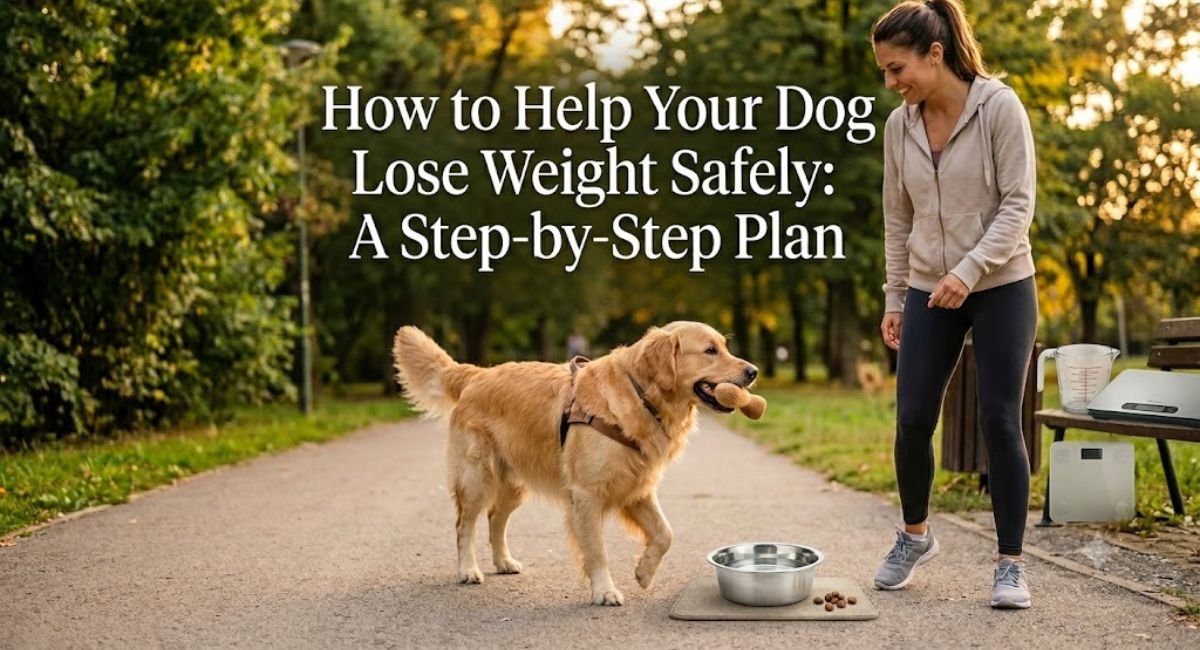
Most dog weight loss attempts fail in the first six weeks, not because the owner didn’t try hard enough, but because the plan was built wrong from day one. Too aggressive on calories. Too aggressive on exercise. Treats counted casually. No tracking. By month two, the dog looks the same, the household has caved on treats, and everyone quietly gives up. That’s not bad effort. That’s a bad plan.
The plan in this guide is different: vet-backed, paced at 1–2% body weight loss per week (the rate Cornell’s veterinary nutritionists call safe), and built so a normal household can actually follow it. This is the step-by-step guide dog lose weight safely playbook for helping any dog lose weight safely without crashing their metabolism, their breathing, or the family’s resolve.
Table of Contents
Why Most Dog Weight Loss Plans Fail
Three things kill almost every plan:
- The calorie target is wrong. Most owners calculate calories from current weight, not ideal weight. That keeps the dog fat.
- Exercise is overcorrected. A sedentary dog suddenly walked an hour daily ends up with joint injuries, paw pad damage, or, for flat-faced breeds, a respiratory crisis.
- Treats stay invisible. “Just one” treat from each household member adds up to hundreds of uncounted calories per day.
The fix isn’t trying harder. It’s setting up the plan so it can’t fail by accident. “Weight loss begins and ends at the food bowl for dogs and cats,” Ernie Ward, DVM, and founder of the Association for Pet Obesity Prevention (APOP), tells us. “Weight loss for humans and dogs is 60-70% diet and 30-40% exercise.” Anyone planning around exercise first has already lost the math.
Before any calorie reduction, confirm the dog actually needs to lose weight. The Body Condition Score (BCS) is the gold standard. See the Body Condition Score Chart for Dogs guide for the full at-home check.
Body condition score
Check your Frenchie’s body condition
The Three Things to Do Before You Change Anything
Skipping these three steps is the single biggest reason weight loss plans stall.
1. Schedule a Vet Visit
Weight gain in dogs isn’t always a feeding problem. Hypothyroidism and Cushing’s disease (hyperadrenocorticism) both drive weight gain even when the dog is eating normally. A vet visit before starting any plan accomplishes:
- Confirms the BCS score (6/9 or higher justifies weight loss)
- Rules out underlying causes, hypothyroidism, Cushing’s, insulin resistance
- Sets a realistic target weight based on frame and breed
- Recommends whether a prescription weight loss diet is needed
For dogs at BCS 8 or 9, the vet visit isn’t optional, it’s where the plan starts.
2. Get the Household Aligned
A single family member sneaking treats can derail months of effort. Before day one:
- One family meeting to align everyone on the plan
- One person assigned to all food and treat decisions
- All treats moved to a single labeled container with the daily allowance pre-portioned
- A clear rule that table scraps are off-limits, including kids and visiting family
Dogs are excellent manipulators. The plan only works when everyone refuses uniformly.
3. Set Up Tracking
Without numbers, weight loss is guesswork. Before starting:
- A digital kitchen scale for portioning food (a cup scoop varies by 15–20%)
- A pet scale, or a method using a bathroom scale (weigh yourself, then weigh yourself holding the dog, subtract)
- Photos of the dog from above and side, same lighting, same room
- A simple notebook or phone log for weekly weigh-ins
How Many Calories Does a Dog Need to Lose Weight?
Here’s the math used by most veterinary nutritionists, including Cornell’s Riney Canine Health Center.
Step 1: Calculate Resting Energy Requirement (RER) from ideal body weight, not current weight.
- Convert ideal weight to kilograms (pounds ÷ 2.2)
- RER = (ideal weight in kg) × 30 + 70 (for dogs 5–55 lbs)
- For very small or very large dogs, RER = 70 × (ideal weight in kg)^0.75
Step 2: Multiply RER by an activity factor.
| Activity factor | Use for |
| 1.0 × RER | Strict weight loss in an obese dog (BCS 8–9) |
| 1.2 × RER | Moderate weight loss (BCS 6–7) |
| 1.4–1.6 × RER | Maintenance (after goal reached) |
Worked example: A 50-lb dog whose ideal weight is 45 lbs
- Ideal weight: 45 lbs ÷ 2.2 = 20.4 kg
- RER = (20.4 × 30) + 70 = 682 kcal
- Weight loss target (1.0 × RER): 682 kcal/day
- Maintenance after goal (1.4 × RER): 955 kcal/day
That 682 kcal is the daily ceiling, food, treats, dental chews, everything. If you are feeding your dog the recommended amount already and they are still gaining weight, Ochoa advises reducing the amount you are feeding them by 10% to 15% as a starting point if the math feels too aggressive.
Daily calorie needs
How many calories does your dog need?
How to Choose the Right Food: OTC (Over The Counter) vs Prescription
Not every overweight dog needs a prescription diet. Here’s the decision tree veterinary nutritionists actually use.
Stick With the Current Food (Smaller Portion)
Works for: Dogs less than 10% over ideal weight.
The simplest plan: reduce the current food by 10–20% and recheck in 4 weeks. No new food needed. Most early-stage weight problems are solved here.
Switch to an OTC Weight Management Food
Works for: Dogs 10–20% over ideal, or dogs that act hungry on reduced portions of their regular food.
Look for foods with:
- Fewer than 300 kcal per cup
- Higher fiber (8–15%) for satiety
- Moderate-to-high protein (25–35%) to preserve muscle
- AAFCO complete-and-balanced statement for adult maintenance
Common options:
- Hill’s Science Diet Adult Perfect Weight
- Royal Canin Weight Care
- Purina Pro Plan Weight Management
- Blue Buffalo Life Protection Healthy Weight
OTC weight management foods typically run $35–80 per bag.
Move to a Prescription Weight Loss Diet
Works for: Dogs more than 20% over ideal, BCS 8–9, or dogs with obesity-related conditions like diabetes or arthritis.
These diets are clinically formulated to support significant calorie restriction without nutrient deficiency. Hill’s Prescription Diet r/d is clinically proven to promote healthy weight loss within just 8 weeks in feeding-trial studies. Common options:
- Hill’s Prescription Diet r/d (lowest fat, highest fiber)
- Hill’s Metabolic
- Royal Canin Satiety Support
- Purina Pro Plan OM Overweight Management
Prescription weight-loss diets typically run $70–140 per bag and require a veterinary prescription.
A note from Cornell’s Riney Center: when restricting OTC food significantly, owners should ask their vet about adding a complete multivitamin to ensure vitamin and trace mineral adequacy. Prescription weight-loss diets already include this; OTC foods at restricted portions may not.
The 12-Week Step-by-Step Plan
This is the protocol used by most veterinary weight-loss programs, paced at the Cornell-cited target of 1–2% body weight loss per week.
Weeks 1–2: Set the Baseline
Goal: Get tracking systems in place and transition food gradually.
- Weigh the dog on day 1, same scale, same time, before breakfast
- Photograph from above and side
- Run a full BCS check
- Begin food transition (if switching foods) over 7–10 days
- Replace measuring cups with a digital kitchen scale
- Move all treats to a single visible container with the daily allowance pre-portioned
Expected outcome: Weight stays stable or rises slightly during food transition. This is normal.
Weeks 3–4: Implement Full Calorie Restriction
Goal: Hit the calculated calorie target consistently.
- Apply the full daily calorie target
- Split into 2 measured meals (morning and evening)
- Switch to low-calorie treats (blueberries 1 kcal each, baby carrots 5 kcal each, plain green beans, cucumber slices)
- Add gentle exercise: two 20-minute walks daily
- Weigh weekly
Expected outcome: First measurable weight loss by end of week 4, typically 0.5–1 lb for a 45-lb dog.
Weeks 5–8: Build Momentum
Goal: Sustain weekly loss and troubleshoot any plateau.
- Continue weekly weigh-ins
- Run a BCS check at the end of week 6, should be trending toward 5/9
- Add mental enrichment with puzzle feeders and snuffle mats
- If weight loss has stalled, reduce daily calories by an additional 5%
- Add one short third walk if the dog tolerates it well
Expected outcome: Steady loss of about 0.5 lb per week for medium dogs, 1 lb per week for larger dogs.
Weeks 9–12: Approach Goal Weight
Goal: Reach target weight and prepare for maintenance.
- Continue weekly weigh-ins
- Run a BCS check at week 12, target is 5/9
- Once goal is reached, gradually increase calories back toward maintenance
- Photograph from above and side, compare to baseline photos
- Plan the maintenance phase
Expected outcome: Goal weight reached around week 12 for most dogs starting 5–10% overweight. Dogs starting 20%+ overweight typically need 4–9 months.
The Exercise Side: Slow and Sustainable Beats Fast and Hard
Diet does 60–70% of the work. Exercise supports it, but only if it doesn’t injure the dog. Low-impact exercises like walking or swimming will help your dog lose weight while maintaining muscle mass and joint mobility. Remember, just like people, if your dog hasn’t been physically active for some time, they must slowly acclimate to conditioning their body to avoid injuries.
Starting Point for Most Dogs
- Two 20-minute walks daily, split morning and evening
- Steady pace that allows normal breathing throughout
- Cool hours for heat-sensitive breeds (early morning, late evening)
- Build duration gradually, increase by 10–15% per week, not 50%
What Works for Different Body Types
- Active, healthy adult dogs: Walking, jogging, fetch, structured play, agility, hiking
- Sedentary or older dogs: Short walks, leashed sniff-walks, gentle play, swimming with a life jacket
- Brachycephalic breeds (Pugs, Bulldogs, French Bulldogs, Boston Terriers): Short walks during cool hours only, avoid stairs and jumping, swimming with a life jacket
- Large or giant breeds (Great Danes, Mastiffs, Saint Bernards): Low-impact only, long walks rather than running, swimming, no aggressive fetch
- Dogs with joint issues: Swimming and underwater treadmill (available at many veterinary rehab clinics)
Warning Signs to Stop Immediately
- Heavy panting that doesn’t settle within 5 minutes of rest
- Tongue turning dark or blue
- Refusal to keep moving
- Limping or visible joint discomfort
- Excessive drooling
- Wide-stance, head-down posture (respiratory distress)
What Not to Do
- No running or jogging with a sedentary dog until they’re conditioned
- No off-leash dog park play during weight loss (overheating risk)
- No exercise in temperatures above 80°F for heavy-coated or flat-faced breeds
- No daily stairs for overweight dogs with joint issues
Mental Enrichment: The Hidden Lever Most Plans Miss (Dog Lose Weight Safely)
A bored dog begs more. A mentally engaged dog begs less. Mental fatigue genuinely reduces calorie-seeking behavior, which is why veterinary behaviorists now treat enrichment as part of weight loss, not a side project.
What actually helps:
- Puzzle feeders: Kong Classic, Outward Hound Puzzle Toys, treat-dispensing balls
- Snuffle mats: kibble portions hidden in fabric, extending mealtime to 15–20 minutes
- Slow feeder bowls: maze patterns that force slower eating
- Lick mats: wet food or a thin layer of peanut butter (in small calorie-counted amounts)
- Training sessions: using daily calorie allowance as training treats
- New walking routes: novelty alone increases mental engagement and calorie burn
A snuffle mat or puzzle feeder costs $15–25 and saves a household from weeks of begging-related setbacks.
Troubleshooting: The 5 Most Common Problems
Problem 1: Weight Loss Has Stalled
Cause: Metabolic adaptation. The body downregulates resting metabolism in response to lower calorie intake. Almost every plan hits this around weeks 4–6.
Fix:
- Reduce daily calories by an additional 5% (not more)
- Increase activity by 10–15 minutes per day if the dog tolerates it
- Add a new puzzle feeder or mental enrichment activity
- Wait, plateaus often break naturally after 2 weeks
Problem 2: The Dog Seems Constantly Hungry
Cause: Either calories are too restrictive, or the food doesn’t support satiety.
Fix:
- Switch to a higher-fiber, higher-protein formula
- Split daily food into 3 smaller meals instead of 2
- Add zero-calorie volume: plain green beans, plain pumpkin, cucumber
- Use slow feeders to extend meal time and mealtime satisfaction
Problem 3: Energy Has Dropped
Cause: Either calories too restrictive, or an underlying medical issue.
Fix:
- Recheck the calorie math, below 65% of maintenance is too aggressive
- Confirm the food meets AAFCO complete-and-balanced standards
- Schedule a vet visit if energy doesn’t recover within 2 weeks
Problem 4: Weight Is Still Climbing
Cause: Almost always either uncounted treats and scraps, or an undiagnosed medical issue (hypothyroidism, Cushing’s).
Fix:
- Audit every food source in the household for 7 days, write down everything
- Verify the daily calorie ceiling is being followed precisely
- If everything checks out, schedule full bloodwork
Problem 5: The Household Isn’t Following the Plan
Cause: Dogs are excellent manipulators, and family members often cave.
Fix:
- Single point of food responsibility, one person controls everything
- All treats locked in a single container with daily allowance
- No exceptions for “special occasions.”
- Set a household weigh-in calendar so everyone sees the numbers
Tracking Success Beyond the Scale
Weight is one number. The full picture includes:
- BCS score: moving toward 4–5/9
- Energy levels: more play, faster recovery from walks
- Breathing quality: quieter at rest, less labored on walks
- Visible body shape: waist returning, tummy tuck returning
- Collar/harness fit: looser without adjustment
- Photo comparison: month-over-month changes from above and side
- Sleep quality: less restless, less snoring
If weight is dropping but breathing, energy, or shape aren’t improving, the plan needs adjustment. If shape and breathing are improving but the scale is stuck, the plan is working, muscle is being built while fat is lost.
Dog years to human years
Convert your dog’s age accurately
The Maintenance Phase: Where Most Owners Quit Too Soon
The hardest part isn’t losing weight. It’s keeping it off. Studies in canine obesity show that without a structured maintenance phase, most dogs regain lost weight within 12 months, the same pattern documented in human weight loss research.
Maintenance principles that hold long-term:
- Weigh weekly forever. Catching 0.5 lb of drift is easy; catching 3 lbs of regain is hard.
- BCS check monthly. Shape and weight together tell the truth.
- Stay on a measured daily calorie target. Increase from weight-loss calories to maintenance gradually (usually 1.4 × RER).
- Account for every treat and scrap. keep them under 10% of daily calories.
- Adjust seasonally. Most dogs move less in summer heat or harsh winter, recalculate calories with the season.
- Recalculate after life changes. Spay/neuter (calories typically drop 20–30%), senior age (calories drop further), illness, or activity-level changes all require new math.
How Much Will This Cost?
Realistic budget for a 12-week weight loss program:
| Item | Cost |
| Vet consultation | $80–150 |
| Bloodwork (if needed) | $150–300 |
| Weight management food (3 months) | $90–250 |
| Digital kitchen scale | $20 |
| Pet scale (small dogs) | $30–80 |
| Slow feeder or puzzle toys | $15–50 |
| Low-calorie treats (3 months) | $40–80 |
| Total | $425–930 |
Most of these are one-time investments that support ongoing maintenance.
When to Call the Vet Again
A vet visit beyond the initial consultation is warranted in any of these situations:
- Weight loss exceeds 2% per week for two consecutive weeks (too fast, risks muscle wasting)
- No weight loss after 6 weeks of strict plan adherence
- Sudden lethargy, vomiting, or appetite refusal
- Breathing problems at rest
- Limping or visible joint pain
- Skin fold infections that develop or worsen
- Significant mood or behavior changes
For severe cases, a veterinary nutritionist consultation or a dedicated veterinary obesity clinic may be warranted. Many veterinary practices now offer structured weight-loss programs with monthly weigh-ins and oversight.
The Bottom Line
Helping a dog lose weight safely isn’t complicated, but it does need to be planned. The successful formula combines a vet-confirmed BCS and target weight, a calculated daily calorie ceiling based on ideal body weight (not current weight), measured food on a digital scale, low-calorie treats counted in the daily budget, low-impact exercise built gradually, mental enrichment to replace calorie-seeking, weekly weigh-ins, monthly BCS checks, and household-wide consistency.
The target rate is 1–2% body weight loss per week, the rate Cornell’s veterinary nutritionists and the AAHA both cite as safe. For a dog starting 5–10% over ideal, expect 12 weeks. For a dog starting 20%+ over ideal, expect 4–9 months. Anyone promising faster results is offering something the breed’s body can’t safely deliver.
The reward is documented in landmark research from the 2002 Kealy/Purina lifespan study: nearly 2 additional years of life, easier breathing, better mobility, lower disease risk, and a dog that’s genuinely happier moving through the world.
For ongoing support, the BCS Calculator keeps body condition honest, the Dog Calorie Calculator handles daily targets, and the Dog Age Calculator keeps life-stage adjustments accurate.
Body condition score
Check your Frenchie’s body condition
Daily calorie needs
How many calories does your dog need?
Dog years to human years
Convert your dog’s age accurately
This guide draws on the American Animal Hospital Association (AAHA), Cornell University College of Veterinary Medicine’s Riney Canine Health Center, Association for Pet Obesity Prevention (APOP), Dr. Ernie Ward (APOP founder), Dr. Michelle Moyal (Cornell), American Kennel Club (AKC), Purina Institute, VCA Animal Hospitals, the 2002 Kealy et al. landmark study in the Journal of the American Veterinary Medical Association, Hill’s Veterinary Diets, Royal Canin Veterinary, Purina Pro Plan Veterinary Diets, and current AAFCO nutritional standards. Always consult a veterinarian before starting a weight loss program, especially for dogs with BCS 8/9, existing health conditions, or those over age 7.

Auston is the founder of Frenchie Nova and a longtime French Bulldog owner. He writes practical, research-backed guides on Frenchie care, feeding, and health. Not a veterinarian — always consult your vet for medical concerns.