


Every Frenchie chart online says something slightly different. Some use kilograms, some skip seniors, some lump all females into one number that fits no actual dog. The fix is a chart built around the three things that genuinely shift a Frenchie’s ideal weight: age, gender, and frame size. The AKC breed standard caps adult Frenchie weight at 28 pounds, but most healthy adults sit well under that, and the right number for any individual depends on whether they’re a small-framed female, a large-framed male, or somewhere in between.
This guide French bulldog ideal weight is the complete reference chart from birth to senior years, with the math and life-stage notes that turn a generic chart into something actually useful for a specific Frenchie.
Table of Contents
The Short Answer: French Bulldog Ideal Weight
The American Kennel Club French Bulldog breed standard sets the maximum healthy adult weight at 28 pounds, and anything over that is a formal show disqualification, not just a soft guideline. Size, Proportion, Substance: Weight not to exceed 28 pounds; over 28 pounds is a disqualification.
At ideal body condition:
- Adult males: 20–28 lbs (average around 23–25 lbs)
- Adult females: 17–24 lbs (average around 21–23 lbs)
- Newborn puppies: 6–9 oz at birth
- Adult height: 11–13 inches at the shoulder per AKC standard
- Seniors (7+): typically lose 1–3 lbs from adult peak due to natural muscle loss
Note that the United Kennel Club permits slightly more weight, males up to about 31 lbs and females up to about 29 lbs in well-conditioned dogs, but most veterinarians and breed clubs use the stricter AKC standard as the health benchmark.
For a frame-specific assessment, the Body Condition Score (BCS) confirms whether a number on the scale is genuinely ideal. See the Body Condition Score Chart for Dogs pillar guide for the full method.
Body condition score
Check your Frenchie’s body condition
French Bulldog Weight Chart by Month (Birth to 12 Months)
This is the most-referenced part of any Frenchie weight guide, the full month-by-month chart. The ranges below combine data from Pawlicy Advisor (reviewed by Dr. Jennifer Coates), Raised Right Pets (reviewed by Dr. Aisling O’Keeffe), and the iHeartDogs growth dataset.

| Age | Male Weight | Female Weight | Average |
| Birth | 6–9 oz | 6–9 oz | ~7 oz |
| 1 week | 14–18 oz | 12–16 oz | ~15 oz |
| 1 month | 4–7 lbs | 3–6 lbs | ~4.5 lbs |
| 2 months | 5–9 lbs | 5–8 lbs | ~6.5 lbs |
| 3 months | 8–12 lbs | 7–11 lbs | ~9.5 lbs |
| 4 months | 11–16 lbs | 10–14 lbs | ~12.5 lbs |
| 5 months | 14–19 lbs | 12–17 lbs | ~15.5 lbs |
| 6 months | 17–22 lbs | 13–20 lbs | ~17 lbs |
| 7 months | 18–24 lbs | 14–22 lbs | ~19 lbs |
| 8 months | 19–26 lbs | 15–24 lbs | ~21 lbs |
| 9 months | 20–27 lbs | 16–25 lbs | ~22 lbs |
| 10 months | 20–28 lbs | 16–26 lbs | ~22.5 lbs |
| 11 months | 21–28 lbs | 17–27 lbs | ~23 lbs |
| 12 months | 21–28 lbs | 17–28 lbs | ~23 lbs |
Most Frenchies reach about 80% of their adult weight by 6 months and full size between 12 and 14 months. Some continue to fill out with muscle until 18 months, that final muscle development is normal and not the same as fat gain.
For complete puppy weight tracking, see the French Bulldog Puppy Weight Chart guide.
Puppy growth tracker
Predict your puppy’s adult weight
How Much Should a French Bulldog Weigh at 6 Months?
At six months, a male French Bulldog typically weighs 17–22 lbs and a female typically weighs 13–20 lbs. A male French Bulldog will weigh between 17 and 22 pounds at six months old and have an average weight of 18.5 pounds. A six-month-old female French Bulldog will weigh between 13 and 20 pounds with an average weight of 17 pounds. By this point, most Frenchies have hit roughly 80% of their adult weight, with growth slowing noticeably from this age forward.
French Bulldog Adult Weight by Frame Size and Gender
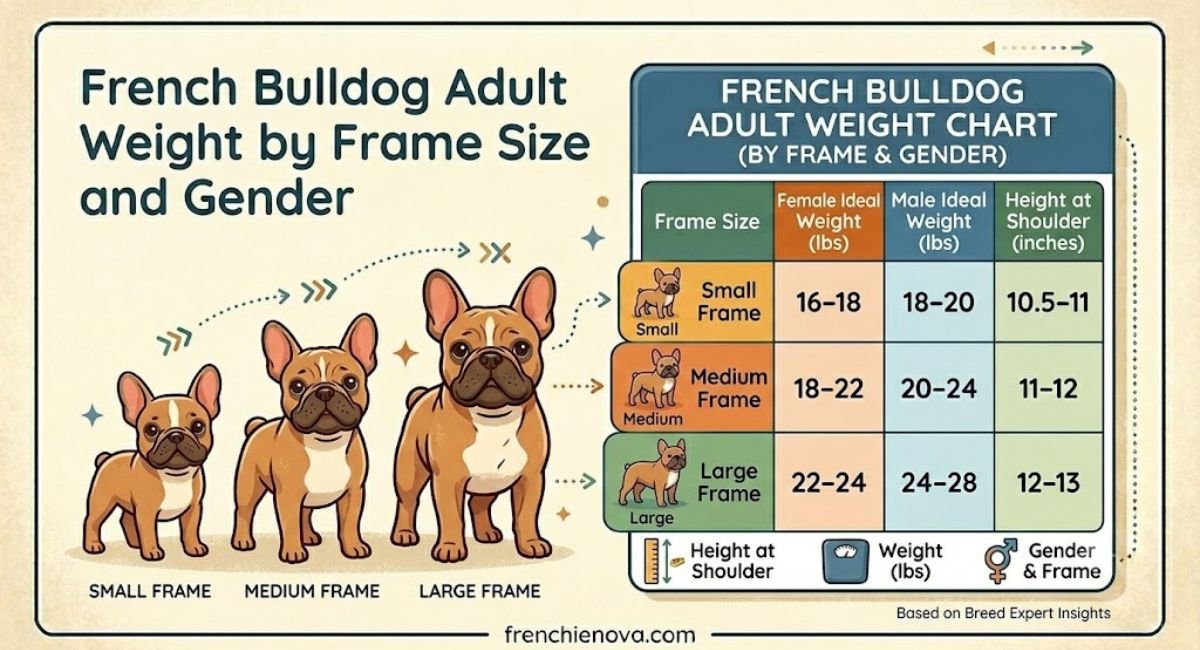
The adult range (17–28 lbs) covers three distinct frame sizes. A small-framed female at 17 lbs is at ideal weight. A large-framed female at 17 lbs is significantly underweight. Frame matters as much as gender.
| Frame Size | Female Ideal | Male Ideal | Height at Shoulder |
| Small | 16–18 lbs | 18–20 lbs | 10.5–11 inches |
| Medium | 18–22 lbs | 20–24 lbs | 11–12 inches |
| Large | 22–24 lbs | 24–28 lbs | 12–13 inches |
How to Identify Your Frenchie’s Frame Size
Three signals together give a reliable read:
- Height at the withers (the top of the shoulder blades) is the most reliable indicator, the AKC standard puts healthy Frenchies in the 11–13 inch range, and where any individual lands in that range tells the frame story
- Parents’ adult weights and heights: Frenchies typically fall within their parents’ frame range
- Bone structure: small-framed Frenchies have narrower chests and lighter bone; large-framed Frenchies have broad chests and heavier bone
A Frenchie that exceeds the AKC 28-lb standard at ideal body condition is uncommon. Most over-28-lb Frenchies are overweight, not just large-framed.
Do Male Frenchies Weigh More Than Females?
Yes, male French Bulldogs typically weigh 3–6 lbs more than females of the same frame size. The AKC breed standard even formally acknowledges this difference, noting that in comparing specimens of different sex, due allowance is to be made in favor of bitches, which do not bear the characteristics of the breed to the same marked degree as do the dogs.
In practical terms: females tend toward narrower chests, lighter bone, and smaller overall mass, even within the same frame category.
French Bulldog Weight by Life Stage
Weight isn’t just an age-and-gender chart, it shifts in predictable ways across life stages.
Adolescent (12–18 Months)
The window when adult weight is reached. Most Frenchies hit their full weight between 12 and 14 months, but muscle development can continue until 18 months. Some still-growing Frenchies in this window may be 1–2 lbs under their adult target, especially males filling out their chest and shoulder muscle.
Activity level peaks in this stage, and calorie needs are usually highest for non-puppy life. For complete adolescent care, see the Frenchie Life Stages pillar guide.
Young Adult (1.5–4 Years)
Peak physical condition. Weight should be stable, month-to-month changes of more than 1 lb usually signal something has shifted: diet drift, exercise change, neuter status, or an emerging health issue.
This is the easiest stage to maintain ideal weight because metabolism and activity sit at their adult baseline.
Mature Adult (4–7 Years)
Slight weight drift upward is common but not normal. Metabolism doesn’t significantly change here, but daily activity often does as Frenchies become more settled. Without portion adjustments, gradual weight gain of 0.5–1 lb per year quietly creeps in.
This is the stage where most preventable Frenchie weight gain happens. Monthly BCS checks catch it early.
Senior (7–10 Years)
Frenchies officially become senior around age 7, earlier than many medium breeds, partly because brachycephalic anatomy ages the body faster.
Typical senior changes:
- Most Frenchies lose 1–3 lbs from their young adult peak through natural muscle loss
- Calorie needs drop 20–30% as activity declines
- BCS becomes harder to interpret because muscle loss can mimic weight loss (a 4/9 BCS in a senior may reflect sarcopenia, not fat loss)
For senior-specific care, see the Senior French Bulldog Care guide.
Geriatric (10+ Years)
Beyond the median Frenchie lifespan. The 2024 Scientific Reports study using the Royal Veterinary College’s VetCompass database documented a median French Bulldog lifespan of 9.8 years. Significant muscle loss is normal in this stage, and weight typically drops another 1–2 lbs from senior levels.
Geriatric weight maintenance focuses on preserving muscle mass through quality protein, not on chasing a number. A geriatric Frenchie at 19 lbs with healthy muscle is in better shape than one at 22 lbs with mostly fat.
Dog years to human years
Convert your dog’s age accurately
Real-World Frenchie Weight Distribution
Breed-standard ranges describe what’s ideal. Population data describes what’s actual, and the two often diverge.
According to weight-tracking data published by 11pets, drawn from thousands of recorded Frenchies:
- Male French Bulldogs: For a typical female, the weight ranges from 9.4kg to 13kg and for a male from 10.7 kg to 13.7 kg. That is, 20.7 lbs to 28.7 lbs for females and 23.6 lbs to 30.2 lbs for males
- Average actual male: 23–25 lbs
- Average actual female: 21–23 lbs
Important context: real-world data reflects both healthy-weight and overweight Frenchies. The fact that some recorded weights exceed the AKC 28-lb standard doesn’t make those weights healthy, it likely reflects the breed’s documented tendency toward obesity. French Bulldogs sit in the top tier of obesity-prone breeds tracked by the Association for Pet Obesity Prevention.
The numbers to aim for stay within the AKC breed standard ranges, not the population averages.
What Affects a Frenchie’s Ideal Weight
Several factors shift where any individual Frenchie should land within the standard range.
Genetics.
The single biggest factor. Parents’ adult weights are the most reliable predictor of a Frenchie’s ideal weight. Two small-framed parents produce small-framed offspring; two large-framed parents produce larger ones.
Spay/neuter status.
Neutered males and spayed females have calorie needs roughly 20–30% lower than intact dogs of the same size. The ideal weight number doesn’t change, but the calorie path to maintain it does.
Activity level.
A sedentary Frenchie and a moderately active one of the same frame have the same ideal weight, but very different daily calorie targets to stay there.
Coat type.
Standard short-coated Frenchies follow the typical profile. Fluffy (long-coated) Frenchies sometimes appear leaner than they are because the coat hides body shape. Tactile assessment matters more than visual in fluffy Frenchies.
Color genetics.
Merle, blue, lilac, and isabella Frenchies sometimes come from narrowed breeding pools with smaller average sizes, so they may naturally sit at the lower end of weight ranges. This is separate from health issues common in those color lines.
Health conditions.
A Frenchie significantly outside the expected weight range despite normal feeding warrants a vet check for:
- Hypothyroidism (slow metabolism, weight gain)
- Cushing’s disease (weight gain and fat redistribution)
- Hyperthyroidism (weight loss, rare in dogs)
- Cancer (weight loss)
- Diabetes (varies with management)
How to Confirm Your Frenchie Is at Ideal Weight
The scale alone isn’t enough. Confirm ideal weight with this 4-step check.
Step 1: Compare to the Chart
Look up the Frenchie’s age, gender, and estimated frame size. Note where the actual weight falls within the expected range.
Step 2: Run a BCS Check
The visual and tactile BCS check confirms whether the weight on the scale is genuinely ideal. A 22-lb Frenchie could be:
- Ideal weight (5/9 BCS) on a medium frame
- Underweight (3/9 BCS) on a large frame
- Overweight (7/9 BCS) on a small frame
BCS catches what the scale can’t.
Step 3: Confirm Visible Signs
At ideal weight (BCS 5/9), a Frenchie should show:
- Ribs felt easily under light pressure, but not visible
- A clear waist when viewed from above
- A visible tummy tuck when viewed from the side
- Easy, normal breathing during light activity
- Energy appropriate for their life stage
Step 4: Cross-Reference With Calorie Math
For a Frenchie at ideal weight on a maintenance diet (~25 cal/lb for sedentary, ~30 cal/lb for active), weight should be stable month-to-month. If weight drifts despite consistent feeding, the calorie target needs adjustment.
Daily calorie needs
How many calories does your dog need?
What If Your Frenchie Is Outside the Ideal Range?
The response depends on which direction.
If Below the Ideal Range
A Frenchie 1–2 lbs under range may simply be small-framed. Concerning signs:
- Visible ribs, hip bones, or spine at rest
- Weight loss month-over-month
- Reduced energy or lethargy
- Poor coat quality
- Diarrhea, vomiting, or appetite refusal
What to do: Schedule a vet visit to rule out parasites, dental issues, congenital problems, or endocrine disease. For puppies under expected weight, vet attention is more urgent than for adults.
If Above the Ideal Range
A Frenchie 1–2 lbs over range may be large-framed and at ideal BCS. A Frenchie 3+ lbs over range, or one that fails the BCS check at any weight over the standard, is overweight.
What to do:
- Run a full BCS check to confirm
- Recalculate daily calorie needs with a weight loss target (10–15% below maintenance)
- See the Is My Frenchie Overweight? guide for full diagnostic steps
- See the How to Help an Overweight Frenchie Lose Weight Safely guide for the full weight-loss protocol
The 2024 Scientific Reports French Bulldog longevity study documented that leaner Frenchies lived nearly 1.8 years longer than overweight ones. For a breed with a 9.8-year median lifespan, staying at or below the AKC 28-lb standard is one of the most impactful longevity decisions an owner can make.
How Often Should You Weigh a Frenchie?
| Life Stage | Recommended Frequency |
| Puppies (0–6 months) | Weekly |
| Adolescent/Young adult (6 months–4 years) | Monthly |
| Mature adult (4–7 years) | Monthly |
| Senior (7–10 years) | Every 2 weeks |
| Geriatric (10+ years) | Weekly |
| During active weight loss | Weekly regardless of age |
Pair monthly weigh-ins with a full BCS check for the clearest picture. Track everything in a notebook or phone app.
How to Weigh a Frenchie at Home
For Frenchies of any size, the easiest method uses a regular bathroom scale:
- Step on the scale alone, record the number
- Pick up the Frenchie and step on together, record the number
- Subtract the first from the second, that’s the Frenchie’s weight
For consistency:
- Use the same scale every time
- Weigh at the same time of day (morning, before food, is most accurate)
- Track the trend across weeks, not just absolute numbers
For Frenchie puppies under 10 lbs, a digital kitchen scale works well — place a towel on the scale, zero it out, then place the puppy on top.
When Do French Bulldogs Stop Growing?
Most French Bulldogs reach full height between 9 and 12 months and full weight between 12 and 14 months. Some continue to fill out with muscle until 18 months, particularly males developing their chest and shoulder mass. By 18 months, almost all Frenchies have reached final adult size. Growth plates typically close by around 12 months for height, with weight filling out for several months after that.
The Bottom Line
The ideal weight for a French Bulldog is a range, not a single number, bounded by the AKC standard maximum of 28 pounds and shaped by gender, frame size, and life stage. Males typically land at 20–28 lbs, females at 17–24 lbs, with most healthy adults averaging 21–25 lbs depending on build.
Weight alone doesn’t tell the full story. Body Condition Score confirms whether that weight reflects healthy muscle and fat distribution, or whether something is off. Frame size, activity level, neuter status, and life stage all shift where any individual Frenchie should sit within the range.
The single most important takeaway: stay at or below the AKC 28-lb maximum for adults, run a monthly BCS check, and watch the trend over time. The 2024 Scientific Reports study documented nearly 2 years of additional life for Frenchies kept lean rather than overweight, a longevity payoff that few other lifestyle factors come close to matching.
For the complete tracking toolkit, the BCS Calculator confirms body condition, the Dog Calorie Calculator handles maintenance feeding, the Puppy Weight Calculator covers the first year, and the Dog Age Calculator keeps life-stage adjustments accurate.
The right number for any Frenchie isn’t found on a chart alone. It’s confirmed by combining the chart, the body, and the math.
Body condition score
Check your Frenchie’s body condition
Daily calorie needs
How many calories does your dog need?
Puppy growth tracker
Predict your puppy’s adult weight
Dog years to human years
Convert your dog’s age accurately
This guide draws on the American Kennel Club (AKC) French Bulldog breed standard, the French Bull Dog Club of America official standard, Pawlicy Advisor (reviewed by Dr. Jennifer Coates), Raised Right Pets (reviewed by Dr. Aisling O’Keeffe), 11pets weight distribution dataset, the 2024 Scientific Reports French Bulldog longevity study using the Royal Veterinary College’s VetCompass database, the Association for Pet Obesity Prevention (APOP), and current veterinary research on brachycephalic breed health. Always consult a veterinarian if a Frenchie’s weight falls significantly outside the expected ranges for their age, gender, and frame size.

Auston is the founder of Frenchie Nova and a longtime French Bulldog owner. He writes practical, research-backed guides on Frenchie care, feeding, and health. Not a veterinarian — always consult your vet for medical concerns.