

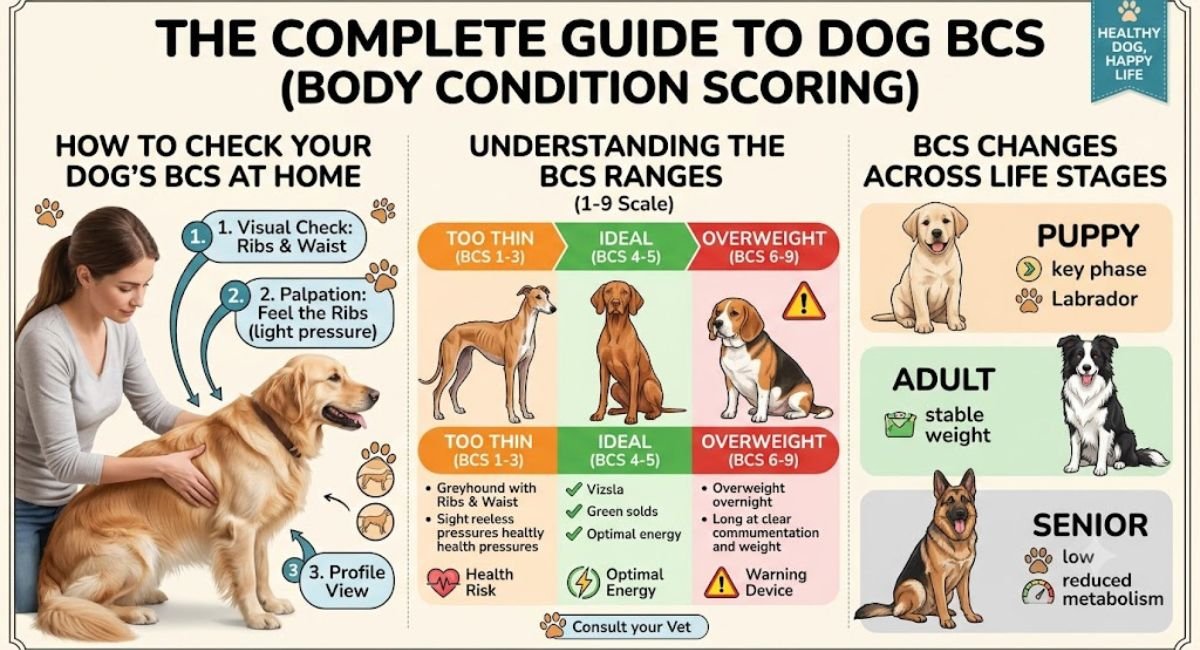
A Labrador can sit at “ideal” in their owner’s eyes for years and still carry 8% extra body fat that only a hands-on check would catch. That’s not a guess. It’s what most veterinary nutritionists see every day, because Body Condition Scoring isn’t a glance from across the room. It’s a three-step, repeatable check that combines what the eye sees with what the hand feels.
This guide walks through the full body condition score chart for dogs, the exact at-home method veterinarians use, and what to do for each score from 1 to 9.
Table of Contents
What Is a Body Condition Score?
Body Condition Score, or BCS, is the standardized way veterinarians estimate how much body fat a dog is carrying. Think of it as the canine version of BMI, except instead of one number on a scale, BCS reads the dog’s actual shape through sight and touch.
Two assessments happen at once:
- Visual inspection: looking at the dog from above and from the side
- Palpation: feeling the ribs, spine, and hips with the hands
That combination matters because the scale alone hides a lot. A 50-lb dog can be ideal at one body shape and obese at another, depending on frame and muscle mass. BCS catches what weight misses.
The system was first validated by Dr. Dorothy Laflamme in 1997 and refined into the modern 9-point chart by Purina Institute researchers. It’s now recognized by the World Small Animal Veterinary Association (WSAVA), used by the American Animal Hospital Association (AAHA), and recommended by the Association for Pet Obesity Prevention (APOP).
The Two BCS Scales: 1–5 vs 1–9
Here’s where most owners get tripped up. There isn’t one BCS scale, there are two.
5-Point Scale:
- 1 = severely underweight
- 3 = ideal
- 5 = obese
9-Point Scale (the standard used by most veterinarians):
- 1 = emaciated
- 4–5 = ideal
- 9 = severely obese
The catch? A dog labeled “5” could be perfect or obese depending on which scale was used. That’s why veterinary teams now write the score as a fraction, 5/9 means ideal, 5/5 means obese. A dog with a BCS of 5 would be obese on the 5-point scale but at ideal weight on the 9-point scale, which is why the denominator always matters.
This guide uses the 9-point scale throughout, since it’s the version preferred by Purina, AAHA, the AKC, and most modern veterinary nutritionists.
What Is a Good Body Condition Score for a Dog?
The ideal body condition score for most dogs is 4 or 5 out of 9. At this range, the ribs can be felt easily under a thin layer of fat, the waist is clearly visible from above, and the belly tucks up from the side. Anything between 1–3 is under ideal; anything 6–9 is over ideal. Naturally lean breeds like Greyhounds and Whippets often sit at 4/9 and are perfectly healthy there.
The Complete BCS 1–9 Chart for Dogs
Here’s what each score actually looks and feels like.
| Score | Category | Visual Signs | Tactile Signs |
| 1/9 | Emaciated | Ribs, spine, hip bones starkly visible; severe muscle loss; extreme tuck | No fat over ribs; bones feel sharp |
| 2/9 | Very Thin | Bones easily visible; minor muscle loss; severe tuck | Very little fat cover |
| 3/9 | Thin | Ribs and spine somewhat visible; pronounced waist | Bones felt with light pressure |
| 4/9 | Slightly Underweight | Ribs may be slightly visible; obvious tuck | Bones easily felt; thin fat cover |
| 5/9 | Ideal | Ribs not visible but felt; visible waist; clear tummy tuck | Thin fat layer; ribs felt with light pressure |
| 6/9 | Slightly Overweight | Ribs not visible; waist less defined | Ribs felt with moderate pressure |
| 7/9 | Overweight | Ribs hard to see or feel; minimal waist | Firm pressure needed; fat pads visible |
| 8/9 | Obese | No waist; abdomen sags; rounded from above | Ribs barely felt; fat pads on back, neck, tail base |
| 9/9 | Severely Obese | Barrel-shaped; pendulous abdomen; obvious fat deposits | Ribs not palpable; thick fat everywhere |
The target for almost every adult dog is 4 or 5 out of 9. That range has been documented in long-term research as the body condition linked to the longest, healthiest lifespans.
Body condition score
Check your Frenchie’s body condition
How to Check Your Dog’s BCS at Home (Step-by-Step) (Body Condition Score Chart for Dogs)
The full check takes about three minutes. No scale needed, just hands, eyes, and a calm dog standing on a flat surface. This is the same method recommended by the American Kennel Club and the Association for Pet Obesity Prevention.
Step 1: Look From Above (Top View)
Stand directly over the dog while they’re standing on all four legs.
What to look for:
- A clear waist narrowing between the ribcage and the hips
- An hourglass shape when viewed from above
- The waist should be visibly narrower than both the chest and the hips
What it means:
- Clear hourglass → likely 4–5/9 (ideal)
- Slight narrowing → 6/9 (borderline overweight)
- Straight or barrel-shaped → 7–9/9 (overweight to obese)
- Severe pinch → 1–3/9 (underweight)
Step 2: Look From the Side (Profile View)
Kneel beside the dog while they’re standing.
What to look for:
- An abdominal tuck: the belly should slope upward from the chest toward the hind legs
- Not a flat horizontal line, not a sagging downward curve
What it means:
- Clear upward slope → ideal BCS
- Straight horizontal belly → 6–7/9
- Sagging belly → 8–9/9
- Severe upward angle showing all ribs → 1–3/9
Step 3: Hands-On Rib Check (The Step Most Owners Skip)
This is the most important step, and the one casual owners miss entirely.
Position: Stand behind the dog. Place both hands flat on either side of the ribcage, just behind the front legs.
Pressure: Use very light pressure, about the same touch you’d use to brush flour off a countertop. Pressing harder makes ribs feel obvious even in overweight dogs, which is one of the most common scoring mistakes.
The Hand Comparison Test (popularized by board-certified veterinary nutritionist Dr. Jackie Parr):
- Too thin (1–3/9): Feels like running fingers over a closed fist, bones sharp, no padding
- Ideal (4–5/9): Feels like the back of a flat hand, Knuckles easy to feel with thin padding
- Overweight (6–9/9): Feels like the palm of a hand, bones hidden under thick padding
A quick note for older dogs: arthritic dogs may flinch when their hips or spine get pressed, so stick to the ribs first. The rib check disturbs the dog far less than poking at the backbone or pelvis.
What Each BCS Range Means (And What to Do)
Knowing the score is half the work. Knowing what to do next is the other half.
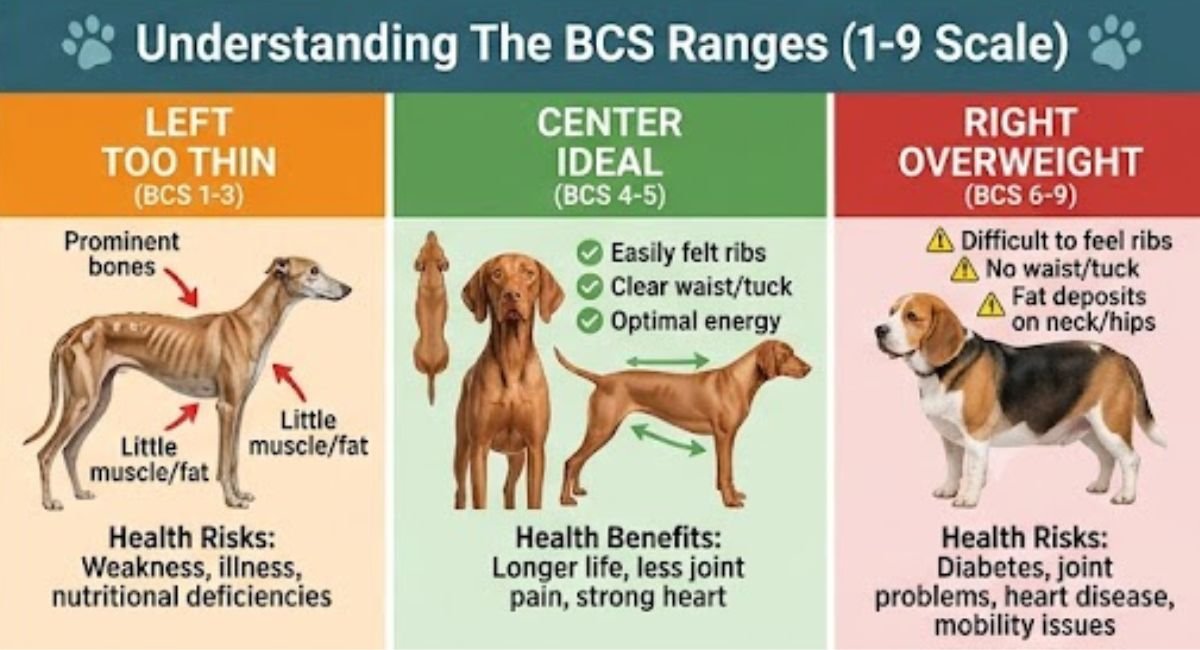
BCS 1–3/9 (Underweight)
Significantly under ideal body condition. Common causes:
- Insufficient calorie intake
- Intestinal parasites
- Dental pain making chewing uncomfortable
- Underlying disease, cancer, kidney issues, diabetes, hyperthyroidism
- Recent illness or surgery recovery
What to do:
- Book a vet visit immediately for a score of 1 or 2
- Run bloodwork and a fecal exam to rule out medical causes
- Increase calorie intake by 10–15% if no medical issue is found
- Switch to a higher-calorie formula or add fresh food to boost appetite
BCS 4/9 (Slightly Lean)
Lean but not concerning. Many active working breeds, Greyhounds, sighthounds, lean herding dogs, naturally sit at 4/9 and are perfectly healthy. Most pet dogs do better at 5/9.
What to do:
- Increase daily calories by 5–10%
- Recheck BCS in 4 weeks
- Monitor weight weekly
BCS 5/9 (Ideal)
The goal for most adult dogs. Ribs felt easily, clear waist from above, tummy tuck from the side. No action needed, just stay consistent.
What to do:
- Continue current feeding and exercise routine
- Weigh weekly to confirm stability
- Recheck BCS monthly to catch drift early
BCS 6/9 (Slightly Overweight)
The most common BCS in pet dogs today, and the easiest one to brush off. In a 14-year Purina study, scientists were the first to prove the importance of keeping dogs in lean body condition from puppyhood, with the lean-fed group developing arthritis and other chronic diseases significantly later than their heavier siblings.
What to do:
- Reduce daily calories by 10%
- Reassess BCS in 4–6 weeks
- Increase moderate activity if breed and health allow
- Count every treat and scrap; they add up fast
BCS 7–8/9 (Overweight to Obese)
The danger zone. The landmark Kealy et al. 2002 study published in the Journal of the American Veterinary Medical Association documented that lean-fed Labrador Retrievers lived a median of 1.8 years longer (about 15%) than control-fed dogs. Compounding risks include:
- Joint disease and arthritis
- Diabetes
- Heart disease
- Higher anesthesia risk
- Reduced exercise tolerance
- For flat-faced breeds like Pugs, Bulldogs, and Boston Terriers: worsened BOAS symptoms
What to do:
- Reduce daily calories by 15–20% under vet supervision
- Switch to a weight-management formula if needed
- Increase activity gradually
- Reweigh weekly, aim for about 1% body weight loss per week (faster causes muscle loss)
- Recheck BCS every 4 weeks
BCS 9/9 (Severely Obese)
This warrants medical intervention, not at-home tweaking.
What to do:
- Schedule a veterinary obesity consultation
- Likely transition to a prescription weight-loss diet, Hill’s Prescription Diet r/d, Royal Canin Satiety, or Purina OM Overweight Management
- Monthly weight checks at the clinic
- Full bloodwork to rule out thyroid disease, Cushing’s, or other endocrine causes
- Pain management if mobility is affected
Daily calorie needs
How many calories does your dog need?
Why BCS Beats the Scale Alone
The scale gives one data point. BCS gives the full picture.
- Fluid retention masks weight loss. Dogs with congestive heart failure can keep stable weight even as they lose muscle, fluid replaces lost tissue. BCS catches this. The scale doesn’t.
- Muscle and fat weigh differently. An athletic 60-lb Labrador and a sedentary 60-lb Labrador have completely different body compositions. BCS distinguishes them.
- Frame size matters. Two dogs of the same breed can sit at the same weight and have completely different body conditions, one lean, one carrying extra fat, depending on bone structure and muscle. The scale can’t tell the difference. BCS can.
- Puppies grow fast. Puppies gain weight rapidly during growth. BCS tells the owner whether it’s the right kind of weight, muscle and bone, or excess fat.
- Purina Institute research has shown that maintaining a lean body condition from puppyhood can extend a dog’s healthy life by up to 15%.
Body Condition Score vs Muscle Condition Score
Most owners stop at BCS, but veterinarians now look at a second measure too. Muscle Condition Score (MCS) tracks muscle mass separately from body fat, because the two don’t always move together.
A dog can be obese and still have moderate muscle loss. A senior dog can be lean and still be losing muscle to sarcopenia. The AAHA muscle condition system grades muscle as normal, mild loss, moderate loss, or severe loss, assessed by visually checking and palpating the epaxials (the muscles along the spine), shoulders, hips, and temporal muscles on the skull.
For most pet owners, the simple takeaway is this: if a senior dog’s BCS drops but their belly stays soft and the back feels bony, it’s likely muscle loss, not fat loss. That’s a vet conversation worth having.
How BCS Changes Across Life Stages
BCS targets shift across a dog’s life, and so does the right way to assess them.
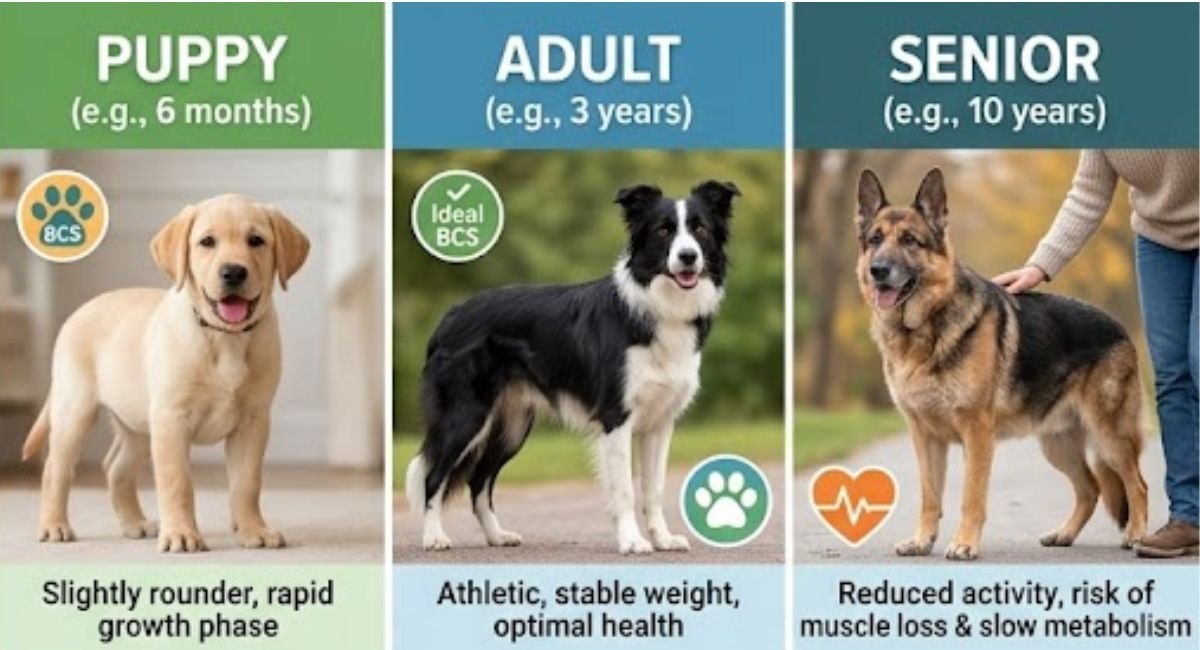
Puppies (0–12 Months)
Puppies under four months naturally have rounder bellies and softer body shapes. Don’t try to apply the adult 4–5/9 target before that age. Concerning signs:
- Visible ribs in a puppy under 4 months → likely underfeeding
- Rolls of fat or a barrel shape → overfeeding, which accelerates joint and bone issues
- No waist forming by 6 months → worth a vet conversation
From around four months onward, the standard adult BCS chart applies.
Adults (1–7 Years)
The 4–5/9 target applies firmly. This is the longest life stage and the easiest to monitor. Monthly BCS checks catch drift before it becomes a real problem.
Seniors (7+ Years)
Senior dogs often lose muscle mass with age, meaning the BCS can drop to 4/9 even when body fat percentage stays the same or even climbs. This is where MCS becomes critical. A senior at 4/9 isn’t necessarily underweight if fat distribution looks normal. Working with a vet to separate muscle loss from fat loss matters more in this life stage than any other.
Dog years to human years
Convert your dog’s age accurately
Breed-Specific BCS Considerations
The standard chart works for most dogs, but a few breed groups need adjustments.
Stocky breeds (English Bulldogs, French Bulldogs, Pugs, Mastiffs, Boxers): Naturally compact bodies often look heavier than they are. The lack of an obvious waist tuck doesn’t always mean obesity — it can be normal breed conformation. Hands-on palpation matters more than visual inspection in these breeds.
Lean breeds (Greyhounds, Whippets, Salukis, Borzois): These dogs naturally sit at 4/9, not 5/9. Their ribs may be slightly visible at ideal weight. By general standards, they look “too thin.” They’re not.
Fluffy and long-coated breeds (Pomeranians, Samoyeds, Golden Retrievers, Bernese Mountain Dogs, Australian Shepherds): The coat hides everything. Visual inspection alone is unreliable here. Owners need to part the fur and feel underneath the coat for an accurate read.
Brachycephalic breeds (Pugs, French Bulldogs, English Bulldogs, Boston Terriers): BCS matters more for these breeds than almost any other group, because excess weight worsens BOAS (Brachycephalic Obstructive Airway Syndrome) and significantly shortens lifespan. For breeds prone to airway issues, every extra pound has an outsized impact.
Deep-chested breeds (Great Danes, German Shepherds, Doberman Pinschers): The natural chest depth can create the illusion of a tucked waist even when the dog is carrying extra fat. Rely on the rib check, not the side profile.
How Can I Tell If My Dog Is Overweight? Common BCS Mistakes
Here’s where owners quietly under-score their own dogs.
- Skipping the hands-on check. Visual inspection alone fails, especially with thick coats or stocky breeds.
- Pressing too hard. Firm pressure makes ribs feel obvious even on overweight dogs. Brush-the-counter pressure only.
- Mixing up the scales. Confusing 5/5 with 5/9 leads to massive scoring errors.
- Scoring through a coat. Long fur hides body shape. Part the coat. Feel the skin.
- Comparing to other dogs. Other neighborhood dogs may also be overweight. Using them as a baseline drags the whole assessment toward “normal-but-actually-overweight.”
- Scoring when the dog is wet, anxious, or moving. Stand the dog calmly on a flat surface. Wet coat or tense muscles distort what gets felt.
- Treating BCS as a one-time check. BCS is a trend tool, not a single snapshot. Monthly tracking catches drift before it becomes obvious.
How Often Should Owners Recheck BCS?
- Monthly: for healthy adults at ideal BCS
- Weekly: for dogs in active weight loss or weight gain programs
- Every 2 weeks: for puppies during the first year
- Every 2 weeks: for senior dogs (7+ years)
Pair BCS checks with weekly weigh-ins. Body shape and absolute weight together catch issues neither one alone would.
The Photo Documentation Trick
Memory is unreliable when tracking gradual change. The single most useful BCS habit no vet website mentions: monthly photos.
The method:
- Take a photo from directly above the dog standing on a flat surface
- Take a second photo from the side, with the dog in profile
- Use the same lighting and same room each month
- Save the photos in one folder, labeled by date
Side-by-side comparisons across two or three months reveal body shape changes that day-to-day observation misses entirely.
When to See the Vet
A home BCS check is a screening tool, not a diagnosis. These situations call for a vet:
- A BCS of 1, 2, or 9, any extreme score
- Sudden change (more than one point in a month)
- BCS dropping despite increased feeding
- BCS rising despite reduced feeding
- BCS combined with lethargy, vomiting, or appetite changes
- A puppy not gaining weight or showing rolls of fat
- A senior dog showing a sudden BCS drop
For most cases, monthly home checks combined with regular vet visits are enough.
The Bottom Line
The body condition score chart for dogs is one of the most useful tools any owner can learn. It takes three minutes, needs no equipment, and reveals more about a dog’s health than the scale ever can. The combination of visual inspection, top view for the waist, side view for the tummy tuck, and the hands-on rib check (using Dr. Jackie Parr’s knuckle comparison) delivers a reliable score from 1 to 9 every time.
The goal for most dogs is 4 to 5 out of 9. Felt-but-not-seen ribs, a visible waist from above, a clear tummy tuck from the side. Maintaining this body condition has been documented to extend healthy lifespan by up to 15% — nearly two years for the breeds in the landmark Purina/Kealy lifespan study.
The single best habit any dog owner can build is the monthly check. Three minutes, twelve times a year, changes everything about how long and how well a dog lives.
Body condition score
Check your Frenchie’s body condition
Daily calorie needs
How many calories does your dog need?
Dog years to human years
Convert your dog’s age accurately
Puppy growth tracker
Predict your puppy’s adult weight
This guide draws on the Purina Institute, World Small Animal Veterinary Association (WSAVA), Association for Pet Obesity Prevention (APOP), American Animal Hospital Association (AAHA), American Kennel Club (AKC), PetMD, VCA Animal Hospitals, the 2002 Kealy et al. landmark study (Journal of the American Veterinary Medical Association), the 1997 Laflamme BCS validation studies, and Dr. Jackie Parr, board-certified veterinary nutritionist. Always consult a veterinarian for individualized weight-management plans, especially for severely under- or overweight dogs.

Auston is the founder of Frenchie Nova and a longtime French Bulldog owner. He writes practical, research-backed guides on Frenchie care, feeding, and health. Not a veterinarian — always consult your vet for medical concerns.