

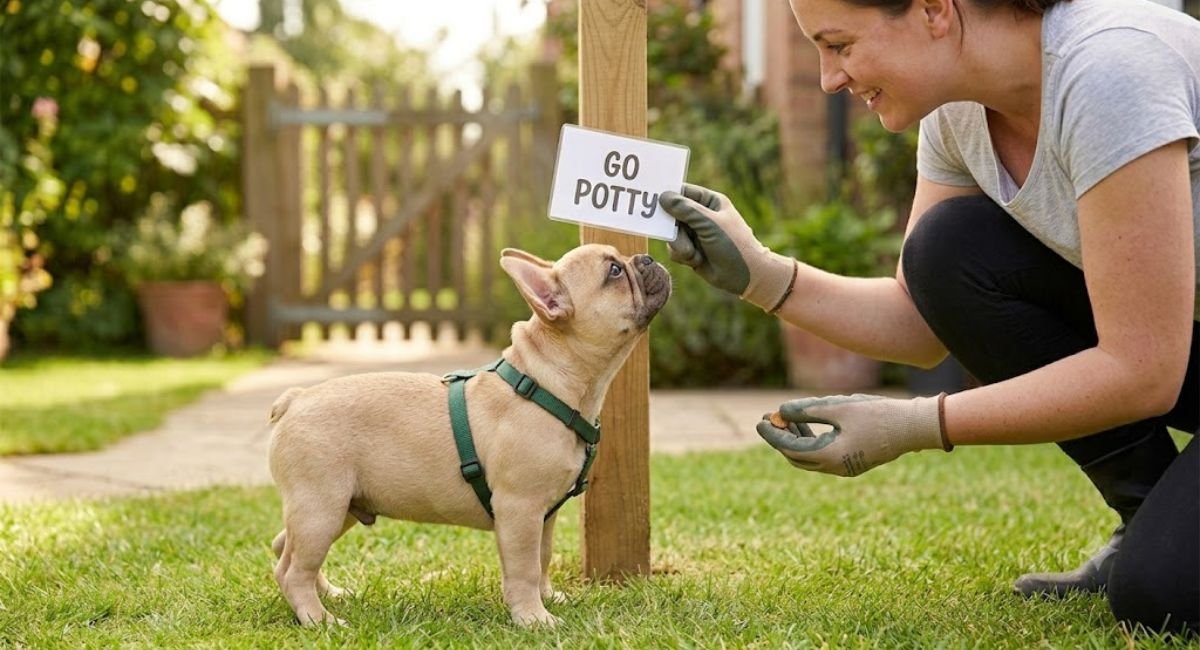
Anyone who’s brought home a Frenchie knows the first week is mostly mopping. The puppy is adorable, the puddles are not, and most guides just say “be consistent” without telling you what that actually looks like at 6 a.m. Potty training a French Bulldog puppy isn’t harder than other breeds because they’re dim, it’s their tiny bladders and stubborn streak working against you.
The good news? With the right schedule and a few breed-specific tricks, most Frenchies are reliably trained in a few months. Here’s the plan that actually holds up in a real home.
Table of Contents
Why French Bulldogs Are Trickier to Potty Train
Frenchies aren’t stubborn for the fun of it. They’re a small, brachycephalic breed, which means two things matter here: their bladders are physically small, so they simply can’t hold it as long as a Labrador puppy can, and their independent personality means they’ll test whether the rules really apply today.
Breeders and trainers who work with the breed daily, like the folks at Great Lakes French Bulldogs, point out that early, repetitive routines literally build the learning pathways in a puppy’s developing brain. Start late or stay inconsistent, and you’re fighting habits that have already set. Knowing this reframes the whole job: you’re not punishing a “bad” dog, you’re working around a small body and a clever mind.
When to Start Potty Training Your Frenchie
The short answer: the day they come home. Most Frenchie puppies arrive at 8 weeks, and experts across the board, agree that 8 weeks is the sweet spot to begin house training. Puppies this young soak up routine faster than older dogs, and you avoid letting bad habits form indoors.
There’s a handy rule of thumb for how long a puppy can hold it: their age in months plus one, in hours. So a 2-month-old can manage roughly three hours, max. That number is the backbone of your whole schedule.
The French Bulldog Potty Training Schedule by Age
This is where most guides go vague. Here’s a clearer breakdown:
- 8–12 weeks: Outside every 1–2 hours during the day, plus right after every meal, nap, drink, and play session. Expect one or two overnight trips too.
- 3–4 months: Stretch to every 2–3 hours as bladder control improves. Accidents start dropping noticeably.
- 4–6 months: Most Frenchies can hold it 3–4 hours and start signaling at the door. This is when training “clicks” for many pups.
- 6+ months: Longer stretches become reliable, and adult Frenchies eventually hold it 6–8 hours comfortably, though pushing that limit daily isn’t kind to them.
Take your puppy to the same outdoor spot every single time. Frenchies navigate by scent, so a consistent location speeds up the association dramatically.
Step-by-Step: How to Potty Train Your French Bulldog
Schedules and theory are great, but here’s the actual day-one-to-trained sequence. Work through these steps in order, and the routine starts running itself.
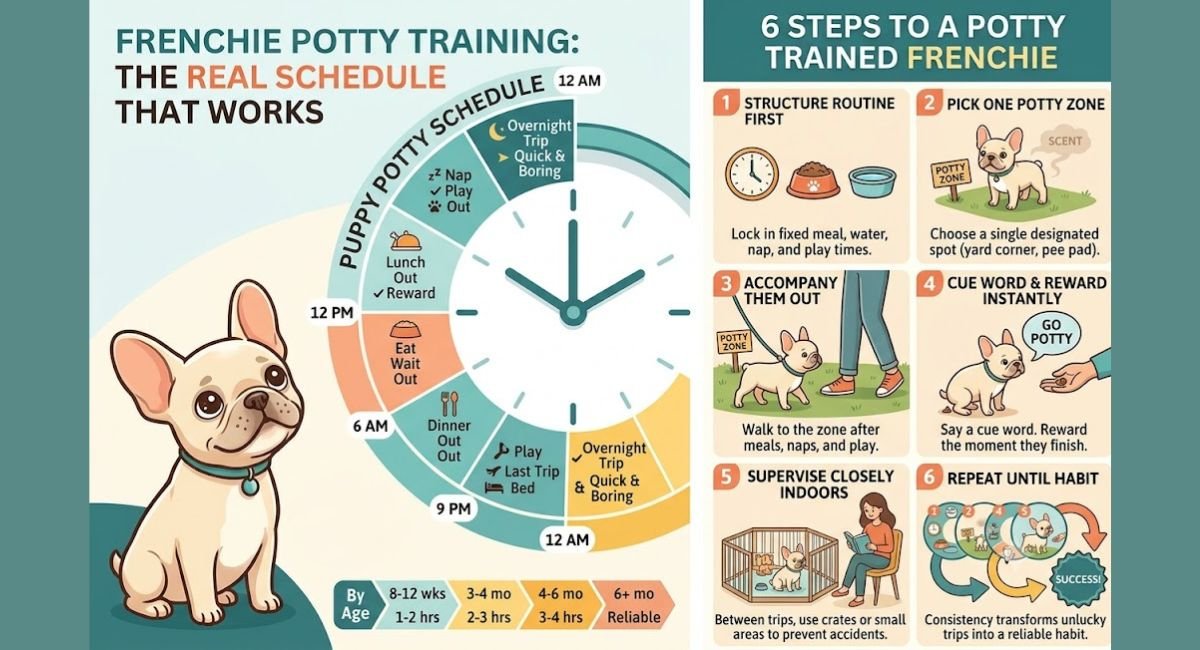
Step 1 — Structure the daily routine first. Lock in fixed times for meals, water, naps, and play. A puppy who eats at set times poops at roughly set times, that’s your whole job made easier.
Step 2 — Pick one designated potty zone. Choose a single spot, a corner of the yard, a specific patch of grass, or a pee pad in an apartment, and commit to it. Because Frenchies rely on scent to recognize where they “should” go, returning to the same place builds the habit far faster than a new spot each trip.
Step 3 — Accompany them out at every set time. Don’t just open the door and hope. Walk your Frenchie to the zone yourself after every meal, nap, drink, and play session, the four moments puppies almost always need to go. Going with them lets you confirm they finished and reward on the spot.
Step 4 — Attach a cue word and reward instantly. As your puppy squats, say one consistent phrase, “go potty” works fine, every single time. Within a couple of weeks the words alone start prompting the action. The moment they finish, praise them and hand over a small treat or a quick play burst. Timing is everything: a treat thirty seconds later teaches nothing, so reward right there in the zone.
Step 5 — Supervise closely indoors. Between trips, keep your Frenchie where you can watch them, or confine them to a small space or crate. Watch for the tells, sniffing, circling, whining, heading for the door, and move fast when you spot one. Catching the signal beats cleaning the carpet.
Step 6 — Repeat until it’s a habit. Same routine, same zone, same cue, same reward, day after day. This is the unglamorous part nobody posts about, but consistency is what turns a string of lucky trips into a genuinely house-trained dog.
Crate Training Makes It Click Faster
Crate training and potty training are best mates. Dogs naturally avoid soiling where they sleep, so a properly sized crate teaches your Frenchie to hold it until you open the door.
Size matters: the crate should let your puppy stand, turn, and lie down, but no bigger. Too much room and they’ll happily pee in one corner and nap in the other. A simple guideline for crate time is the same age-plus-one math: a 3-month-old puppy maxes out around four hours. Never use the crate as punishment, or it loses its safe-den value entirely.
Potty Training a Frenchie in an Apartment
No yard? You’re far from stuck. Plenty of city Frenchie owners use a pee pad or an artificial grass patch on a balcony as the designated indoor spot, then transition to outdoors as the puppy matures. The same rules apply: one consistent location, immediate rewards, and close supervision.
If you want the long-term goal to be outside, start carrying the puppy straight to the elevator and out, every two hours, rather than letting them get too comfortable on pads. The quicker the outdoor habit forms, the easier the eventual switch.
How to Handle Night-Time Potty Training
For puppies under about 12 weeks, expect to set an alarm for one overnight trip. Their bladder just can’t last eight hours yet. Keep these night runs boring, no play, no chatter, just outside, potty, praise, and back to bed, so your Frenchie learns night-time isn’t social hour. Cut off water about an hour before bedtime, and the overnight accidents fade fast.
Potty Training a French Bulldog in Winter: Special Considerations
Cold weather throws a real wrench into potty training, and Frenchies feel it more than most. As a brachycephalic breed with thin coats and low body fat, French Bulldogs get cold fast — so a puppy who happily trotted outside in October may flat-out refuse in January. Here’s how to keep progress going when the temperature drops.
Keep trips short and snappy, a shivering puppy won’t focus. Bundle them in a well-fitting dog sweater, head straight to the potty zone, and come back the moment they finish. Shovel a small bare patch in their usual spot so the familiar scent cues still work, and they’re not wading belly-deep just to pee. Watch their paws too: road salt and ice can crack those little pads, so wipe them after every trip and consider a pet-safe paw balm or booties.
Expect a few setbacks, and don’t punish them, winter regression is common and isn’t a failure. On genuinely dangerous days, an indoor pee pad or artificial grass patch is a reasonable fallback, just keep guiding them back outdoors as soon as conditions allow so the outdoor habit doesn’t unravel.
Dealing With Accidents the Right Way
Accidents will happen, they’re part of the process, not a sign of failure. Two rules keep them from snowballing.
Never punish after the fact. Yelling or rubbing a nose in it only creates fear, and a frightened Frenchie may start hiding to pee or even develop fear-induced urination. Clean every accident with an enzymatic cleaner, not a regular household spray. Enzyme cleaners break down the scent markers completely, while ordinary cleaners leave traces only a dog’s nose can detect, which basically signs the same spot for a repeat.
One more thing: if a previously trained Frenchie suddenly starts having accidents, treat it as a red flag. A urinary tract infection or other medical issue can disrupt house training overnight, so a quick vet check is worth it.
The Takeaway
Potty training a French Bulldog puppy comes down to three things working together: a tight age-appropriate schedule, immediate positive reinforcement, and patience through the setbacks. Most Frenchies land somewhere in the 4-to-6-month range before they’re truly reliable, and a stubborn few take closer to a year. Stick with the routine even on the messy days, it’s temporary, and the payoff is a confident dog who tells you when they need out. If progress completely stalls, looping in a professional dog trainer or your veterinarian is always a smart move.
Last updated: 2026. For persistent accidents or sudden regression, consult a licensed veterinarian to rule out medical causes.

Auston is the founder of Frenchie Nova and a longtime French Bulldog owner. He writes practical, research-backed guides on Frenchie care, feeding, and health. Not a veterinarian — always consult your vet for medical concerns.