

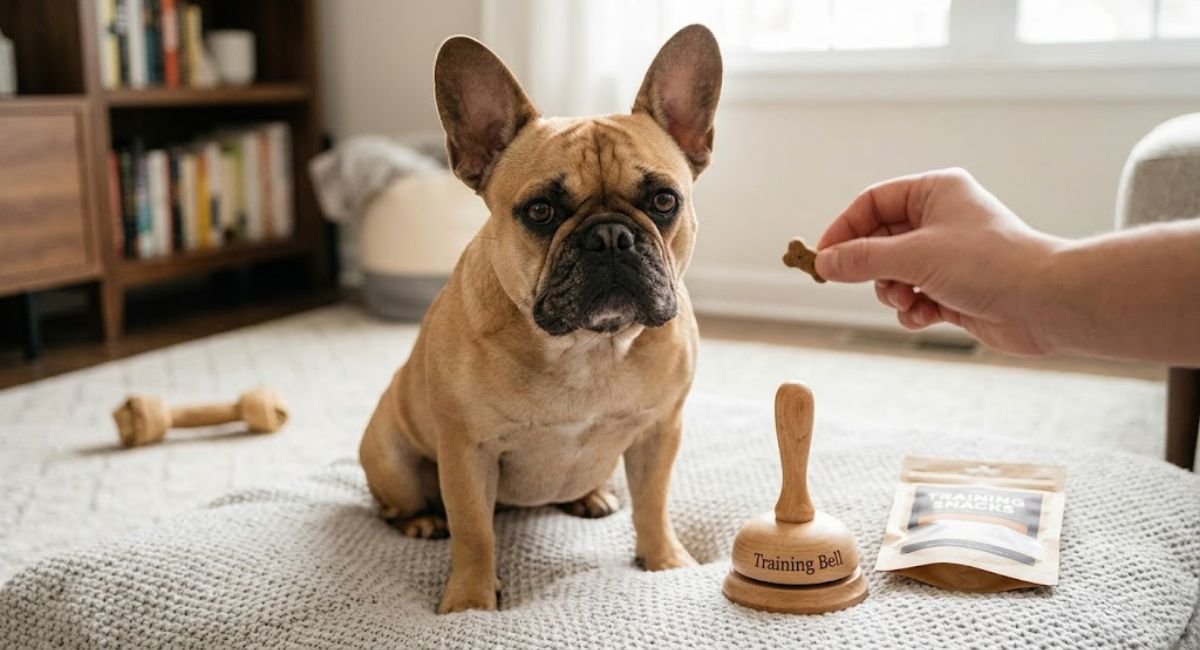
Picture a nine-month-old Frenchie planting all four feet on the sidewalk, refusing to budge, while staring up with those enormous bat ears like the walk was entirely your idea. Most Frenchie owners have lived some version of this moment. And it raises the question almost everyone asks before or right after bringing one home: are French Bulldogs easy to train, or did they just sign up for two years of stubborn standoffs?
The honest answer sits in the middle. French Bulldogs are smart, food-driven, and genuinely capable learners, but they train on their own terms, not out of a desperate need to please. Get the approach right, and they pick things up fast. Get it wrong, and you’ll meet the famous stubborn streak. This guide breaks down what actually works, what to expect at each age, and the question that comes right after training: when do Frenchies calm down?
Table of Contents
So, Are French Bulldogs Easy to Train?
Yes, with a catch. Frenchies are clever little dogs, and among the bulldog breeds they’re considered the brightest. They sit roughly mid-range for trainability when stacked against all breeds, which means they’re far from the bottom of the class. What trips people up is the assumption that intelligence equals obedience. It doesn’t.
Unlike a Labrador or Golden Retriever, a French Bulldog wasn’t bred to take direction across a field. The breed began as a companion dog in England and later became the favorite of lace workers in France, hence the name. They were bred to sit on laps and be charming, not to herd or retrieve. That history still shows up in their personality today. A Frenchie doesn’t learn “sit” to make you proud. They learn it because there’s something in it for them.
This is why the breeder and AKC judge Sharon Dykes, a board member of the French Bulldog Club of America with decades of experience, frames Frenchie training as training yourself first. Set a schedule, stay consistent, and the dog follows. Drop the routine, and the dog drops the lessons.
Why “Stubborn” Is Usually Something Else
Here’s a reframe that changes everything: most of what owners label stubbornness isn’t defiance at all. It’s one of three things, boredom, anxiety, or a behavior that was never fully taught in the first place.
Frenchies are creatures of habit. When the rules of the house feel predictable, they relax and cooperate. When the rules keep shifting, allowed on the couch Monday, scolded for it Tuesday, they get confused, and confusion looks a lot like willfulness. A dog that “won’t listen” is often a dog that was taught a command in the kitchen and has no idea it also applies in the park. Dogs don’t generalize the way people assume they do.
So before getting frustrated with a Frenchie that ignores you, it’s worth asking whether the behavior was truly trained in that exact context. Nine times out of ten, the answer points back to the human end of the leash.
What Actually Works When Training a Frenchie
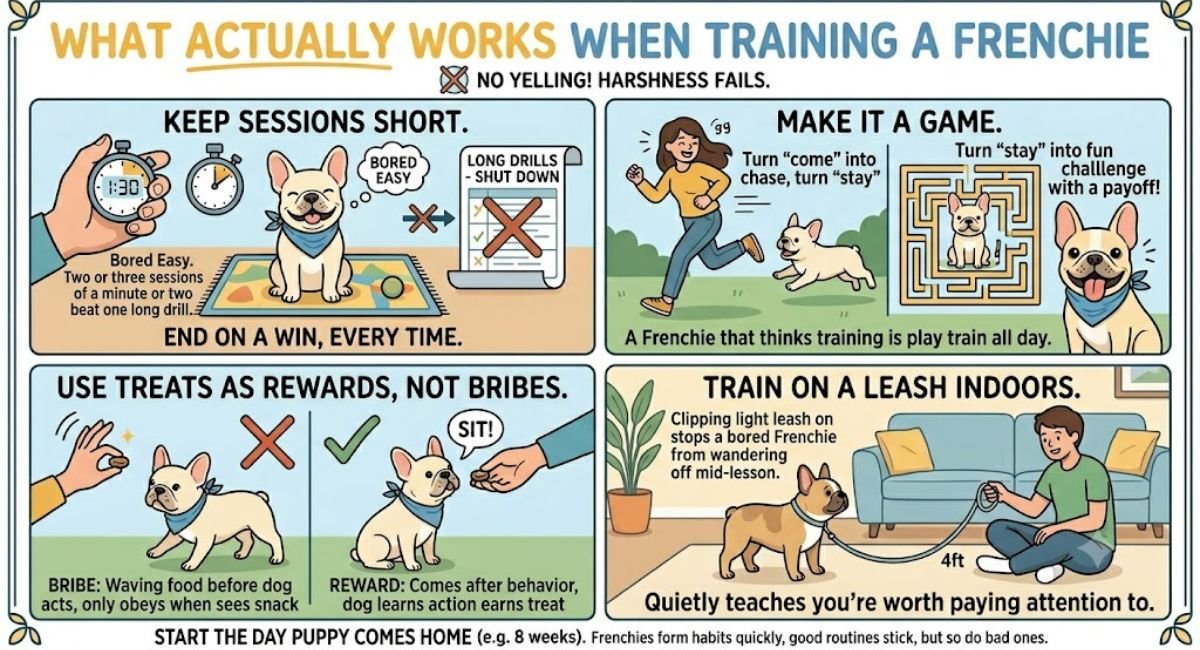
French Bulldogs respond to positive reinforcement and almost nothing else. Yelling backfires badly, it tends to make them more anxious and more stubborn, not less. The breed simply shuts down under harsh correction.
A few things that consistently work:
Keep sessions short.
Frenchies bore fast. Two or three sessions of a minute or two beat one long drill. End on a win, every time.
Make it a game.
Turn “come” into chase, turn “stay” into a fun challenge with a payoff. A Frenchie that thinks training is play will train all day.
Use treats as rewards, not bribes.
This distinction matters more than most guides admit. A bribe is waving food before the dog acts, so the dog only obeys when it sees the snack. A reward comes after the behavior, so the dog learns the action earns the treat. Same food, completely different result. Fade the treats gradually once a behavior is solid.
Train on a leash indoors.
Clipping a light leash on during home training stops a bored Frenchie from wandering off mid-lesson and quietly teaches that you’re worth paying attention to.
Start the day the puppy comes home, ideally around 8 weeks, when they’re already receptive to basic obedience. Frenchies form habits quickly, which cuts both ways, good routines stick, but so do bad ones. As Dykes points out, don’t let the cute baby sleep in your bed unless you plan to share it with a fully grown adult dog for the next decade.
Potty Training and the Small-Bladder Reality
Frenchies have a reputation for being hard to house train, but it’s mostly overblown. They’re smart and habit-forming, which works in your favor. The real challenge is physical: a small bladder means more frequent trips outside, especially as a puppy.
A predictable schedule does the heavy lifting. Feed, walk, play, and rest at consistent times, and the potty trips fall into a rhythm you can actually anticipate. Pair it with crate training, dogs naturally avoid soiling their den, and most Frenchies are reliably house trained within three to five months of consistent effort. Supervision and rewards for good choices beat punishment every single time.
The Stages Every Frenchie Owner Should Expect
Training difficulty isn’t constant. It rises and falls with development, and knowing the map makes the hard weeks survivable.
8 weeks to 4 months: A sponge. Curious, eager, and ready for basic commands and early socialization. This is the golden window.
4 to 6 months, the “brat stage”: Independence kicks in. Your puppy suddenly “forgets” commands and tests every limit. Teething overlaps here too, so expect mouthing and biting as sore gums look for relief. It’s not aggression; it’s discomfort plus boundary-pushing.
6 to 18 months, adolescence: The teenage phase. Energy spikes, confidence grows, and even well-trained dogs regress temporarily. Consistency is everything now. Don’t panic when a dog that knew “stay” last month pretends it never heard the word.
During adolescence, a lot of owners start wondering when all this energy finally settles. The short version: most Frenchies begin to calm down as they move through their second year, and the same consistency that makes training work is what speeds that up. (For the full age-by-age timeline and how to handle the wild months, see the companion guide on French Bulldog behavior problems and when Frenchies calm down.)
The Bottom Line
So, are French Bulldogs easy to train? They’re easy to train well once you work with their personality instead of against it, short fun sessions, real rewards, rock-solid consistency, and patience through the brat and teenage stages. The stubbornness is mostly a communication gap, not a character flaw.
Train the dog in front of you, expect the hard months, and trust the timeline. The wild little gremlin planting their feet on the sidewalk today really does grow into a wonderful companion.
This guide is for general informational purposes. For persistent behavior concerns, biting that escalates, or signs of anxiety, consult a certified dog trainer, a veterinary behaviorist, or your vet — especially given the breed’s brachycephalic health considerations.
[Written by a contributor with hands-on French Bulldog experience, drawing on guidance from the American Kennel Club and the French Bulldog Club of America.

Auston is the founder of Frenchie Nova and a longtime French Bulldog owner. He writes practical, research-backed guides on Frenchie care, feeding, and health. Not a veterinarian — always consult your vet for medical concerns.