

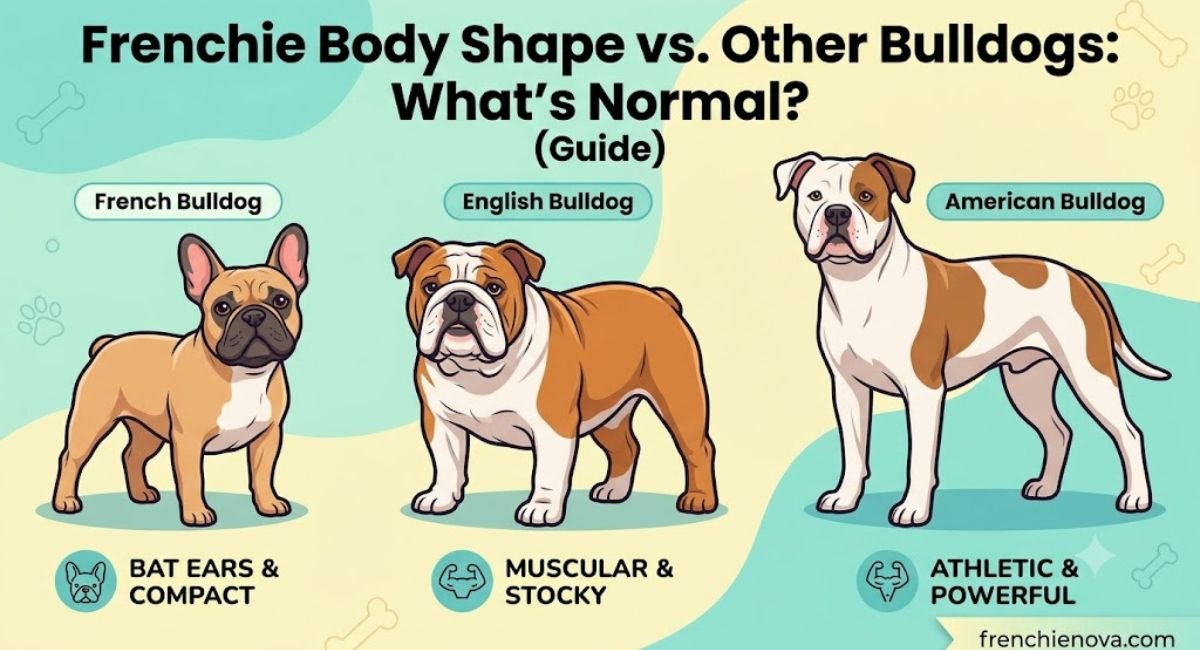
A Frenchie walking next to an English Bulldog at the park can look like a totally different breed, and a lot of new owners start wondering if their dog is built “right.” Maybe the chest looks smaller. Maybe the legs seem longer. Maybe the back curves a little where a friend’s Bulldog goes straight.
Here’s the short version: Frenchies are supposed to look different. They share DNA with the bigger bulldog breeds but were shaped over decades into something compact, muscular, and built on its own scale.
This guide Frenchie Body Shape vs. Other Bulldogs breaks down exactly what a normal Frenchie body looks like, how it compares to English, American, and Olde English Bulldogged (and the Boston Terrier lookalike), and how to tell if a Frenchie’s shape is healthy, or signaling something worth checking.
Table of Contents
What a “Normal” French Bulldog Body Looks Like
The American Kennel Club (AKC) lays out a clear breed standard, and it gives owners a real reference point.
A healthy adult French Bulldog should be:
- Height: 11 to 13 inches at the shoulder
- Weight: 16 to 28 pounds (males slightly heavier than females, but not by much)
- Build: Compact, muscular, with heavy bone for its size
- Topline: Slight roach back, meaning the back rises gently behind the shoulders and falls toward the tail. This is correct, not a defect.
- Chest: Broad, deep, and well-let-down between the shoulders
- Legs: Short, stout, and set wide apart
- Body length: Slightly longer than tall, but not low and stretched like a Dachshund
- Head: Square, large in proportion to the body, with the iconic erect “bat ears”
The defining word is cobby, short-coupled, muscular, and packed into a small frame. A Frenchie should look like a small bull, not a small Bulldog.
👉 Not sure if your Frenchie’s body matches the standard? Run them through the BCS as per Breed Standard tool for a guided check.
Body condition score
Check your Frenchie’s body condition
Frenchie vs. English Bulldog: The Biggest Body-Shape Differences
These two get confused most often, but side by side they’re not even close.
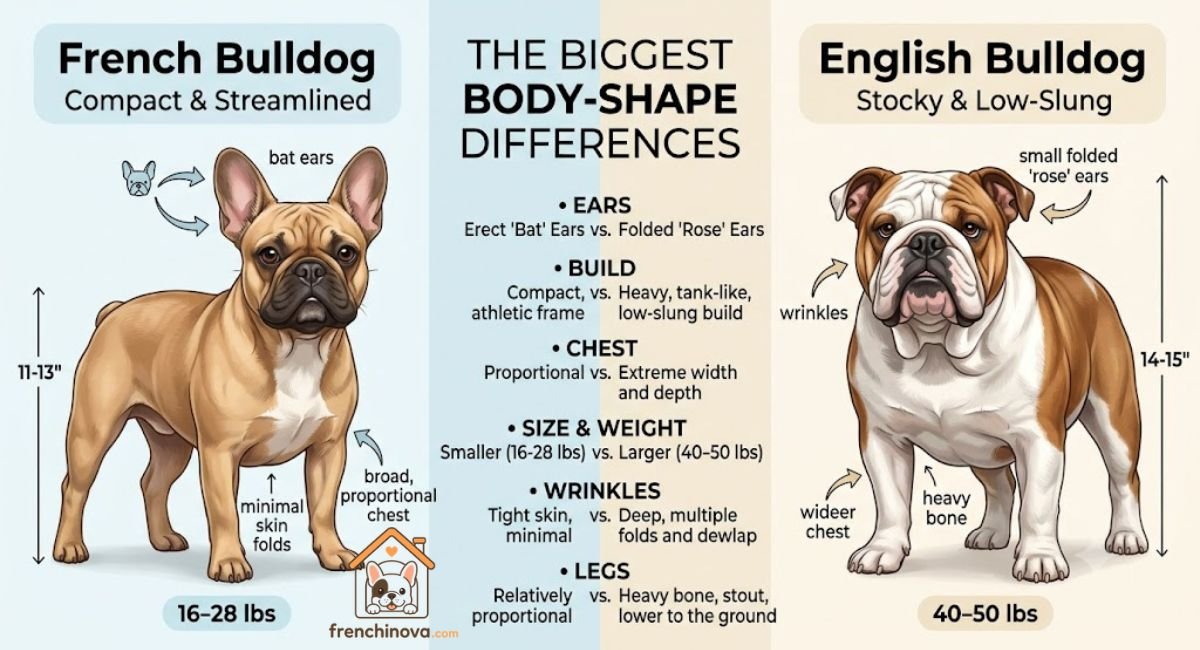
| Feature | French Bulldog | English Bulldog |
| Height | 11–13 inches | 14–15 inches |
| Weight | 16–28 lbs | 40–50 lbs |
| Build | Compact, athletic-looking | Stocky, heavy, low-slung |
| Chest | Broad but proportional | Very wide and deep |
| Skin folds | Tight skin, few folds | Heavy wrinkles, loose dewlap |
| Ears | Erect “bat ears” | Folded “rose ears” |
| Tail | Short, straight or screw | Short, straight or screw |
| Lifespan | 10–12 years | 8–10 years |
The English Bulldog is built like a tank, wider chest, heavier bone, lower to the ground. The Frenchie is the streamlined, mini version: same family, very different frame.
Frenchie vs. American Bulldog: A Bigger Gap Than People Think
American Bulldogs throw the comparison off because they’re a working breed, bred for farm work, not companionship.
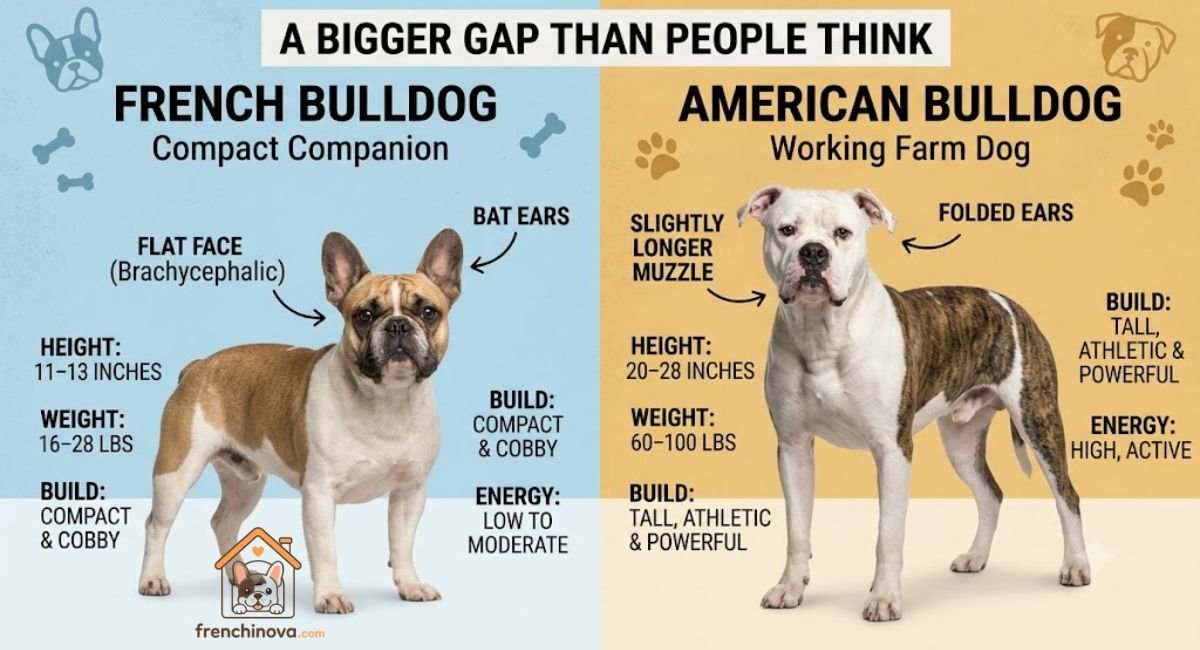
| Feature | French Bulldog | American Bulldog |
| Height | 11–13 inches | 20–28 inches |
| Weight | 16–28 lbs | 60–100 lbs |
| Build | Compact, cobby | Tall, athletic, powerful |
| Face | Flat, brachycephalic | Slightly longer muzzle |
| Energy | Low to moderate | High, active |
A standard American Bulldog can weigh four times what a Frenchie weighs. They share the bulldog name and the broad chest, but the American Bulldog is a different working animal entirely. Their faces are also less brachycephalic, meaning fewer breathing issues than Frenchies or English Bulldogs.
Frenchie vs. Olde English Bulldogge: The Modern Hybrid
The Olde English Bulldogge is a relatively new breed (developed in the 1970s) meant to recreate a healthier, more athletic version of the old working bulldog.
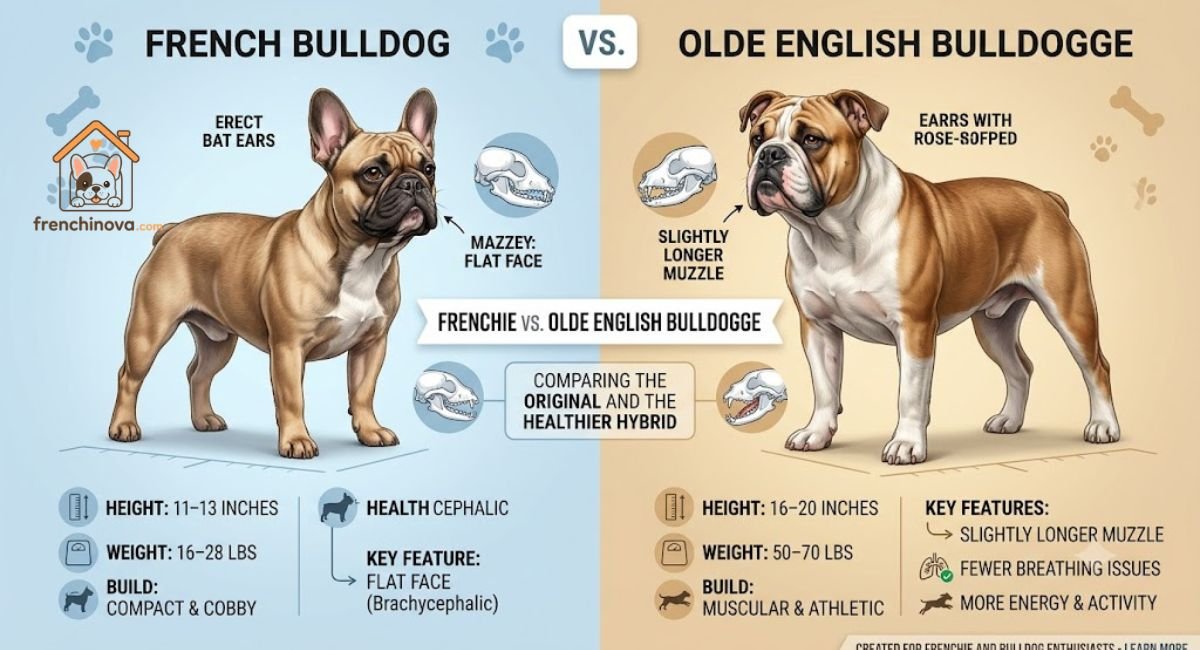
- Height: 16–20 inches
- Weight: 50–70 lbs
- Build: Muscular, athletic, less brachycephalic than the modern English Bulldog
- Compared to Frenchie: Twice the size, longer muzzle, more energy, fewer breathing issues
Owners who love the bulldog look but want a more active, healthier dog often land here. Body-shape-wise, an Olde English Bulldogge looks like an English Bulldog stretched taller and leaner.
Frenchie vs. Boston Terrier: The Body Mix-Up
This is the comparison that catches new owners off guard. The Boston Terrier and the French Bulldog share an ancestor and look strikingly similar.
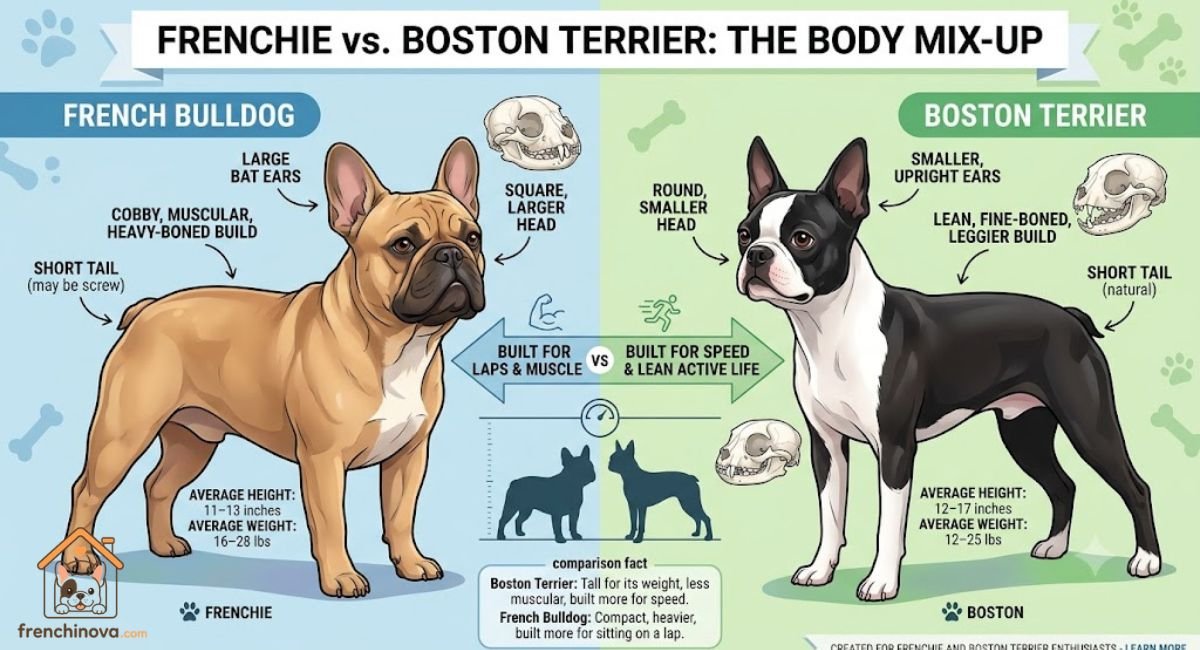
| Feature | French Bulldog | Boston Terrier |
| Height | 11–13 inches | 12–17 inches |
| Weight | 16–28 lbs | 12–25 lbs |
| Build | Cobby, muscular, heavy-boned | Lean, fine-boned, leggier |
| Head | Square, larger | Round, smaller |
| Ears | Large bat ears | Smaller, upright ears |
| Tail | Short, may be screw | Short, naturally |
A Boston Terrier looks like a Frenchie’s lighter cousin, taller for its weight, less muscular, and built more for speed than for sitting on a lap.
Is Your Frenchie’s Body Shape Normal? A Quick Self-Check
Run through this list. A normal Frenchie should:
- Stand 11–13 inches at the shoulder as an adult
- Have a clear waist when viewed from above (slight hourglass behind the ribs)
- Have a topline that rises slightly toward the hips, not a sway or hump
- Have legs that are short and straight, not bowed or knock-kneed
- Have a chest broader than the hips (pear-shaped from above)
- Have ribs that can be felt with light pressure, not seen across the room
- Move easily without wobbling, hopping, or struggling to get up
If two or more of those check out as “off,” the body shape may signal a health or weight issue worth a vet visit.
👉 Compare your puppy’s body growth to the breed curve with the Puppy Weight Calculator.
Puppy growth tracker
Predict your puppy’s adult weight
When Frenchie Body Shape Signals a Problem
Some body changes look cosmetic but actually point to a health concern.
Red flags to watch for
- Visible ribs, spine, or hip bones: underweight, possibly from parasites, food intolerance, or illness
- Round, sagging belly with thin legs: possible Cushing’s disease, heart issues, or pregnancy
- Hunched topline (severe roach): back pain, spinal issue, or hemivertebrae (common in Frenchies)
- Bowed front legs: may indicate chondrodysplasia or improper growth plate development
- Pear-shaped body with no waist: overweight, very common in Frenchies and dangerous for a brachycephalic breed
- Asymmetry between left and right side: possible muscle wasting from old injury or nerve issue
A Frenchie carrying even 4–6 extra pounds is medically considered obese and at significantly higher risk for breathing problems, joint damage, and heart disease.
👉 Confirm your Frenchie’s healthy weight range and calorie needs with the Dog Calorie Calculator.
Daily calorie needs
How many calories does your dog need?
How Body Shape Changes With Age (Frenchie Body Shape vs. Other Bulldogs)
A Frenchie’s body looks slightly different at each life stage, and that’s normal.
Puppy (0–6 months)
Lean, gangly, sometimes a little awkward. Ribs may be visible. Don’t panic, puppies aren’t supposed to look like mini adult Frenchies yet.
Adolescent (6–12 months)
Filling out the chest and shoulders. This is when most owners worry the dog is “too skinny”, but it’s typically just growth catching up.
Adult (1–7 years)
Full breed-standard shape: compact, muscular, with a clear waist and broad chest.
Senior (7+ years)
Some muscle loss is normal. The topline may flatten, the belly may sag slightly, and the dog may look thinner around the shoulders. Sudden, dramatic shape changes still warrant a vet check.
👉 Check your Frenchie’s life stage in human-equivalent years with the Dog Age Calculator.
Dog years to human years
Convert your dog’s age accurately
Common Misconceptions About Frenchie Body Shape
A few myths worth clearing up:
- “My Frenchie is too skinny, Frenchies are supposed to be chunky.” False. A healthy Frenchie has a waist, defined musculature, and ribs you can feel. Chunky is overweight, not breed-standard.
- “Bigger Frenchies are better Frenchies.” No. An oversized Frenchie (35+ lbs) is usually overweight or crossed with another breed. The AKC standard caps at 28 lbs for a reason.
- “The roach back means something’s wrong.” A slight roach is correct. A sharp hunch or sway is not.
- “Smaller Frenchies are ‘mini Frenchies.'” There’s no official “mini” or “teacup” Frenchie. Undersized Frenchies are often the result of unethical breeding and may carry serious health risks.
Final Thoughts
A normal Frenchie body is compact, muscular, broad-chested, and built lower than other Bulldogs. They’re not supposed to look like a mini English Bulldog, and they shouldn’t look like a Boston Terrier either. They’re their own breed with their own proportions.
If a Frenchie checks the breed-standard boxes and has a healthy body condition score, the shape is doing its job. If something looks off, weight, posture, symmetry, or movement, a vet check beats guessing every time.
Body condition score
Check your Frenchie’s body condition
Puppy growth tracker
Predict your puppy’s adult weight
Daily calorie needs
How many calories does your dog need?
Dog years to human years
Convert your dog’s age accurately
This guide is informational and not a substitute for veterinary advice. Any persistent body-shape change in a French Bulldog should be evaluated by a licensed veterinarian.

Auston is the founder of Frenchie Nova and a longtime French Bulldog owner. He writes practical, research-backed guides on Frenchie care, feeding, and health. Not a veterinarian — always consult your vet for medical concerns.