


A Frenchie owner’s first year with a puppy comes with one question on a near-constant loop: is my Frenchie growing the right way? Most charts online start at one month, skip the newborn weeks entirely, and give a single number per age band that doesn’t actually tell anyone whether their puppy is on track.
This guide French Bulldog Puppy Weight Chart by Month does it differently. Every week from birth, every month from 1 to 12, both male and female ranges, the formulas that predict adult size, the calorie targets that match each weight band, and the warning signs that mean a vet visit. The goal is one chart owners can actually use, not just look at.
Table of Contents
How Big Do French Bulldogs Get?
Before the chart matters, the destination matters. Most full-grown Frenchies land between 16 and 28 pounds (7.3–12.7 kg) and stand 11 to 13 inches tall at the shoulder. Males usually weigh 3–5 pounds more than females, but height stays roughly the same across sexes.
A few quick anchor points the rest of this guide builds on:
- Newborn: 6–9 oz (under 1 lb)
- 8 weeks (typical adoption age): 4–7 lb
- 6 months: 13–22 lb (80% of adult weight)
- 12 months: 17–28 lb (near full adult size)
- Fully grown: 12–14 months for weight, with some muscle filling out until 18–24 months
Anything significantly outside these ranges is worth a vet conversation, especially in the early months.
Newborn to 8 Weeks: The Weekly Weight Chart
Most charts skip this window because puppies are still with their breeder. But for breeders, foster carers, or owners taking home an early-adoption puppy, the first 8 weeks are when growth concerns are most urgent. A Frenchie that isn’t doubling its birth weight in the first 7–10 days needs vet attention.
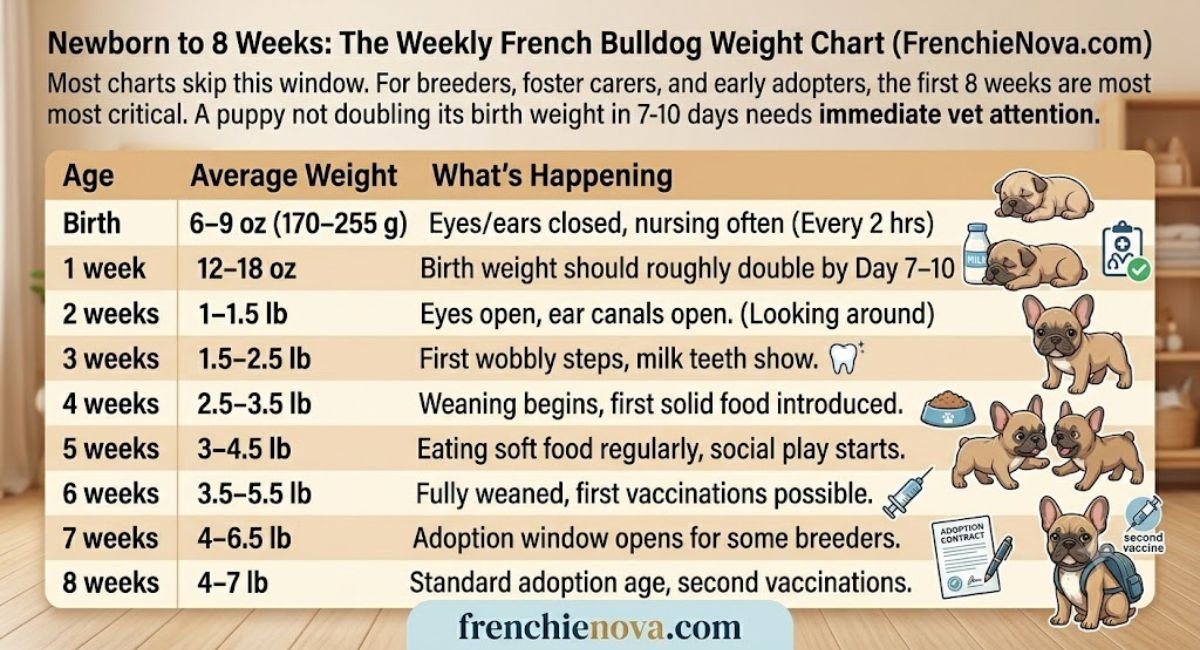
| Age | Average Weight | What’s Happening |
| Birth | 6–9 oz (170–255 g) | Eyes and ears closed, nursing every 2 hours |
| 1 week | 12–18 oz | Birth weight should roughly double by day 7–10 |
| 2 weeks | 1–1.5 lb | Eyes start opening, ear canals open |
| 3 weeks | 1.5–2.5 lb | First wobbly steps, milk teeth start showing |
| 4 weeks | 2.5–3.5 lb | Weaning begins, first solid food introduced |
| 5 weeks | 3–4.5 lb | Eating soft food regularly, social play starts |
| 6 weeks | 3.5–5.5 lb | Fully weaned, first vaccinations possible |
| 7 weeks | 4–6.5 lb | Adoption window opens for some breeders |
| 8 weeks | 4–7 lb | Standard adoption age, second vaccinations |
If a Frenchie puppy is consistently below the lower end of the range for its age, the most common causes are inadequate nursing time, parasites, or hypoglycemia, all worth a vet visit, not a wait-and-see approach.
Frenchie Puppy Weight Chart by Month (1 to 12 Months) French Bulldog Puppy Weight Chart
This is the main chart most owners come looking for. Numbers reflect the typical range vets and breeders cite, with male and female split because the gap widens noticeably from month 3 onward.
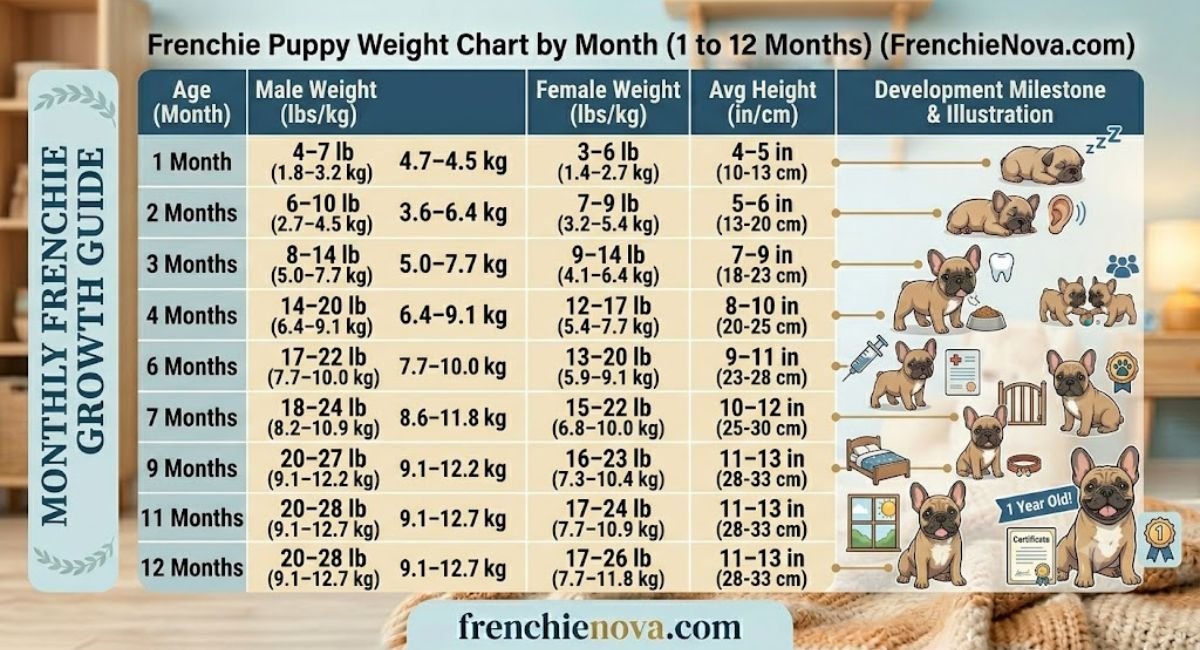
| Age | Male Weight | Female Weight | Avg Height |
| 1 month | 4–7 lb (1.8–3.2 kg) | 3–6 lb (1.4–2.7 kg) | 4–5 in |
| 2 months | 6–10 lb (2.7–4.5 kg) | 5–9 lb (2.3–4.1 kg) | 5–6 in |
| 3 months | 8–14 lb (3.6–6.4 kg) | 7–12 lb (3.2–5.4 kg) | 6–8 in |
| 4 months | 11–17 lb (5.0–7.7 kg) | 9–14 lb (4.1–6.4 kg) | 7–9 in |
| 5 months | 14–20 lb (6.4–9.1 kg) | 12–17 lb (5.4–7.7 kg) | 8–10 in |
| 6 months | 17–22 lb (7.7–10.0 kg) | 13–20 lb (5.9–9.1 kg) | 9–11 in |
| 7 months | 18–24 lb (8.2–10.9 kg) | 14–21 lb (6.4–9.5 kg) | 10–12 in |
| 8 months | 19–26 lb (8.6–11.8 kg) | 15–22 lb (6.8–10.0 kg) | 10–12 in |
| 9 months | 20–27 lb (9.1–12.2 kg) | 16–23 lb (7.3–10.4 kg) | 11–13 in |
| 10 months | 20–28 lb (9.1–12.7 kg) | 17–24 lb (7.7–10.9 kg) | 11–13 in |
| 11 months | 20–28 lb (9.1–12.7 kg) | 17–25 lb (7.7–11.3 kg) | 11–13 in |
| 12 months | 20–28 lb (9.1–12.7 kg) | 17–26 lb (7.7–11.8 kg) | 11–13 in |
Puppy growth tracker
Predict your puppy’s adult weight
A few read-the-chart tips:
- The 4-month mark is the rough halfway point. Most Frenchies reach about 50% of their adult weight by 4 months.
- The 6-month mark is roughly 80% of adult weight. Growth dramatically slows after this.
- Height stops first, weight stops second. Height plateaus around 9–10 months; weight keeps filling out until 12–14 months.
How to Predict a Frenchie’s Adult Weight
Three formulas show up across veterinary and breeder sources. None is perfect, genetics, diet, and individual variation always have the final word, but together they bracket a realistic range.
Formula 1: The Double Up Formula (best for 4-month-old Frenchies)
Take the puppy’s weight at 4 months and double it.
Example: a 4-month-old Frenchie weighing 13 lb is likely to land near 26 lb as an adult.
Formula 2: The Four Fold Formula (best at 8 weeks)
Take the puppy’s weight at 8 weeks (2 months) and multiply by 4.
Example: a 2-month-old at 7 lb projects to roughly 28 lb adult weight.
Formula 3: The Weeks × 52 Formula (best for early estimates, especially in small breeds)
Adult weight ≈ (current weight ÷ age in weeks) × 52
Example: a 16-week-old at 12 lb → (12 ÷ 16) × 52 = 39 lb. This formula overestimates for short-statured breeds like Frenchies, so it works better as an upper-bound check than a true target.
The most reliable predictor isn’t a formula at all, it’s the parents. Female Frenchie puppies tend to land close to the dam’s adult weight; male puppies tend to land close to the sire’s. If both parents are 25 lb, expecting a 30-lb puppy is unrealistic. If both are at the lighter end, the puppy will most likely follow.
Calorie Needs by Weight Stage
A weight chart isn’t useful without the feeding piece, most puppy weight problems come from a mismatch between portion size and growth phase.

| Age | Average Weight | Daily Calories | Meals/Day |
| 2 months | 5–9 lb | 250–400 kcal | 4 |
| 3 months | 7–14 lb | 350–550 kcal | 3–4 |
| 4 months | 9–17 lb | 400–650 kcal | 3 |
| 6 months | 13–22 lb | 500–750 kcal | 3 |
| 9 months | 16–27 lb | 550–700 kcal | 2–3 |
| 12 months | 17–28 lb | 500–650 kcal | 2 |
Puppy food should meet AAFCO growth standards: a minimum of 22% protein and 8% fat by dry matter, plus a balanced calcium-to-phosphorus ratio for proper bone development. Most Frenchies do best on a small-breed puppy formula until 10–12 months, then transition to adult food over 7–10 days.
Daily calorie needs
How many calories does your dog need?
How to Weigh a Frenchie Puppy at Home
Most pet scales only handle exact small-puppy weights well, for older puppies, the at-home method most vets recommend is the bathroom scale subtraction trick:
- Step on a digital bathroom scale alone and note the number.
- Step on, holding the puppy, and note the new number.
- Subtract.
For accuracy, do it at the same time of day (ideally morning, before breakfast) and on the same scale. Weighing weekly during puppyhood, monthly during adolescence, and quarterly in adulthood gives a clean trendline that catches problems early.
A handy reference: every 1 lb gain in a Frenchie puppy is roughly the equivalent of a 7–8 lb gain in a grown adult human. Small swings matter.
Signs a Frenchie Puppy Is Growing Too Fast or Too Slow
Both ends of the spectrum carry real risks. Frenchies are chondrodystrophic, short-legged with a compact build, which means too-rapid growth puts unusual strain on developing joints and spine.
Signs of growth happening too fast:
- Weight consistently above the high end of the chart for the age
- Rounded belly and no visible waist
- Difficulty feeling the ribs through a light layer of skin
- Loose joints, splayed legs, or a “bunny hop” walking pattern
- Picky eating because portions are too generous
Signs of growth happening too slowly:
- Weight consistently below the low end of the chart for the age
- Visible ribs, spine, or hip bones
- Lethargy or low energy compared to littermates
- Poor coat quality (dull, sparse)
- Frequent diarrhea or vomiting
Either pattern is worth a vet conversation, not an internet diagnosis. Both can be reversed quickly when caught early.
When to Call the Vet About Puppy Weight
Specific triggers, not vague worry, should prompt a vet visit:
- No weight gain in 5–7 consecutive days during the first 6 months
- Weight drop of more than 5% at any point during puppyhood
- Refusal to eat for more than 24 hours (Frenchie puppies are vulnerable to hypoglycemia, especially the smallest ones)
- Tracking 30%+ below the chart range for the puppy’s age and sex
- Tracking 30%+ above the chart range consistently (early-onset obesity in a brachycephalic breed creates BOAS and joint problems fast)
The earlier these get caught, the simpler the fix usually is.
What About “Miniature” or “Teacup” French Bulldogs?
The “miniature” and “teacup” Frenchie labels show up constantly in marketing, rarely in veterinary literature. There is no AKC-recognized miniature French Bulldog standard. Most “teacup” Frenchies are produced through one of three methods: breeding the runts of consecutive litters, crossing with smaller breeds like the Chihuahua, or selecting for the dwarfism gene.
All three approaches carry real health costs, narrower airways (worse BOAS), more fragile spines (worse IVDD risk), and shorter lifespans. A Frenchie that grows up to weigh 12 lb instead of the typical 22 isn’t a bonus feature; it’s often a sign of compromised breeding. Owners shopping for a Frenchie are better off finding a reputable breeder producing standard-size dogs than chasing a smaller version that comes with bigger health bills.
Factors That Affect Frenchie Puppy Growth
Beyond the chart, a handful of variables shift where a specific puppy lands:
Genetics.
Parents’ adult weights are the single best predictor. Reputable breeders share both sire and dam weights freely.
Nutrition quality.
Puppy formulas with AAFCO-compliant labels, real meat as the first ingredient, and a 1.2–1.5:1 calcium-to-phosphorus ratio support steady, healthy growth.
Spay/neuter timing.
Early spay/neuter (before 6 months) can subtly affect growth plate closure and lifetime metabolic rate. Most veterinarians now recommend waiting until at least 9–12 months in Frenchies, but this conversation belongs with a vet who knows the breed.
Health conditions.
Persistent parasites, allergies, or undiagnosed conditions like hypothyroidism can slow growth. Sudden growth jumps can occasionally signal Cushing’s disease in older puppies.
Activity level.
Puppies need controlled play, not intense daily workouts. Over-exercising a growing Frenchie puts strain on developing growth plates and joints.
When Do Frenchies Stop Growing?
Most Frenchies finish growing in two distinct phases:
- Height stops first, usually between 9 and 10 months
- Weight finishes filling out between 12 and 14 months
- Muscle development continues until 18–24 months in some dogs
By the time the growth plates close (typically 8–12 months in this breed), the skeleton is locked in. After that, any weight change is body composition, fat or muscle, not actual growth.
Quick Reference Card: Frenchie Puppy Milestones
For owners who want the essentials at a glance:
- Newborn weight: 6–9 oz
- Birth weight should double by: day 7–10
- Standard adoption age: 8 weeks (4–7 lb)
- 50% adult weight reached at: 4 months
- 80% adult weight reached at: 6 months
- Growth plates close: 8–12 months
- Height plateaus: 9–10 months
- Full adult weight: 12–14 months
- Full muscle maturity: 18–24 months
- Final adult weight: 16–28 lb (males higher, females lower)
Body condition score
Check your Frenchie’s body condition
The Bottom Line
A French Bulldog puppy weight chart is most useful when it stops being a number on a screen and becomes a weekly habit. Owners who weigh consistently, log the trend, and compare against the male or female range catch problems early, when they’re cheap and simple to fix. Numbers that drift outside the range aren’t automatically an emergency, but they’re always a conversation worth having with a vet.
The full picture: a typical Frenchie starts around half a pound at birth, hits 80% of adult weight by 6 months, finishes growing in height by 9–10 months, and lands somewhere between 16 and 28 pounds by their first birthday, give or take a few pounds for genetics and lean body composition.
For the math behind a specific puppy’s likely adult weight, the Puppy Weight Calculator handles it. For matching that weight to a daily calorie target, the Dog Calorie Calculator runs the numbers. For ongoing body condition checks once the puppy hits adulthood, the BCS Calculator keeps things honest. And for the full picture of where this stage fits in a Frenchie’s lifetime, the French Bulldog Life Stages guide pulls it all together.
Puppy growth tracker
Predict your puppy’s adult weight
Daily calorie needs
How many calories does your dog need?
Dog years to human years
Convert your dog’s age accurately
Body condition score
Check your Frenchie’s body condition
This guide draws on veterinary growth data published by Pawlicy Advisor, the Puppy Growth Calculator (vet-reviewed by Dr. Jennifer Coates), iHeartDogs, TomKings Kennel, and Frenchie Box, plus AAFCO puppy nutrition standards and current veterinary guidance on brachycephalic breed development. Always consult a veterinarian for individualized growth concerns, especially in the first 8 weeks and around spay/neuter timing.

Auston is the founder of Frenchie Nova and a longtime French Bulldog owner. He writes practical, research-backed guides on Frenchie care, feeding, and health. Not a veterinarian — always consult your vet for medical concerns.