


A new Frenchie owner stares at the puppy curled up on the couch, barely the size of a loaf of bread, and asks the question every Frenchie parent eventually asks: how big is this little one going to get?
Most online charts give the same answer: 16 to 28 pounds, 11 to 13 inches tall, fully grown by 12 months. Technically correct. Practically useless, because every Frenchie hits those numbers differently, and a lot of them don’t land neatly inside that range at all.
This guide How Big Will My French Bulldog Get goes past the chart. It covers the real size prediction methods breeders use, what actually affects how big a Frenchie ends up, and the truth about mini Frenchies, oversized Frenchies, and everything in between.
The Short Answer: How Big Frenchies Get
A fully grown French Bulldog typically lands in this range, according to the American Kennel Club (AKC) breed standard:
- Height: 11 to 13 inches at the shoulder
- Weight: 16 to 28 pounds (males slightly heavier)
- Body shape: Compact, muscular, heavy-boned for the size
That’s the average. But “average” hides a lot of variation, and Frenchies outside this range are common, sometimes healthy, sometimes not.
Month-by-Month French Bulldog Growth Chart (How Big Will My French Bulldog Get?)
Here’s what a typical Frenchie puppy looks like at each stage. These are estimates, not targets, most puppies sit anywhere within the range.
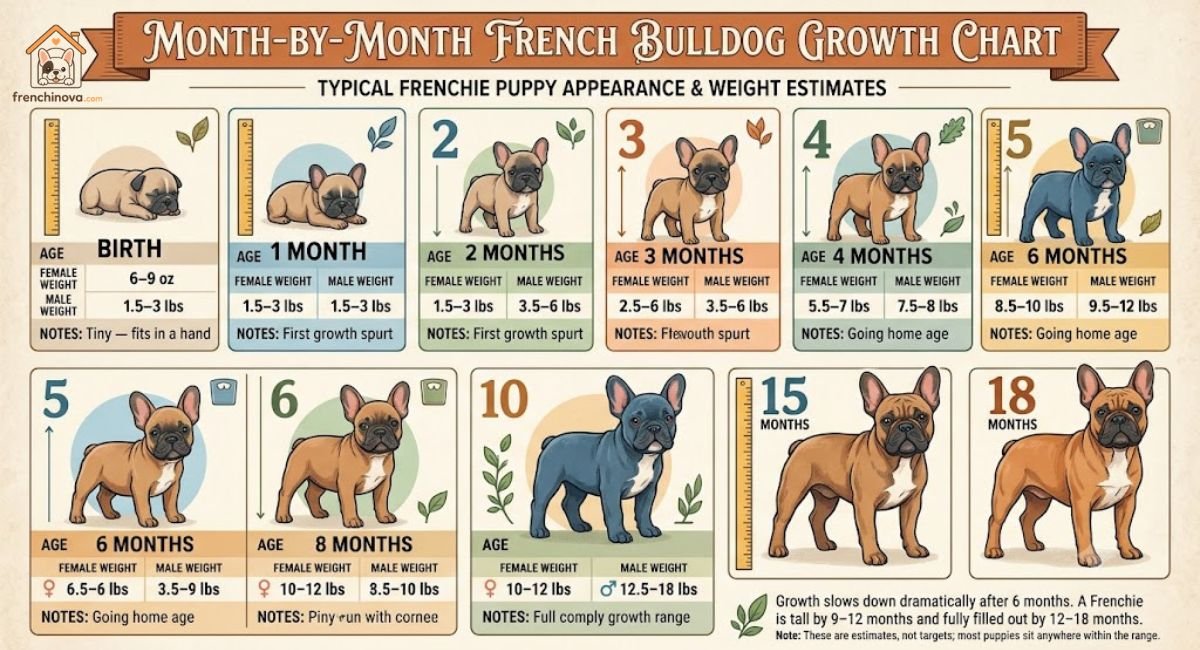
| Age | Female Weight | Male Weight | Notes |
| Birth | 6–9 oz | 6–9 oz | Tiny — fits in a hand |
| 1 month | 1.5–3 lbs | 1.5–3 lbs | First growth spurt |
| 2 months | 3.5–6 lbs | 4–7 lbs | Going home age |
| 3 months | 5–9 lbs | 6–10 lbs | Major growth phase |
| 4 months | 8–13 lbs | 9–15 lbs | Often the fastest gain |
| 6 months | 12–20 lbs | 15–22 lbs | Adolescent, looks leggy |
| 9 months | 15–23 lbs | 18–25 lbs | Near full height |
| 12 months | 16–25 lbs | 20–28 lbs | Mostly there |
| 18 months | 17–28 lbs | 22–30 lbs | Filled out, mature |
Growth slows down dramatically after 6 months. A Frenchie is tall by 9–12 months and fully filled out by 12–18 months.
Puppy growth tracker
Predict your puppy’s adult weight
A Realistic Method to Predict Adult Size
The standard advice is “look at the parents.” That’s a start, but not enough. Here’s a more reliable four-part method:
1. Parents’ actual adult weight
The single best predictor. Ask the breeder for both parents’ adult weights, not estimates. Most Frenchies land within 2–3 pounds of their parents’ average.
2. The double-by-four rule
A Frenchie’s weight at 4 months old, doubled, is a rough estimate of adult weight. A puppy that weighs 10 lbs at 4 months is likely to end up around 20 lbs as an adult.
3. Paw size check
Stand the puppy on a flat surface and look at the paws relative to the legs. If the paws look oversized for the legs, the puppy still has growing to do. Once the paws look proportional, growth is mostly finished.
4. Litter position
The largest puppy in a litter usually ends up slightly larger than average. The runt usually ends up slightly smaller, though most runts catch up by 6 months.
Combine all four signals, not just one, and the prediction becomes a lot more accurate.
Puppy growth tracker
Predict your puppy’s adult weight
What Actually Affects How Big a Frenchie Gets
A few real factors push final size up or down, and most have nothing to do with feeding more food.
Genetics (the biggest factor)
About 60–70% of final size is locked in by genes. Parents, grandparents, and littermates are the best clue.
Nutrition during the first 6 months
This is when most growth happens. A puppy on low-quality food will hit a smaller final size, not because they’re naturally small, but because they didn’t have the fuel. Puppies need high-quality puppy food with the right protein-to-fat ratio (around 25–30% protein, 15–18% fat).
Neuter or spay timing
Frenchies neutered before 6 months sometimes grow slightly taller because the growth plates stay open a bit longer. Many vets now recommend waiting until at least 12 months for this reason.
Illness or parasites during puppyhood
A puppy that fought parasites (coccidia, Giardia, worms) or had repeated GI issues often ends up smaller than predicted. Catching and treating these early matters.
Overexercising
Sounds counterintuitive, but too much hard exercise, long runs, stairs, jumping, before 12 months can cause premature growth plate closure, leading to a shorter adult dog.
Sex
Males average 2–4 pounds heavier than females. Females also tend to mature slightly faster.
The Truth About Mini and Teacup Frenchies
There is no official “mini,” “micro,” or “teacup” French Bulldog recognized by the AKC, FCI, or any major kennel club. When breeders advertise these, the small size usually comes from one of three things:
- Breeding the runts of multiple litters: passes down genetic weakness
- Breeding dogs with dwarfism (chondrodysplasia): causes joint issues, back problems, and breathing difficulties
- Mixing with smaller breeds: these aren’t purebred Frenchies even when marketed as such
Undersized Frenchies (under 14 lbs as adults) often live shorter lives and carry higher veterinary costs. A normal-sized Frenchie at 18–24 pounds is small enough for apartment life, there’s no real need for “mini.”
What If My Frenchie Ends Up Oversized?
The opposite extreme also happens. A Frenchie over 30 pounds is usually one of three things:
- Overweight: The most common reason. Frenchies pack on weight fast, and 4–6 extra pounds is medically obese for the breed.
- Mixed breed: A Frenchton (Frenchie + Boston Terrier) or Frenchie + Pug cross often sits 30–35 lbs.
- From a larger genetic line: Some American Frenchie lines, particularly show lines, run heavier-boned.
Carrying excess weight is dangerous for any brachycephalic breed. Frenchies already struggle with breathing, joint stress, and heat tolerance, extra pounds make all three worse.
Daily calorie needs
How many calories does your dog need?
When Is a French Bulldog Fully Grown?
This trips up many owners because Frenchies finish growing in two stages.
- Height (skeletal growth): Complete by 9–12 months. The Frenchie is as tall as they’ll ever be.
- Weight (muscle and bone filling out): Complete by 12–18 months. Some Frenchies keep filling out until 24 months, especially males.
If a Frenchie still looks gangly or “skinny” at 10 months, they’re not undersized, they’re still filling out. Patience pays off here.
Dog years to human years
Convert your dog’s age accurately
Signs Your Frenchie’s Size Might Be a Problem
Most size variation is normal. But a few patterns mean a vet visit is in order:
- Sudden weight loss of more than 5% in a week
- No weight gain for 4+ weeks in a growing puppy
- Visible ribs, spine, or hip bones in an adult
- Sagging belly with thin legs (possible Cushing’s or heart issue)
- Failure to grow in height at all by 6 months (possible chondrodysplasia)
- Sudden weight gain of 2+ pounds in a week as an adult
The body condition score (BCS), a 1-to-9 scale used by vets, is a better signal than weight alone.
Body condition score
Check your Frenchie’s body condition
Common Questions Frenchie Owners Ask
At what age is a French Bulldog fully grown?
Most Frenchies reach full height by 9–12 months and full weight by 12–18 months. Males may continue to fill out until 24 months.
Can I predict my Frenchie’s adult size from paw size alone?
Not reliably on its own. Paw size combined with parents’ weight, current weight at 4 months, and growth pattern gives a much better estimate.
Do male and female Frenchies grow differently?
Yes, slightly. Females mature faster and end up 2–4 pounds lighter on average. Males take longer to fill out their chest and shoulders.
Will neutering early stunt my Frenchie’s growth?
Early neutering (before 6 months) can actually make a Frenchie slightly taller due to delayed growth plate closure, but it may come with joint health trade-offs. Many vets now recommend waiting until 12+ months.
My Frenchie is over 30 lbs, is something wrong?
Probably overweight, possibly mixed-breed, occasionally a heavier genetic line. A vet visit clarifies which one quickly.
Final Thoughts
A French Bulldog’s adult size is mostly written into their genes by the time they’re born, but the path to that size depends on nutrition, vet care, and timing. The 16-to-28-pound chart is a useful guide, not a guarantee, and Frenchies who land outside it aren’t automatically a problem.
The healthiest Frenchies are the ones who grow at their own pace, hit a body condition score around 4–5 out of 9, and stay within their genetic blueprint, not the ones forced toward an “ideal” number on a scale.
This guide is informational and not a substitute for veterinary advice. Any concern about a French Bulldog’s growth or size should be discussed with a licensed veterinarian.
Puppy growth tracker
Predict your puppy’s adult weight
Daily calorie needs
How many calories does your dog need?
Dog years to human years
Convert your dog’s age accurately
Body condition score
Check your Frenchie’s body condition
Table of Contents

Auston is the founder of Frenchie Nova and a longtime French Bulldog owner. He writes practical, research-backed guides on Frenchie care, feeding, and health. Not a veterinarian — always consult your vet for medical concerns.