


It’s a hot afternoon, you’re slicing a cucumber for a salad, and a hopeful Frenchie face appears at your feet. Before you share a slice, the sensible question: can French Bulldogs actually have cucumbers?
Yes, cucumbers are one of the best treats you can give a Frenchie. They’re safe, hydrating, and so low in calories they’re practically guilt-free, which matters a lot for a breed that gains weight easily. There are just a couple of simple serving rules to keep in mind, mostly around size and moderation.
This guide covers whether Cucumbers Safe for French Bulldogs, why they’re good for your Frenchie, the small risks to watch for, and exactly how to serve them.
Table of Contents
Can French Bulldogs Eat Cucumbers? The Short Answer
Yes. Cucumbers are safe and healthy for French Bulldogs to eat in moderation. They’re non-toxic, low in calories, and made up of about 96% water, which makes them a refreshing, hydrating snack, especially useful for a flat-faced breed that can overheat in warm weather.
In fact, cucumbers are close to an ideal Frenchie treat. The main things to get right are cutting them into manageable pieces (to avoid choking) and not overdoing the quantity (to avoid an upset stomach). Beyond that, they’re about as safe as a treat gets.
Why Cucumbers Are Good for French Bulldogs
Cucumbers are what some vets call a “functional treat”, they do more than just taste good. For a breed with a tendency toward overheating, weight gain, and food sensitivities, cucumber checks a surprising number of boxes.
Cucumbers are a genuinely beneficial treat for French Bulldogs, they’re 96% water (great for a breed prone to overheating), only about 8 calories per half-cup (ideal for weight management), and offer vitamin K, vitamin C, magnesium, and digestion-supporting fiber.
Hydration
At roughly 96% water, cucumbers are one of the most hydrating snacks you can offer. This matters more for a Frenchie than for most breeds.
- Brachycephalic dogs struggle to cool down efficiently because their shortened airways make panting, a dog’s main cooling mechanism, less effective.
- This puts Frenchies at higher risk of overheating and heat stroke, especially in hot or humid weather.
- A few chilled cucumber slices on a warm day can be a small but genuine assist in keeping your dog hydrated and comfortable, on top of regular water intake.
Very Low-Calorie
With only around 8 calories per half-cup, cucumbers are one of the lowest-calorie treats you can give a dog.
- French Bulldogs are a weight-prone breed; their low activity tolerance and stocky build mean excess weight adds up quickly and puts extra strain on joints and breathing.
- Cucumber satisfies the urge to treat without the calorie load of a biscuit or commercial jerky treat, which can run 20-40+ calories per piece.
- This makes it a smart substitute during training sessions where you’d otherwise be handing out multiple higher-calorie treats in a row.
Vitamins and Minerals
Cucumbers aren’t nutritionally empty, they carry a modest but useful micronutrient profile.
- Vitamin K supports proper blood clotting and bone health.
- Vitamin C contributes to immune function, though healthy dogs already produce their own, so this is a minor bonus rather than a necessity.
- Magnesium plays a role in muscle and nerve function, as well as energy metabolism.
- None of these replace a complete diet, but they add a small nutritional edge over “empty” treats.
Fiber for Digestion
Cucumber’s fiber content is modest compared to something like pumpkin, but it’s still meaningful.
- Supports regular bowel movements by adding gentle bulk to the digestive process.
- Can help firm up stool in dogs with mild, occasional digestive irregularity.
- As covered in the risks section, this same fiber (plus water content) is why overfeeding can tip into the opposite problem, moderation is key.
Crunch
Texture matters more than owners often realize when it comes to treats.
- The audible crunch and resistance mimic the satisfaction of a biscuit without the calories or additives.
- This makes cucumber an effective low-stakes training reward, small, fast to eat, and easy to portion out repeatedly during a session without overfeeding.
- Many dogs also enjoy the cold, refreshing texture straight from the fridge, which can double as a warm-weather enrichment snack.
Cucumber isn’t just filler, it’s one of the few treats that actively works in a Frenchie’s favor. The hydration helps offset heat sensitivity, the low calorie count keeps weight gain in check, and the light nutrient and fiber content adds real value without any downside when fed in moderation. Combined with its satisfying crunch, it’s an easy swap for calorie-dense treats, especially during training.
Read our Guide Can French bulldog eat Rice
Cucumber Risks for French Bulldogs: What to Watch For
Cucumbers are one of the safer human foods to share with a Frenchie, but their body shape and eating habits mean a few precautions matter more than they would for other breeds.
Yes, cucumber is safe for French Bulldogs in small, plain, peeled pieces. The main risks are choking (cut into bite-sized pieces), digestive upset from overfeeding, and pesticide residue (wash or peel). Never feed a pickled or seasoned cucumber.
Choking: The Main Risk
French Bulldogs have a flat, brachycephalic face and a narrower airway than most breeds, which makes them more prone to gulping food rather than chewing it thoroughly. A whole cucumber slice or a large chunk can lodge in the throat.
- Cut into small, bite-sized pieces, think coin-sized or smaller for puppies and adult Frenchies alike.
- Never leave a whole cucumber unsupervised with your dog, even if it seems too big to swallow.
- Watch first-time feedings closely to see how your dog handles the texture.
Digestive Upset from Overfeeding
Cucumbers are roughly 95% water and contain a fair amount of fiber. That combination is great in moderation, but can backfire if you’re generous with portions.
- Start with a few small pieces and monitor stool consistency over the next 24 hours.
- Watch for gas, loose stools, or a mildly upset stomach, these are the most common signs of overdoing it.
- Treat cucumber as an occasional snack, not a daily staple, especially for Frenchies with already-sensitive digestion.
Skin and Seeds
The outer skin is tougher and more fibrous than the flesh, and the seeds add extra bulk that a small dog’s gut has to process.
- Peel the cucumber before feeding, particularly for puppies or dogs with a history of digestive sensitivity.
- Scoop out the seeds if the cucumber is more mature (seeds get larger and tougher as cucumbers grow).
- Doing both reduces choking risk and fiber load at the same time, making it easier on your Frenchie’s stomach.
Pesticides and Seasoning
What’s on or in the cucumber matters just as much as the cucumber itself.
- Wash thoroughly under running water to remove pesticide residue, even if you plan to peel it.
- Choose organic when possible if pesticide exposure is a concern for your household.
- Never feed pickled, salted, or seasoned cucumber, the salt, vinegar, garlic, and spices used in pickling are all harmful to dogs, with salt in particular posing a risk of sodium ion poisoning in larger amounts.
Cucumber is a low-risk, hydrating treat for most Frenchies when served plain and prepped correctly. Cut it small, peel and deseed it if you can, wash it well, and keep portions modest. Skip anything pickled or seasoned entirely, and if your dog has a sensitive stomach, introduce it gradually and watch how they respond.
Read our guide can French bulldog have watermelon?
How Many Cucumbers Can a Frenchie Eat?
Like all treats, a cucumber should stay within the 10% rule, no more than 10% of your Frenchie’s daily calories from treats, with the rest from balanced dog food. Happily, because cucumber is so low-calorie, a few slices barely make a dent in that budget.
For a small breed like a French Bulldog, a few thin slices or a small handful of diced pieces is plenty for one sitting. Start with just a slice or two the first time to make sure your dog tolerates it, then build up to a small regular portion. As always, more isn’t better, even a healthy treat can cause problems in excess.
How to Serve Cucumber to Your Frenchie
Serving cucumber the Frenchie-safe way takes seconds:
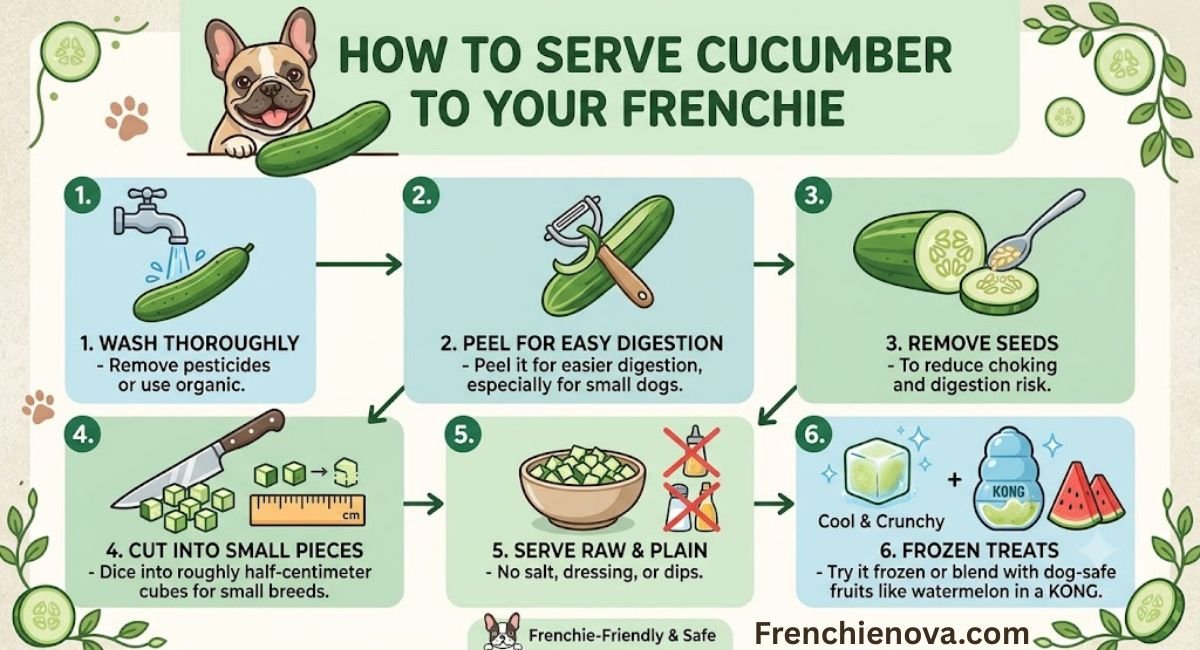
- Wash it thoroughly to remove pesticides, or use organic.
- Peel it for easier digestion, especially helpful for small dogs.
- Remove the seeds to reduce the choking and digestion risk.
- Cut into small, bite-sized pieces, dice into roughly half-centimeter cubes for a small breed.
- Serve raw and plain, no salt, dressing, or dips.
- Try it frozen for a cool, crunchy summer treat, or blend with dog-safe fruits like watermelon and freeze in a KONG.
Are cucumbers safe for French Bulldogs?
Yes. Cucumbers are non-toxic, hydrating, and very low in calories, making them an excellent treat for Frenchies in moderation. Just cut them into small pieces and don’t overfeed.
Can French Bulldog puppies eat cucumber?
Yes, in small amounts. Cut cucumber into tiny, puppy-sized pieces to prevent choking, peel and deseed it, and offer just a little at a time alongside a complete puppy diet.
How much cucumber can my Frenchie have?
A few thin slices or a small handful of diced pieces per sitting is plenty for a small breed. Keep all treats under 10% of daily calories, and start small to check tolerance.
Can cucumbers help my Frenchie lose weight?
They can help. Because cucumbers are so low in calories and filling thanks to their water content, swapping richer treats for cucumber is a smart move for a weight-prone Frenchie, but always pair it with proper portion control at mealtimes.
The Bottom Line
Cucumbers are a genuinely great treat for French Bulldogs, safe, hydrating, low in calories, and crunchy enough that most Frenchies love them. They’re especially valuable for this weight-prone, overheating-prone breed. Just remember to wash and peel them, remove the seeds, cut them into small pieces to prevent choking, and keep the portion modest to avoid an upset stomach.
Serve them plain and in moderation, and cucumbers become one of the healthiest snacks in your Frenchie’s rotation. As always, introduce any new food gradually and check with your vet if your dog has specific health concerns.
For more safe and unsafe foods, see our full guide on what foods French Bulldogs can eat and our complete French Bulldog puppy diet guide.

Auston is the founder of Frenchie Nova and a longtime French Bulldog owner. He writes practical, research-backed guides on Frenchie care, feeding, and health. Not a veterinarian — always consult your vet for medical concerns.