

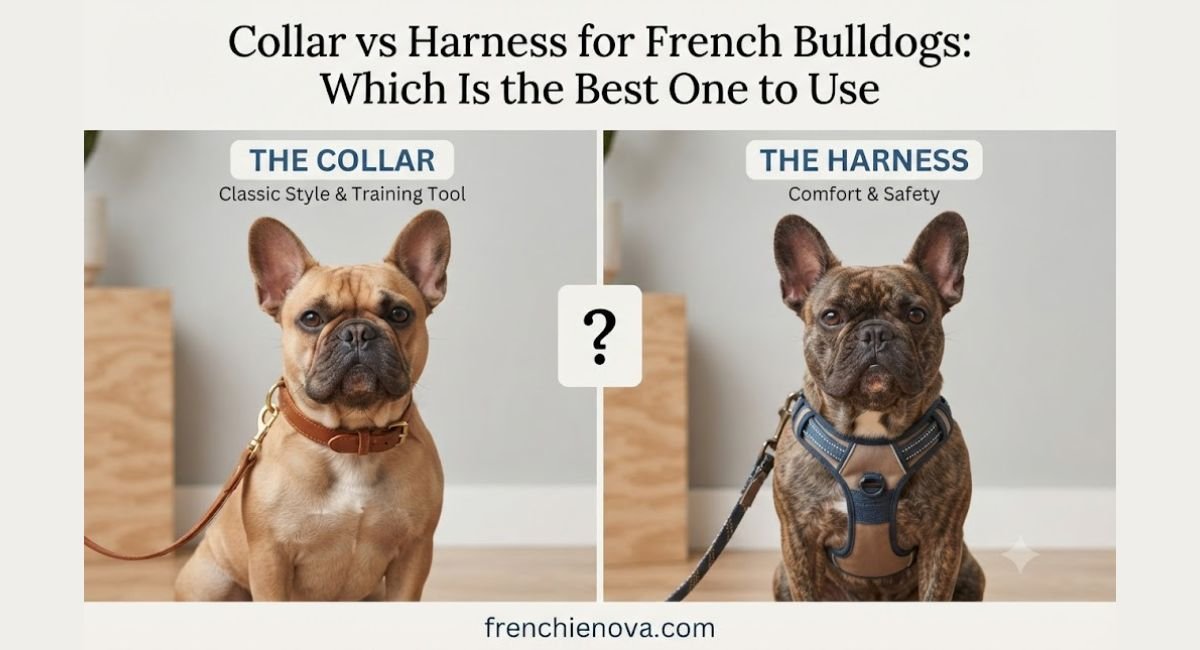
Stand in the leash aisle long enough, and the question comes up fast, Does a French Bulldog actually need a harness, or is a collar fine? The two pieces of gear do different jobs, and for a breed built the way a Frenchie is, that difference matters more than it does for most dogs. Collar vs Harness for French bulldogs? Here’s exactly what each one does, where each one falls short, and how to decide which belongs on the leash for a walk.
The Short and Quick Answer
For everyday walks, a harness is the better default for a French Bulldog. For ID tags, quick trips to the yard, or a dog that genuinely doesn’t pull, a collar still has a place. Most Frenchie households end up owning both and using each for what it’s actually good at, rather than picking one forever.
Best Collar for French Bulldogs
Table of Contents
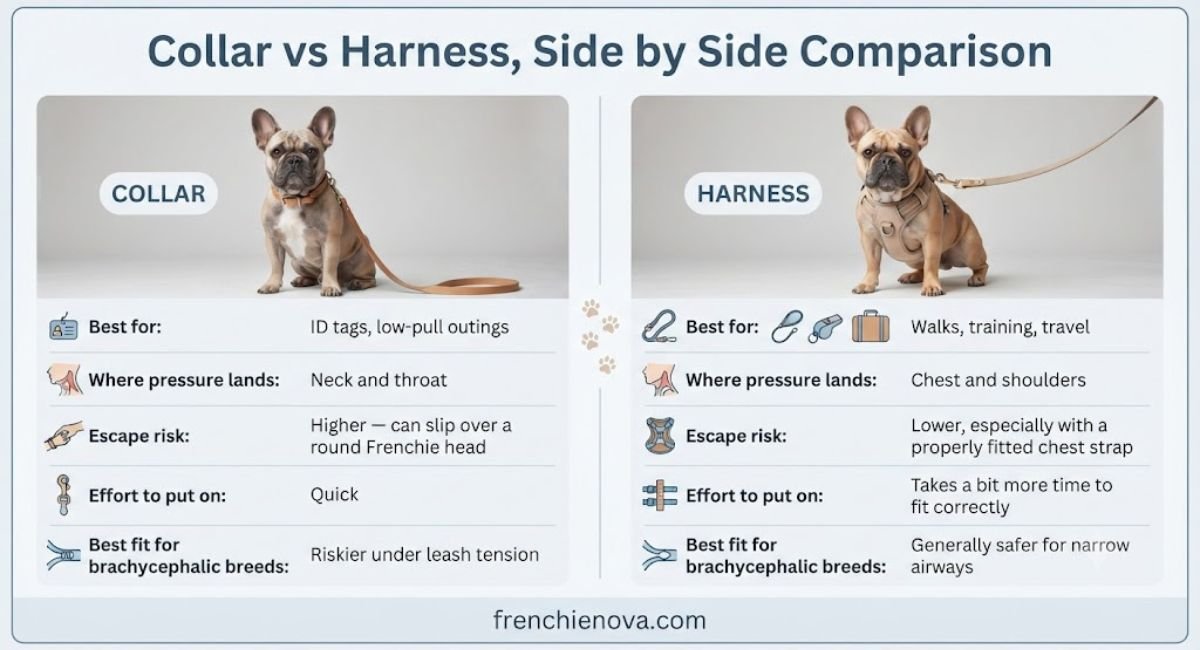
Collar vs Harness for French Bulldogs: A Side by Side Comparison
| Collar | Harness | |
| Best for | ID tags, low-pull outings | Walks, training, travel |
| Where pressure lands | Neck and throat | Chest and shoulders |
| Escape risk | Higher — can slip over a round Frenchie head | Lower, especially with a properly fitted chest strap |
| Effort to put on | Quick | Takes a bit more time to fit correctly |
| Best fit for brachycephalic breeds | Riskier under leash tension | Generally safer for narrow airways |
Why the Airway Matters Here Specifically
French Bulldogs are brachycephalic, flat-faced, with shorter airways that already work harder to move air than those of longer-nosed breeds. A collar puts leash tension directly across the front of the throat, right where the trachea sits closest to the surface. On a dog that never pulls, that’s rarely an issue day to day. On a dog that lunges at a squirrel, coughs when excited, or strains at the leash, repeated pressure in that spot is the mechanism behind the tracheal irritation and, in more serious cases, tracheal collapse that vets warn about in small, flat-faced breeds.
A harness routes that same force across the chest and shoulders instead, which is simply a sturdier place for it to land.
Read our Guide French Bulldog Collar size chart
Not All Harnesses Do the Same Job
Picking “a harness” isn’t the end of the decision, the clip position changes what it actually does.
- Back-clip harnesses are the easiest to put on and most comfortable for a calm dog, but on a dog that pulls, a back clip can actually encourage more pulling, since it doesn’t discourage forward momentum the way a front clip does.
- Front-clip harnesses attach at the chest and gently steer a pulling dog back toward the handler, making them a better training tool for a Frenchie still learning to walk on a loose leash.
- Step-in harnesses go on from below and skip going over the head entirely, which suits a Frenchie that dislikes anything passing near its face or ears.
- Overhead harnesses go on over the head like a collar, generally faster to put on, but not the best choice for a dog that’s headshy.
A dual-clip harness with both a front and back ring covers the most ground, letting the same piece of gear handle calm walks and pulling-in-progress training without switching gear.
When a Collar Alone is Genuinely Fine
The “always harness” advice online often skips the exceptions, and there are real ones:
- A senior or low-energy Frenchie that walks calmly on a loose leash puts very little tension through the neck regardless of gear.
- Indoor-only or yard use, where there’s no leash tension at all, a collar’s main job here is just holding an ID tag.
- A dog with a harness aversion that genuinely can’t be conditioned to tolerate one, where a well-padded, wide flat collar used carefully may be the more realistic day-to-day option.
None of this overrides the general safety picture for actual leash-pulling situations, it just means “collar or harness” isn’t a strict either/or for every household.
What to Look for When Buying a Harness
- A wide, padded chest strap: a thin strap concentrates the same pressure problem a collar has, just moved to a different spot.
- An adjustable, snug-but-not-tight fit: loose enough to move freely, tight enough that the dog can’t back out of it (test with the same two-finger rule used for collars).
- A sturdy front D-ring, back D-ring, or both: depending on whether it’s needed for training, everyday walks, or a mix of both.
- A car-safe attachment point: if it’ll double as a seatbelt harness, this matters more for a breed already at higher risk during sudden stops due to its compact build.
What to Look for in a Backup Collar
Even a harness-first household usually keeps a collar around for ID:
- A flat buckle or quick-release style is enough for identification duty.
- A martingale is worth considering for a Frenchie that’s ever slipped a flat collar, since it tightens just enough to stop a slip-out without choking.
- Skip chain, choke, or prong styles entirely, there’s no version of those that makes sense for this breed’s airway.
French Bulldog vs Pug vs Boston Terrier Collar Sizes Compared
Can a French Bulldog Wear a Collar and a Harness at the Same Time?
Yes, and many owners do, the collar stays on for ID tags while the harness handles the leash connection for walks, so neither piece is doing a job it’s not built for.
Is a Harness Bad for a Frenchie’s Shoulders?
A poorly fitted one can rub or restrict shoulder movement, which is why a properly adjusted, padded harness matters as much as picking a harness over a collar in the first place. Check that the front strap sits above the shoulder blades, not across them, and that the dog can move its front legs freely once it’s on.
How do I Get My French Bulldog Used to Wearing a Harness?
Let the dog sniff and see the harness first, put it on for a few minutes at a time indoors with treats and praise, and build up gradually before the first real walk. Most resistance fades within a week or two of short, positive sessions.
Does a Harness Stop a French Bulldog from Pulling?
Not on its own, a back-clip harness can even make pulling easier since it doesn’t discourage forward motion. A front-clip harness helps redirect a pulling dog, but leash training is still what actually teaches loose-leash walking over time.
The Bottom Line
A harness is the safer everyday choice for a French Bulldog on a walk, because it keeps leash pressure off an airway that’s already working harder than most breeds’. A collar isn’t obsolete, it’s still the right spot for an ID tag, and it can cover low-pull situations just fine, but it shouldn’t be the thing absorbing the force of a pull. The best setup for most Frenchie owners is exactly what it looks like in practice: a well-fitted harness for walks and training, a comfortable collar for identification, and a clear sense of which one is doing which job.
A dog showing signs of frequent coughing, gagging, or breathing difficulty during or after walks should be seen by a veterinarian, regardless of which gear is being used.

Auston is the founder of Frenchie Nova and a longtime French Bulldog owner. He writes practical, research-backed guides on Frenchie care, feeding, and health. Not a veterinarian — always consult your vet for medical concerns.