


Most Frenchie parents stand over the food bowl at least once during a pregnancy, wondering whether it’s time to change something. Too little worries them. Too much worries them more, and for good reason: extra weight makes a flat-faced dog’s delivery harder, not easier. The French Bulldog pregnancy diet that works is smaller and steadier than most people expect. It follows the calendar, not the cravings. This guide walks through each week, with real numbers from veterinary nutrition sources, so you know what to feed, when to switch, and when to call the vet.
Quick answer: Feed a pregnant French Bulldog her normal complete-and-balanced adult food until about week six. Then switch gradually to a highly digestible puppy or all-life-stages food, raise portions in small weekly steps, and split meals so she’s never stuffed. Skip calcium and other supplements unless her vet prescribes them.
Disclosure: frenchienova.com is a participant in the Amazon Associates program and earns from qualifying purchases. Prices change, so check the current price before buying.
Table of Contents
Why a French Bulldog Pregnancy Diet Looks Different
Frenchies are compact, flat-faced, and narrow through the hips. That build shows up in the numbers. A Royal Veterinary College study found French Bulldog bitches are 15.9 times more likely than crossbreds to have difficult births, and those with problems are 2.4 times more likely to need a caesarean. The data came from UK emergency-care clinics, so it reflects dogs that ran into trouble. Even so, the message holds: Frenchie pregnancies deserve a plan.
Feeding is part of that plan, and the goal isn’t a bigger belly. It’s a fit, strong mother. The American Kennel Club (AKC) notes that excess weight gain in a pregnant dog can mean larger puppies and weaker contractions, which raises the odds of a difficult birth.
Litter size matters too. French Bulldogs average about three puppies per litter. A dam carrying three has very different needs from a retriever carrying nine.
Space also runs out. A pregnant dog needs more calories but has less room to eat them, which is why smaller, more frequent meals help. Flat-faced dogs also tend to swallow air when they gulp big meals, so the same advice does double duty.
French Bulldog Pregnancy Week by Week: Feeding Chart
Canine gestation runs about nine weeks, or roughly 63 days. Use this chart as a starting point, then let her reproductive vet adjust it.
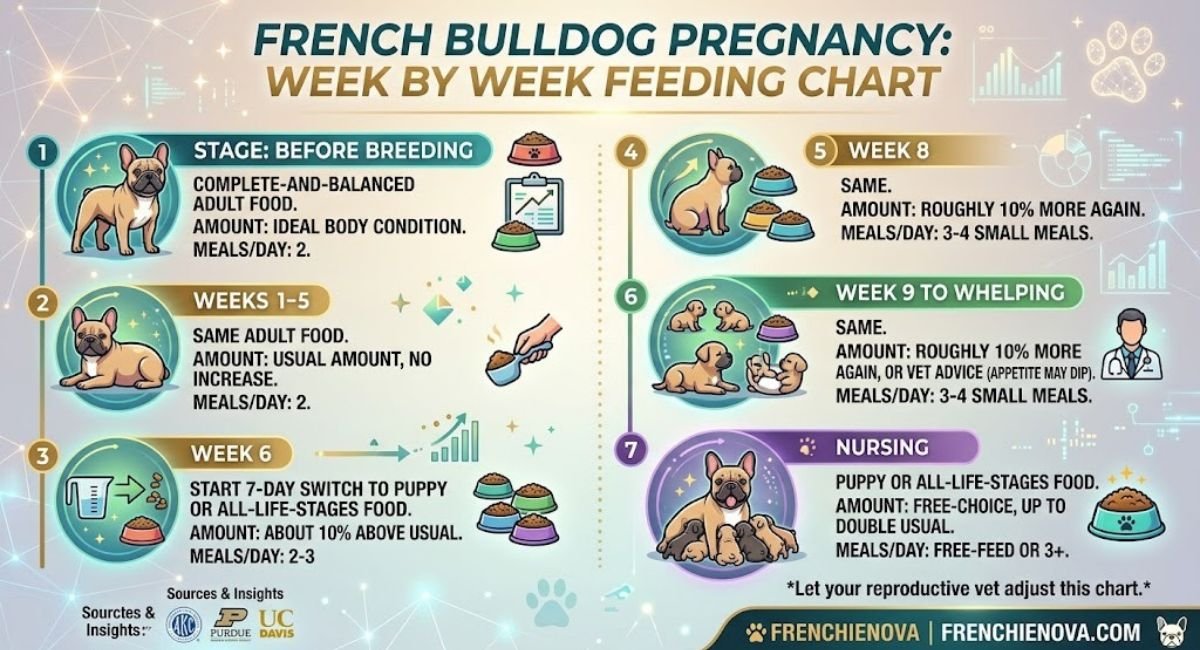
| Stage | What to feed | How much | Meals per day |
| Before breeding | Complete-and-balanced adult food | Enough to hold an ideal body condition | 2 |
| Weeks 1–5 | Same adult food | Usual amount, no increase | 2 |
| Week 6 | Start a 7-day switch to puppy or all-life-stages food | About 10% above usual | 2–3 |
| Week 7 | Puppy or all-life-stages food | Roughly 10% more again | 3 |
| Week 8 | Same | Roughly 10% more again | 3–4 small meals |
| Week 9 to whelping | Same | Roughly 10% more again, or as her vet advises; appetite may dip near labor | 3–4 small meals |
| Nursing | Puppy or all-life-stages food | Free-choice, up to about double usual by late lactation | Free-feed or 3+ |
The week-six switch matches AKC’s guidance: maintenance adult food until week six, then a highly digestible, nutrient-dense puppy or performance food through lactation. Purdue’s Canine Welfare Science program lays out the same timeline with a weekly step: maintenance plus 10% at week six, then another 10% each week after. UC Davis starts earlier and says to move to an all-life-stages diet once pregnancy is confirmed at around 30 days. The gap between these sources is why her vet gets the final say.
Weeks 1–5: Keep the Bowl Boring
Early pregnancy is a “nothing to see here” phase for her calories. UC Davis says no extra calories or nutrients are needed in the first half of pregnancy. Purdue adds that holding an optimal body condition matters now, because overweight dogs face a higher risk of dystocia.
A few things are worth knowing in these weeks:
- Confirmation comes first: AKC points to a vet check around the 30-day mark to confirm pregnancy. Until then, the diet stays as it is.
- Mild queasiness can happen: Some Frenchies pick at meals around weeks three to five. A splash of warm water over her usual food is fine. Bacon grease, cheese and other rich toppers are not.
- The 24-hour rule: A full day of refusing food, or repeated vomiting, means a call to the vet.
- DHA is worth a question: Purdue’s handout lists DHA, such as from salmon or other cold-water fish oil, for eye and brain development. Ask the vet whether her food already has enough or whether a fish oil makes sense. Don’t add one on a hunch.
Weeks 6–9: Puppy Food, Small Meals, Gradual Increases
This is the stretch where the French Bulldog pregnancy diet actually changes. Puppy food is calorie-dense and highly digestible, which suits a dam with a crowded belly. Purina also notes that a label that says “all life stages” works for pregnant and nursing dogs too.
The switch. Frenchie stomachs don’t like surprises. Swap about a quarter of the bowl every two days: 25% new food for two days, then 50%, then 75%, then 100% by day seven.
The meals. By weeks eight and nine, Purdue recommends several meals a day or free-choice feeding, since abdominal space is limited. Many owners land on three or four small meals. A shallow bowl and kibble moistened with warm water make eating easier.
An example of the math. Say her usual intake is 2 cups a day of adult food. These figures follow Purdue’s pace, rounded, and they’re an illustration only. Puppy food and adult food carry different calories per cup, so match the numbers by calories on each bag, not by cups.
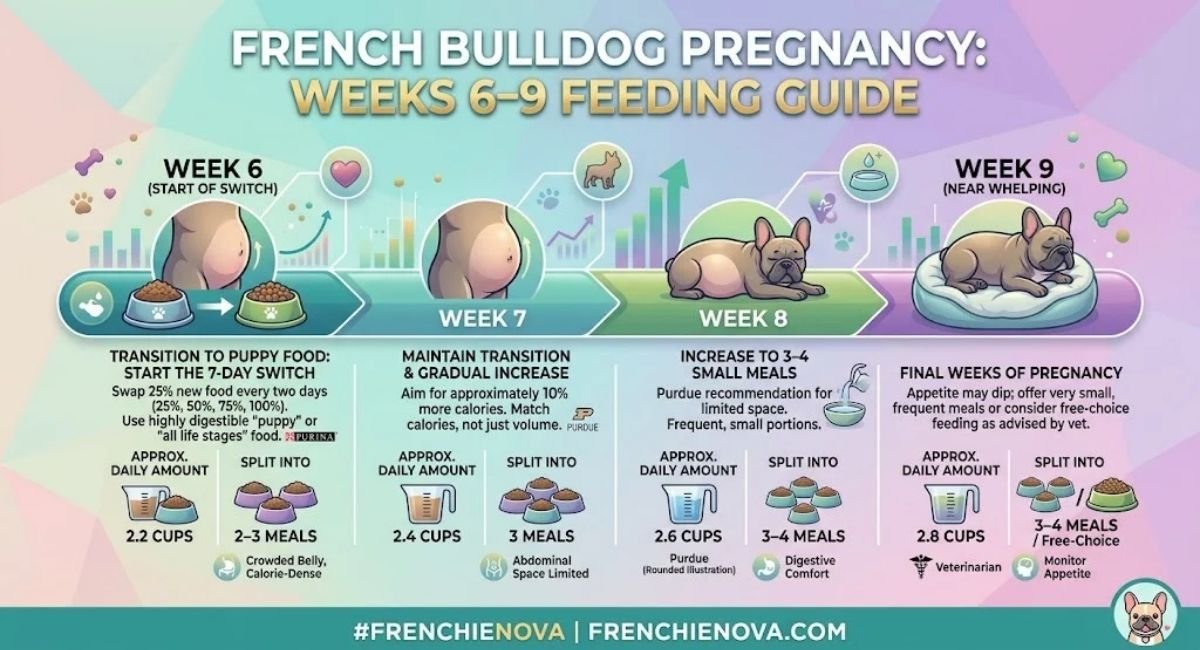
| Week | Approx. daily amount | Split into |
| 6 | 2.2 cups | 2–3 meals |
| 7 | 2.4 cups | 3 meals |
| 8 | 2.6 cups | 3–4 meals |
| 9 | 2.8 cups | 3–4 meals |
How Much Should a Pregnant French Bulldog Eat? Two Vet-School Approaches
Two respected sources give two different pacing rules:
- Purdue: increase energy by 10% each week from week six.
- UC Davis: increase the amount by about 25% in each of the last four weeks, and cut back slightly if she starts to get fat.
Followed straight through, UC Davis’s rule adds up to roughly double her usual intake by the end. Purdue’s lands closer to 40% above it. Neither is wrong. They suit different dogs.
A Frenchie carrying two or three pups may not need the steepest climb, and extra fat works against an already high-risk delivery. Her vet can see what the owner can’t, such as the puppy count on ultrasound or X-ray, so this is the conversation to have. Whatever the pace, weekly weigh-ins and the rib check below decide the final number.
What to Look For in a Pregnant French Bulldog Food
Ignore the front of the bag and read the facts:
- High digestibility: More nutrition in less volume matters when space is tight.
- Protein and fat: AKC and Purdue both point to a highly digestible food with at least 29% protein and 17% fat. Compare on a dry matter basis, which takes the water out of the math. A canned food can look low in protein on the label and still be rich once the moisture is set aside.
- DHA: Check whether it’s already in the formula.
- A life-stage statement: Look for puppy, growth or all-life-stages wording from an AAFCO-aligned maker.
- Not a large-breed puppy formula: Hill’s says large-breed puppy food isn’t recommended for pregnant or nursing dogs.
- Wet food?: If she eats wet only, Purina suggests feeding more meals or larger portions to reach the extra energy she needs.
Read Our Guide wet vs. dry food for Frenchies
The Rib Check: Tracking Body Condition Week by Week
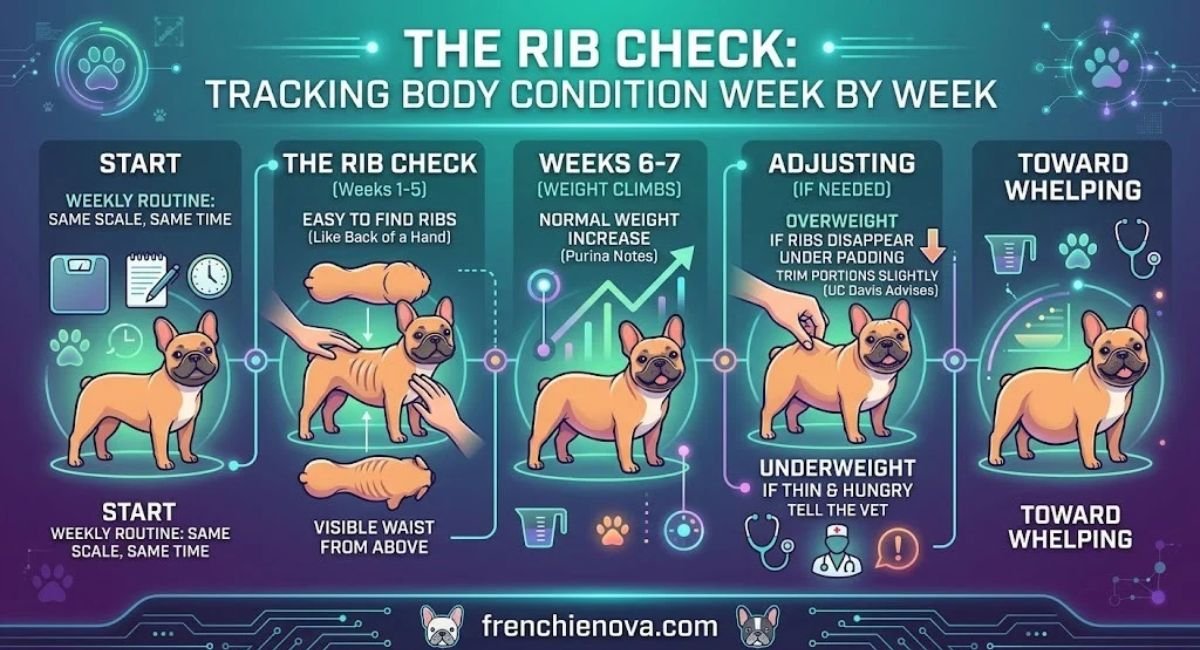
The scale tells part of the story. Her ribs tell the rest. Run both hands along her sides each week. The ribs should feel easy to find under light pressure, like the back of a hand, and she should still show a waist from above until the belly rounds out.
Weigh her weekly on the same scale at the same time of day, and write it down. Purina notes that weight climbs noticeably between weeks six and seven. That’s normal. If her ribs disappear under padding, trim portions slightly, as UC Davis advises. If she’s thin and hungry, tell the vet.
When a Pregnant Frenchie Won’t Eat
A skipped meal isn’t always a crisis. Three windows tend to cause it:
- Weeks three to five: mild queasiness, as described above.
- Weeks eight and nine: the belly takes up the room her stomach used to have. Offer smaller, more frequent portions, and warm her food slightly to boost the smell.
- Close to labor: AKC’s breeding nutrition guide flags that interest in food can drop as the due date approaches.
Rich toppers can train a dam to hold out for them, so keep the base diet as the main event. A bland diet is only for when her vet says so. Anything beyond a day of refusing food gets a phone call, not a guess.
Foods and Supplements to Skip
Known toxins: grapes, raisins, chocolate, onions, garlic, and anything with xylitol. Physical hazards: cooked bones, which splinter. Grease bombs: bacon, sausage and fatty scraps.
Raw and homemade diets are hard to balance and can carry bacteria like Salmonella, which is a poor trade when she’s carrying puppies. A veterinary nutrition review in the journal Reproduction in Domestic Animals notes that complete commercial diets don’t need extra supplementation. UC Davis agrees: an all-life-stages diet is adequate in minerals and vitamins and shouldn’t be supplemented further. Human prenatal vitamins stay in the cabinet.
Why Calcium Pills Backfire
It seems logical that more calcium means stronger puppy bones. The MSD Veterinary Manual says the opposite can happen: calcium supplements in pregnancy can shut down the body’s own calcium regulation, setting the dam up for low calcium when milk demand peaks. The owner-facing version is blunt: oral calcium shouldn’t be given during pregnancy because it may cause, not prevent, the problem.
That problem is eclampsia. It usually strikes 2 to 3 weeks after whelping, most often in small breeds with large litters, though any breed can be affected. Frenchies tend to have small litters, but “less likely” isn’t “never.” Panting and restlessness are early signs, and it’s an emergency.
Safe Extras and Treats
Treats can stay, but they’re garnish. Keep them under about 10% of her daily calories:
- Plain, cooked chicken in small bits, with no skin, bones or seasoning
- A few pieces of her puppy kibble as rewards
- Crunchy carrot slices
- A little plain cooked chicken or rice egg now and then
Water Matters More Than It Looks
Keep a full, clean bowl in every spot she rests. Dehydration shows up as dry or tacky gums, thick saliva, and sudden lethargy. During nursing, move a water dish right beside the whelping box so she never has to choose between her puppies and a drink.
After the Puppies Arrive: Nursing and Weaning Diet
Milk production is the most demanding job of her life. UC Davis puts the late-lactation requirement at about twice her normal intake. Litter size drives the exact figure.
- Keep the same food. Hill’s advises staying on puppy food until the puppies finish weaning.
- Let her eat freely. MSD recommends food and water available at all times during lactation. Don’t cut calories to chase her old figure.
- Bring the bowl to her. Many dams won’t leave their puppies to eat, so feeding in the whelping box helps.
- Watch the stomach. If diarrhea appears from the sheer volume of food, a slight reduction can help. UC Davis says so, and a call to the vet is smart.
Puppies start solid food around three to four weeks. As they eat more and nurse less, her portions come down. UC Davis says to reduce her food after weaning based on her condition and return her to her usual variety.
When to Call the Vet Right Away
- She refuses food for more than 24 hours
- Repeated vomiting, severe diarrhea or collapse
- Panting, restlessness, tremors or stiffness, especially in the weeks after whelping
- Bloody, dark green or foul-smelling discharge before labor starts
- Hard straining for 30 to 60 minutes without a puppy
- Trouble breathing or pale or bluish gums
Plan the birth with a reproductive vet well before week nine, including what happens if a caesarean is needed. Given the RVC numbers above, that plan is part of responsible Frenchie care.
Gear Worth Having
Small-breed puppy or all-life-stages dry food Look for a highly digestible formula with a life-stage statement and DHA. Skip large-breed puppy formulas.

- The Proactive 5 health benefits for IAMS Small Breed are scientifically designed to support five key areas of your dog’s…
- Supports Healthy Digestion: IAMS Proactive Health Small Breed Adult Dry Dog Food Chicken & Whole Grain Recipe features a…
- Healthy Teeth: IAMS Dry Dog Food for small dogs includes crunchy kibbles that scrub your dog’s teeth with every bite to …
Small-breed puppy wet food or mousse A soft option for weeks when dry kibble feels like too much.

- FORMULATED FOR MOTHERS & BABYDOGS: Royal Canin Small Starter Mother and Babydog Wet Dog Food is tailor-made for both the…
- EXCLUSIVE NUTRITIONAL COMPLEX: Contains a combination of nutritional elements to help promote digestive health and help …
- MICROBIOME SUPPORT: A combination of prebiotics and highly digestible proteins helps promote a healthy balance of intest…
Shallow, wide bowl or slow feeder Easier on a flat face and helpful for gulpers.

- Ceramic Material, More Suit For Your Dog: The veterinarian recommends using a ceramic bowl for your dogs. According to i…
- Premium Ceramic, Durable and Stable: We use premium ceramic, not easy to damage and certified by Amazon Climate Pledge F…
- Easy Clean, Save More Time: The surface is smooth and very easy to clean. Whether you put it under the faucet for rinsin…
Digital scale for weekly weigh-ins Consistent numbers beat guesses.

- 𝑹𝒆𝒍𝒊𝒂𝒃𝒍𝒆 𝑷𝒓𝒆𝒄𝒊𝒔𝒊𝒐𝒏: With professional expertise refined over 10 years, our brand design ensures accuracy and reliability…
- 𝑬𝒂𝒔𝒚 𝒕𝒐 𝑼𝒔𝒆: The scale is equipped with an easy-to-read display with automatic on/off, low battery, and overload indicat…
- 𝑴𝒊𝒏𝒊𝒎𝒂𝒍 𝑫𝒆𝒔𝒊𝒈𝒏: Never Let a scale ruin your style. Place this scale in your bathroom, bedroom, or living room. It will c…
Can a Pregnant French Bulldog Eat Puppy Food?
Yes, and most sources recommend it from around week six. UC Davis suggests an earlier switch after confirmation. Go with a small-breed puppy or all-life-stages formula, and transition over seven days.
When Should a Pregnant Frenchie’s Portions Go Up?
Not before week six for most dogs. After that, small weekly steps work better than a sudden jump. Her body condition and her vet decide the pace.
How Many Times a Day Should a Pregnant French Bulldog Eat?
Two meals in early pregnancy. From about week six, three or four smaller meals fit a belly with less room.
Do Pregnant French Bulldogs Need Prenatal Vitamins or Calcium?
No. A complete puppy or all-life-stages food already covers it, and calcium pills can raise the risk of eclampsia after birth. Only a vet should prescribe supplements.
Can a Pregnant French Bulldog Eat Raw Food?
Raw diets are hard to balance and carry bacterial risks. A complete commercial diet is the safer route during pregnancy and nursing.
How Long is a French Bulldog Pregnant?
Roughly 63 days, give or take a few. Hepper’s breed guide gives a range of 58 to 63 days.
How Many Puppies do French Bulldogs Usually Have?
About three on average. Smaller litters usually mean she needs less of a boost than a large-litter breed.
What Should a Nursing French Bulldog Eat?
Puppy or all-life-stages food, available freely, with water close by. Intake can reach about double normal by peak lactation.
Bottom Line: Keep the French Bulldog Pregnancy Diet Simple
A strong French Bulldog pregnancy diet comes down to five habits:
- Keep adult food and usual portions through week five.
- Switch to puppy or all-life-stages food around week six, over seven days.
- Raise portions gradually and split them into smaller meals.
- Check ribs and weight every week.
- Skip calcium, raw experiments, and unprescribed supplements.
Then keep her vet’s number handy for the rest.
This article is for education and isn’t a substitute for veterinary advice. Pregnant French Bulldogs need guidance from a licensed veterinarian, ideally a reproductive specialist.
Sources: AKC: Breeding Bitch Nutrition · AKC: Puppy Nutrition From the Dam · Purdue: Nutrition for the Pregnant Dog · UC Davis: Nutrition for the Pregnant and Nursing Bitch · MSD Vet Manual: Disorders of Calcium Metabolism in Dogs · RVC VetCompass: French Bulldogs and Birthing Problems · Hill’s: What to Feed a Pregnant Dog · Purina: What to Feed a Pregnant Dog · Hepper: How Long Are French Bulldogs Pregnant

Auston is the founder of Frenchie Nova and a longtime French Bulldog owner. He writes practical, research-backed guides on Frenchie care, feeding, and health. Not a veterinarian — always consult your vet for medical concerns.
1 thought on “French Bulldog Pregnancy Diet: Weekly Portions & Food Chart”