

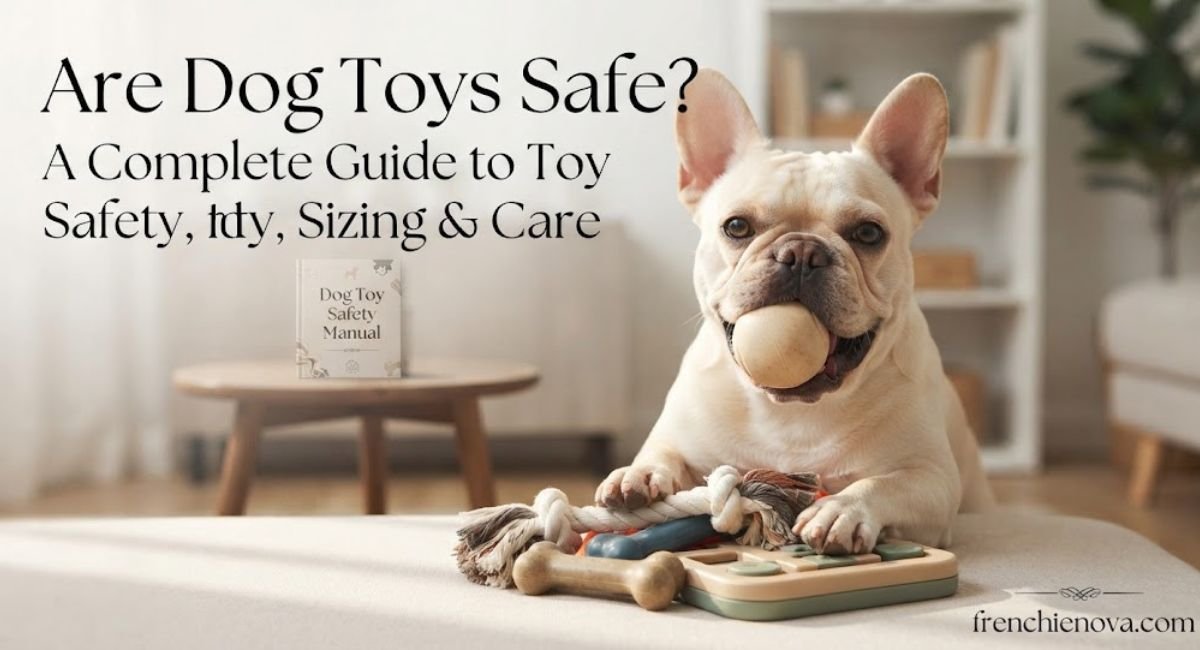
Most owners assume that if a toy is sold for dogs, it must be safe for dogs. That assumption sends thousands of pets to the vet every year. The truth is that toy safety depends far less on the label and far more on choosing the right toy for the right dog and using it well. So are dog toys safe? The honest answer is: the good ones are, when matched to the dog and supervised properly. This guide walks through what makes a toy safe or risky, how to size and clean toys, and when to throw them away, so playtime stays fun and trouble-free.
Table of Contents
Quick Reference: The Toy Safety Checklist
| Check | What to look for |
| Size | Too big to swallow or fit fully in the mouth |
| Hardness | Slight give (thumbnail test) — not rock-hard |
| Construction | One piece, no small detachable parts |
| Materials | Stated, non-toxic, BPA/phthalate/lead-free |
| Condition | Not cracked, frayed, or in swallowable pieces |
| Supervision | Matched to supervised vs. alone-time use |
What Actually Makes a Dog Toy Dangerous
Most toy injuries stem from a handful of predictable causes, and knowing them makes almost every risk avoidable.
Choking and Swallowing
The biggest one. A toy small enough to fit fully in a dog’s mouth can be swallowed or lodge in the throat. This is why sizing is the single most important safety factor, and why a toy that’s perfect for a Beagle can be deadly for a Labrador.
Intestinal Blockage
Swallowed pieces, stuffing, squeakers, rope fibers, and chunks of a destroyed toy can cause a blockage that often requires surgery. Long, string-like material (rope, ribbon) is especially risky because of how it can bunch in the gut.
Tooth Fractures
Toys that are too hard, antlers, hooves, cooked bones, hard nylon used too aggressively, can crack teeth, one of the most common and expensive chewing injuries vets see.
Toxic Materials
Cheap, poorly regulated toys can contain BPA, phthalates, lead, or unsafe dyes, compounds no one wants in something a dog mouths for hours. That’s why it’s worth checking our guide to non-toxic and made-in-USA dog toys before you buy, so you know exactly what to look for (and avoid) on the label.
Worn-out Toys
A perfectly good toy becomes dangerous once it’s chewed into small or sharp pieces. Most injuries from “safe” toys happen because they weren’t retired in time, which is why it’s worth choosing from indestructible toys built to survive heavy chewers rather than standard designs that break down fast.
A few specific toy types deserve extra caution because they show up in vet visits again and again. Squeakers are a classic culprit, a dog that chews one out can swallow it, so squeaky toys are best supervised. Rope toys shed long fibers that can bunch in the gut. Stuffed toys leak filling that gets swallowed once a seam tears. Balls that are too small (including tennis balls for big dogs) are a top choking cause. And the rigid “natural” chews, antlers, hooves, and cooked bones are the leading cause of cracked teeth. None of these are automatically off-limits, but each needs the right size, supervision, and a willingness to retire it early.
How to Choose the Right Size (The Most Important Safety Step)
Size matters more than almost anything else. The rule is simple: a toy should be too large to fit entirely inside the dog’s mouth, with no risk of being swallowed whole. When choosing between two sizes, the bigger one is almost always the safer call, this goes for puppies too, so look for safe teething toys for puppies sized correctly for their growing mouths, not just their current age.
A practical dog toy size guide by build, small breeds need scaled-down toys that are still too big to swallow, medium dogs do well with mid-sized toys matched to their chew strength; and large or powerful breeds need the biggest size a brand offers, since they can compress and swallow toys meant for smaller dogs. Most reputable brands size their toys by the dog’s weight range, follow that, and size up rather than down for powerful chewers.
One overlooked point: a toy can become the wrong size over time. As a toy wears down, a once safe piece can shrink to a swallowable size. Re-check fit as toys age, not just on day one.
The Hardness Rule: The Thumbnail Test (Are Dog Toys Safe?)
A toy that’s too soft gets destroyed; one that’s too hard cracks teeth. The sweet spot is firm-but-giving, and there’s an easy way to check it.
Press a thumbnail into the toy. If it leaves a slight dent, the hardness is about right, tough enough to last, soft enough to spare the teeth. If it doesn’t dent at all, it’s hard enough to risk a fracture. By that test, antlers, hooves, cooked bones, and very hard nylon all land in the caution zone for aggressive chewers. A good rule from many vets: if you wouldn’t want to be hit on the kneecap with it, it’s probably too hard for a dog to chew safely.
Are Dog Toys Non-Toxic? How to Check
Material safety is real but easy to verify. Reputable, genuinely safe toys are made without BPA, phthalates, and lead, and they say so plainly. Look for clearly named materials, natural rubber, food-grade silicone, organic cotton, rather than a vague “durable plastic.” Explicit BPA-, phthalate-, and lead-free claims, and ideally testing to standards like the ASTM guidelines used for children’s products, are strong trust signals. When a toy is vague about what it’s made of, that silence is its own answer. (The dedicated guide on non-toxic and made-in-USA toys goes deeper on this.)
How to Clean Dog Toys
Toys get slobbery, dirty, and germy, and a little upkeep keeps them safe and lasting longer. Here’s how to clean dog toys by type:
- Rubber and Silicone Toys are the easiest, most are top-rack dishwasher-safe, or wash by hand with hot water and mild soap. For toys with treat cavities, a bottle brush reaches what the dishwasher misses. Do this weekly for toys used with food.
- Rope and fabric toys can go in the washing machine (a mesh bag helps) and air-dry, or get a hand wash. Some rope toys can even be microwaved damp briefly to kill bacteria, but only pure cotton, never with any plastic or metal parts.
- Plush toys are usually machine-washable on a gentle cycle inside a pillowcase to protect the seams; air-drying is kinder to the shape and fabric than a hot dryer.
- Hard plastic toys wipe down with hot soapy water or a pet-safe disinfectant, rinsed well.
A good habit: give every toy a quick wash and inspection on the same day each week. It keeps germs down and catches wear before it becomes a hazard.
When to Throw Away Dog Toys
Knowing when to throw away dog toys is half of toy safety, because most “safe toy” injuries come from toys kept too long. Retire a toy the moment it shows any of these:
- Chunks or pieces small enough to swallow
- Deep cracks, splits, or torn-off parts
- An exposed or loosened squeaker
- Frayed rope or fabric coming apart into strands
- Leaking stuffing
- Sharp edges from chewing
- General thinning or weakening that signals it’s about to fail
When in doubt, throw it out, a replacement costs far less than emergency surgery.
How Many Toys Does a Dog Need?
A common question with a practical answer: most dogs do best with a small, varied rotation rather than a huge pile. How many toys does a dog need? Roughly a handful that cover different jobs, something to chew, something to fetch or play with, and something that engages the brain, with a few held in reserve. Rotating them every week or so keeps each one feeling novel, since dogs lose interest in toys that are always available and rediscover them with fresh enthusiasm after a break. More toys aren’t better; the right mix, rotated, is.
Supervised Toys vs. Leave-Alone Toys
One distinction prevents a huge share of accidents: knowing which toys are safe to leave with a dog alone and which need an owner watching. Getting this right matters as much as picking a good toy in the first place.
Supervised-Only Toya
Toys include puzzle toys with removable pieces, rope and tug toys, plush and squeaky toys, lick mats and snuffle mats, and any homemade toy. These are activity toys, great fun with a person present, but a dog left alone with them can chew off and swallow parts. Put them away after the session.
Leave-Alone Safe Toys
Toys are sturdy, one-piece chews with no small parts, a solid rubber toy like a KONG, or a durable chew sized correctly for the dog. Even these deserve a periodic check for wear, but they’re built to be left with a dog during crate time or while the owner is out.
When in doubt, treat a toy as supervised-only. It’s the safer assumption, and it’s how most experienced owners avoid the “I only left for ten minutes” accidents.
The Bottom Line
So, are dog toys safe? The good ones are, when they’re sized so they can’t be swallowed, firm but not tooth-crackingly hard, made of stated non-toxic materials, kept clean, and retired before they break into hazards. Almost every toy injury traces back to one of those being missed, wrong size, too hard, toxic material, or a toy kept too long. Match the toy to the dog, run the thumbnail and size checks, wash and inspect weekly, and toss anything worn out. Do that, and playtime stays exactly what it should be, safe, healthy fun.
This guide offers general safety information, not veterinary advice. Always supervise play and consult a veterinarian about the safest toys and chews for a dog’s specific size, age, breed, and dental health, or if a dog has swallowed part of a toy.

Auston is the founder of Frenchie Nova and a longtime French Bulldog owner. He writes practical, research-backed guides on Frenchie care, feeding, and health. Not a veterinarian — always consult your vet for medical concerns.
1 thought on “Are Dog Toys Safe? A Complete Guide to Toy Safety, Sizing & Care”