
Most dogs do not care whether a toy costs twenty dollars or came from the recycling bin, they care that it is fun. That is the quiet secret behind DIY dog toys: a braided old t-shirt or a treat hidden in a cardboard box can entertain a dog just as well as a store-bought toy, often better. It’s cheaper, it is a great rainy-day project, and it keeps useful junk out of the trash. This guide covers easy homemade dog toys anyone can make in minutes, what’s safe, and what to skip, so a bored dog gets a fresh activity without a trip to the store.
Table of Contents
Why Homemade Toys Work So Well for Dogs
Dogs are driven by instinct, not price tags. The things they love most about toys, chewing, shaking, foraging for hidden food, the satisfying crinkle of something destructible, are easy to recreate at home. A puzzle that makes a dog work for a treat delivers the same mental tiring as a store-bought one, because the dog’s brain doesn’t know the difference.
There’s a real practical upside too. DIY toys are nearly free, they’re perfect for a rainy day when a dog has cabin fever, and they let an owner customize the challenge to their specific dog. The flip side is that homemade toys are usually less durable and need closer supervision, which is exactly why the safety rules below matter before diving in.
A quick honest note, homemade toys are best as supervised activities, not as replacements for sturdy chew toys left with a dog alone. Think of them as fun, cheap enrichment sessions rather than all-day unsupervised toys.
Easy No-Sew DIY Dog Toys
These take minutes and need zero crafting ability.
Braided T-Shirt Tug
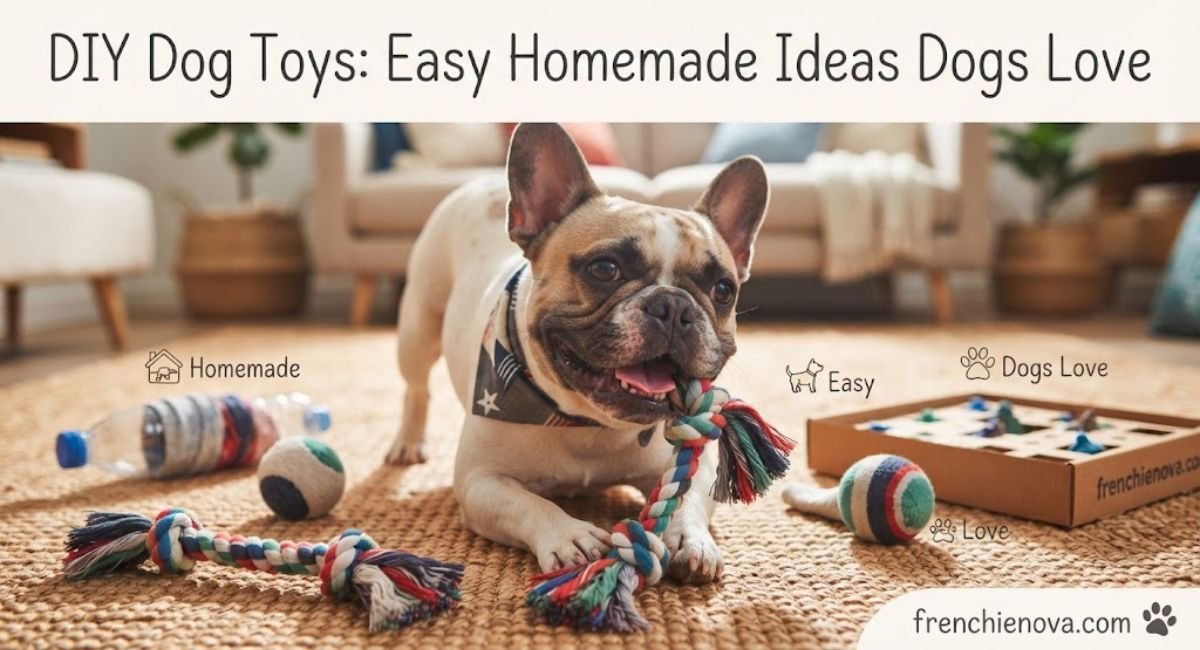
Cut three strips from an old cotton t-shirt, tie them together at one end, braid them tightly, and knot the other end. That’s it, a sturdy tug and chew toy for free. Among no-sew dog toys, this is the classic, and cotton is safer than synthetic if a few fibers get chewed off. Supervise and retire it when it frays.
Bottle in a Sock
Drop an empty plastic bottle (cap and ring removed) into an old sock and tie off the end. The crinkle and crunch drive many dogs wild. Supervise closely, the bottle is for crinkle fun, not for eating, and it should be taken away once chewed.
Treat-Stuffed Cardboard Box
Scatter a few treats or some kibble inside a cardboard box, fold the flaps loosely, and let the dog nose, paw, and “destroy” it to get the food. It taps the foraging instinct, and the shredding is part of the fun, just supervise so the dog doesn’t eat the cardboard, and clean up the bits.
Frozen Towel Chew
Wet an old cotton towel, twist or braid it, and freeze it. The cold soothes a teething puppy’s gums and gives a satisfying chew. Supervise, since a determined dog can chew off pieces of frozen fabric.
Homemade Puzzle and Foraging Toys
For mental tiring on a budget, these homemade puzzle toys for dogs are hard to beat, and they hold up just as well as store-bought puzzle toys.
Muffin Tin Puzzle
Drop a treat into each cup of a muffin tin, then cover every cup with a tennis ball. The dog has to nudge each ball aside to find the treats, a genuine puzzle that costs nothing if the tin and balls are already around. Adjust difficulty by using fewer treats than cups so the dog keeps searching.
Towel Roll-Up
Lay a treat trail along a flat towel, then roll or fold it up. The dog unrolls and noses through to find the food. A softer cousin of the snuffle mat, made in seconds.
Cardboard Tube Foragers
Fold the ends of an empty paper-towel tube after dropping treats inside. The dog works to open it for the reward. Cheap, satisfying, and fully recyclable afterward.
DIY Snuffle Mat (The One Worth the Effort)
A snuffle mat, a fabric mat that hides kibble in its folds for a dog to sniff out, is one of the best calming, foraging activities there is, and a homemade one rivals even ready-made lick mats and snuffle mats you’d find in stores. It’s the one project here that takes real time, but it’s worth it.
The basic method, get a rubber sink mat with holes (or a piece of plastic grid), cut fleece into strips, and tie each strip through the holes until the whole mat is dense with fabric. Hide kibble deep in the fleece and let the dog snuffle it out. No sewing required, just a lot of knots and about an hour of TV time. A DIY snuffle mat is endlessly reusable and washable, and it’s a fantastic rainy-day enrichment tool. (For owners who’d rather buy one, the calming-toys guide covers ready-made options.)
What to Avoid With Homemade Toys (Safety First)
Free and fun shouldn’t mean risky. Steer clear of these:
- Anything with small swallowable parts: Bottle caps, rings, buttons, and small knots can be chewed off and swallowed. Remove caps and rings, and supervise.
- Cooked bones or food packaging: Cooked bones splinter; greasy packaging tempts a dog to eat it.
- Toxic materials: Avoid anything with glue, staples, rubber bands, string that can be swallowed, or fabric with non-pet-safe dyes.
- Synthetic string and yarn: Long synthetic strands are a serious ingestion/blockage risk, stick to cotton, and keep it supervised.
- Toys for unsupervised chewing: Homemade toys aren’t built to survive a dog left alone. Use them with you in the room, and put them away after.
When in doubt, watch how the dog interacts with a new homemade toy before trusting it, and toss anything that’s been chewed into small or sharp pieces.
Are DIY Dog Toys Safe?
They can be, with supervision and a few rules. Homemade toys are less durable than commercial ones, so they’re best used as supervised activities rather than left with a dog alone to chew apart. Remove any small swallowable parts (bottle caps, rings), stick to pet-safe materials like 100% cotton, avoid glue, staples, and synthetic string, and retire a toy once it’s chewed into small or sharp pieces. Used that way, DIY toys are a safe, fun, cheap source of enrichment.
What Household Items Make Good Dog toys?
Lots of common items work: old cotton t-shirts (braided into a tug), cardboard boxes and paper-towel tubes (treat-stuffed foragers), a muffin tin plus tennis balls (a puzzle), an empty plastic bottle in a sock (crinkle toy), and an old towel (frozen for teething, or rolled up with treats). The key is matching the item to an instinct, chewing, foraging, or shaking, and supervising play.
How do I Make a Snuffle Mat at Home?
Get a rubber sink mat with holes (or a plastic grid), cut fleece into strips, and tie each strip through the holes until the mat is dense with fabric. Hide kibble deep in the fleece and let the dog sniff it out. No sewing needed, just knots and about an hour. A homemade snuffle mat is reusable, washable, and rivals store-bought versions for foraging enrichment.
Can Homemade Toys Really Replace Store-Bought Ones?
For enrichment and play, often yes, dogs care about fun, not price, and a treat-stuffed box or muffin-tin puzzle tires a dog just as well as a bought one. But for unsupervised chewing, sturdy commercial chew toys are safer and last far longer. The best setup combines both: DIY toys for supervised enrichment sessions, plus a few durable store-bought chews for alone-time.
Are Cardboard and Paper Safe for Dogs to Play With?
In small amounts and with supervision, occasional cardboard play (shredding a treat box) is fine for most dogs and taps their love of “destroying” things. The cautions: don’t let a dog actually eat large amounts of cardboard, clean up the bits promptly, and skip anything with tape, staples, glossy ink, or food grease that tempts ingestion. Dogs that compulsively eat paper rather than just shredding it should skip this one.
The Bottom Line
The best DIY dog toys prove a simple truth: dogs care about fun, not price. A braided t-shirt tug, a treat-stuffed box, a muffin-tin puzzle, and a homemade snuffle mat can entertain a dog as well as anything off a shelf, for next to nothing. Keep them supervised, remove small swallowable parts, stick to pet-safe materials, and retire them when they wear out, and a bored dog gets fresh, free entertainment any day of the week. They’re a perfect complement to a few sturdy store-bought chews for the times a dog is on its own.
Always supervise play with homemade toys, since they’re less durable than commercial ones, and consult a veterinarian if a dog swallows any non-food material.

Auston is the founder of Frenchie Nova and a longtime French Bulldog owner. He writes practical, research-backed guides on Frenchie care, feeding, and health. Not a veterinarian — always consult your vet for medical concerns.