

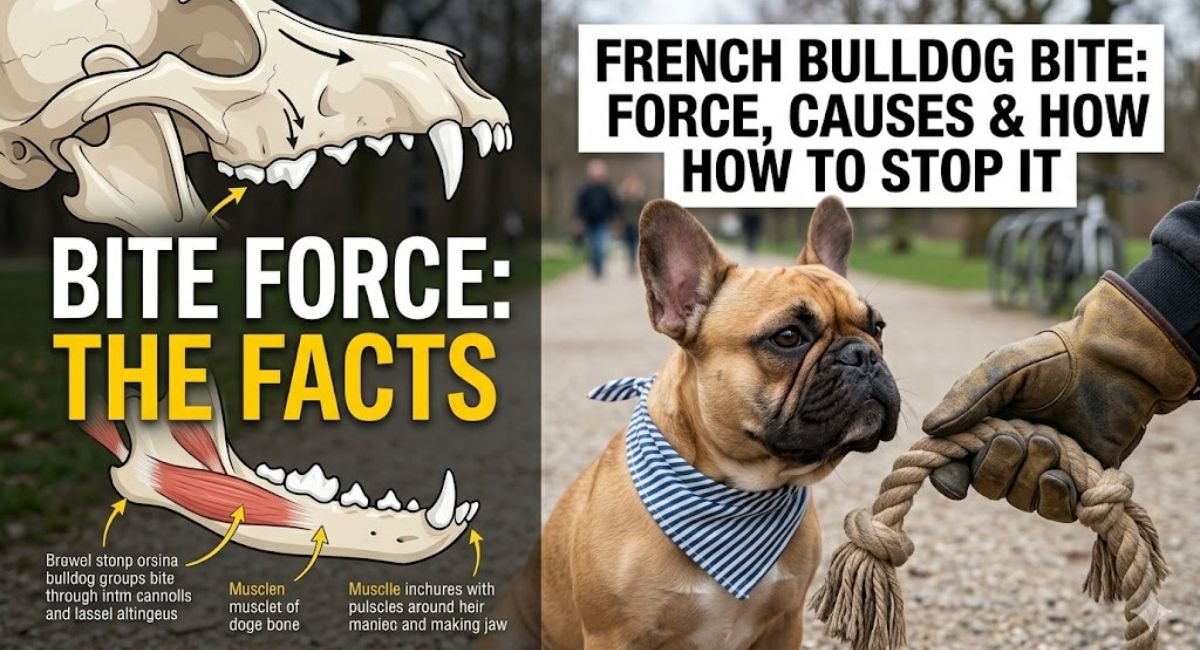
A small bat-eared dog locked onto a pant leg. A “sweet” Frenchie that suddenly growls when someone walks past her food bowl. A puppy whose adorable nibbling turned into a real bite somewhere around six months old. These scenarios fill Frenchie owner forums every week, and most of the advice they get online misses the point.
A French Bulldog bite is rarely random. There’s almost always a pattern leading up to it: a warning signal that got missed, a fear trigger nobody noticed, or a health issue hiding underneath the behavior change.
This guide breaks down the real bite force data, the five triggers behind 90% of Frenchie bites, the three-stage escalation pattern most owners never learn to read, and a step-by-step training protocol that actually works.
Table of Contents
What Is a French Bulldog’s Bite Force in PSI?
A French Bulldog’s bite force lands somewhere between 100 and 230 PSI (pounds per square inch), with the most reliable veterinary range sitting at roughly 140–180 PSI. That puts the breed in the moderate range for domestic dogs, far below the Rottweiler’s 328 PSI or the German Shepherd’s 238 PSI, but still capable of causing real injury when a situation escalates.
Here’s the truth most articles skip: no comprehensive scientific study has been run on French Bulldog bite force under controlled conditions. The figures above come from research on similarly sized breeds, cadaver reconstructions, and skull biomechanical modeling. Even those methods carry known flaws, most dog bite pressure studies test dogs under general anesthesia, which can’t replicate the force a genuinely threatened or provoked dog applies in the real world.
Why the Frenchie’s Skull Shape Matters
French Bulldogs belong to the brachycephalic group, they carry short, broad, compressed skulls. That signature flat-faced look (the same feature that makes them so distinctive) actually works against bite force. The shortened muzzle reduces the mechanical leverage that longer-jawed dogs use to generate power.
Breeds with longer muzzles, like German Shepherds or Belgian Malinois, get more jaw muscle leverage and can apply significantly more concentrated force at the tip of the jaw. French Bulldogs have those same jaw muscles packed into a much more compact arrangement, which lowers peak biting efficiency.
The brachycephalic skull also contributes to dental crowding, which affects how cleanly a Frenchie bites and chews. That alone explains why so many Frenchies struggle with tougher chew toys or bones.
French Bulldog Bite Force vs. Other Bulldogs
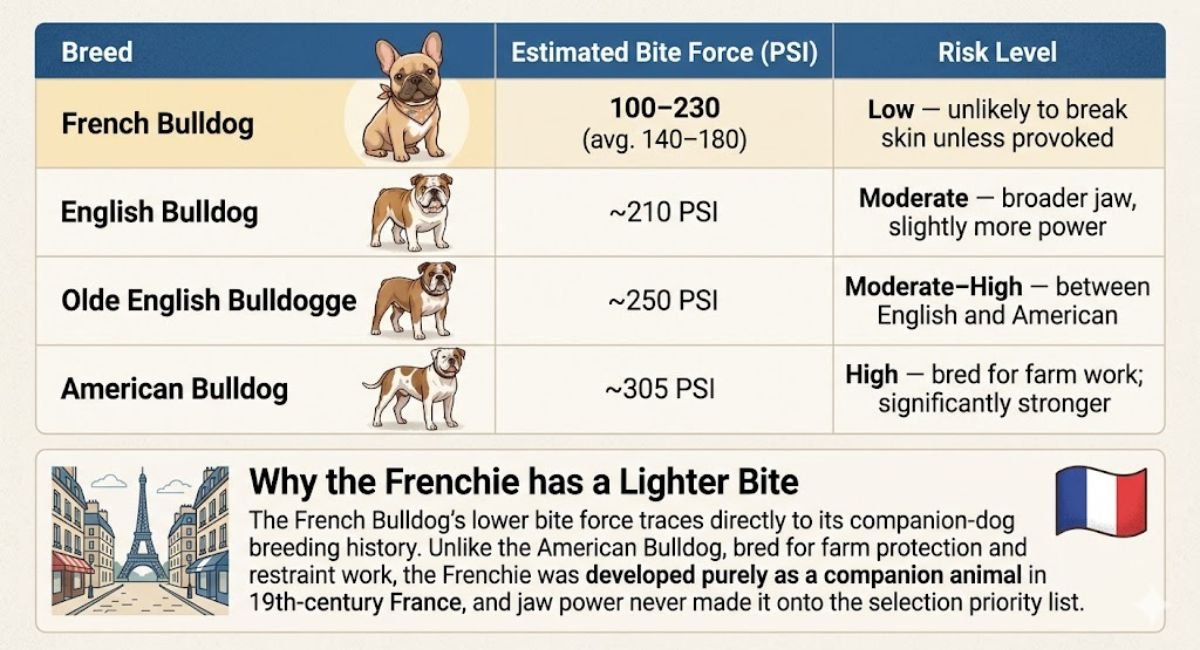
| Breed | Estimated Bite Force (PSI) | Risk Level |
| French Bulldog | 100–230 (avg. 140–180) | Low — unlikely to break skin unless provoked |
| English Bulldog | ~210 | Moderate — broader jaw, slightly more power |
| American Bulldog | ~305 | High — bred for farm work; significantly stronger |
| Olde English Bulldogge | ~250 | Moderate–High — between English and American |
The French Bulldog’s lower bite force traces directly to its companion-dog breeding history. Unlike the American Bulldog, bred for farm protection and restraint work, the Frenchie was developed purely as a companion animal in 19th-century France, and jaw power never made it onto the selection priority list.
Does a French Bulldog Bite Hurt?
Yes. The honest answer depends on the type of bite.
A playful nip from a Frenchie feels like a firm pinch. It’s uncomfortable, but rarely breaks skin on an adult. A warning snap is faster and sharper, designed to communicate, not injure. Most experienced trainers and behaviorists read it as the dog’s clearest way of saying back off.
A full defensive bite is a different story entirely. Owners who have been bitten while separating a dog fight describe a bite that tears through denim, breaks skin, leaves puncture wounds, and produces bruising that lingers well over a week. The breed’s bite consistently delivers more damage than people expect from such a small dog.
The severity of a French Bulldog bite depends on:
- Context: Defensive bites (fear, pain, resource guarding) hit much harder than play bites
- Individual temperament: A well-socialized Frenchie bites very differently from an anxious or under-trained one
- Body part bitten: Thinner skin areas, hands, ankles, children’s faces, are far more vulnerable
- Provocation level: A Frenchie pushed past its warning threshold bites significantly harder than one giving a routine signal
The 3-Stage Bite Escalation Pattern Most Owners Miss
This is the content gap almost every Frenchie resource fails to cover clearly. Most dogs, French Bulldogs included, don’t go from calm to biting with zero warning. What looks like a “sudden attack” is almost always the result of ignored earlier signals.
Stage 1: Soft Warnings (Often Missed)
- Whale eye (showing the whites of the eyes)
- Ears pinned flat or rotated back
- Yawning or lip-licking in a tense context (not just after eating)
- Stiff, frozen body posture
- Slowly turning the head away
Stage 2: Hard Warnings (Visible but Often Dismissed)
- Low growling, a sustained, low-frequency sound that differs from play growling
- Wrinkled muzzle or bared teeth without snapping
- Stiff body with raised hackles along the spine
- A fixed, unblinking stare
Stage 3: Escalation (Active Bite Behavior)
- Snapping: a warning bite that stops short of contact
- Lunging: often a bluff charge: forward movement without full contact
- A full bite
The critical mistake many owners make is suppressing Stage 1 and 2 warnings through punishment. When a Frenchie gets scolded for growling, it learns to suppress that warning, and the next escalation jumps straight from tension to biting with no audible signal. Dogs that supposedly “bite without warning” are almost always dogs whose early warnings were trained out of them.
5 Root Causes of French Bulldog Biting
Animal behavior research consistently shows that roughly 90% of dog-on-human aggressive behavior is rooted in fear. For French Bulldogs specifically, five triggers account for the vast majority of biting incidents.
1. Fear and Threat Perception
A Frenchie that feels cornered, startled, or overwhelmed will bite defensively. This shows up most often in dogs with poor early socialization, those not exposed to a range of people, sounds, environments, and animals during the critical window between 3 and 14 weeks of age.
The American Veterinary Society of Animal Behavior (AVSAB) identifies early socialization as the single strongest predictor of adult dog bite risk. A Frenchie properly socialized before 16 weeks is dramatically less likely to bite out of fear than one raised in isolation.
2. Resource Guarding (Possessive Aggression)
This is one of the most misunderstood triggers. Resource guarding kicks in when a Frenchie believes someone is approaching or threatening something they value, food, a favorite toy, a couch spot, even a specific person.
In mild cases, a guarding Frenchie stiffens, turns the head, or shows whale eye. In severe cases, a growl, snap, or bite follows immediately. The confusion comes from misreading the behavior as “bad”, but guarding resources is a deeply instinctive survival behavior. It’s also entirely manageable with proper behavioral work.
3. Pain or Underlying Medical Issues
A French Bulldog that suddenly starts biting, especially one with no prior history, deserves a vet workup before any behavioral training begins.
Pain-driven aggression is common in Frenchies dealing with:
- Intervertebral disc disease (IVDD): a spinal condition disproportionately common in brachycephalic breeds
- Joint pain or arthritis in older dogs
- Ear or skin infections; Frenchies are prone to both because of their skin fold anatomy
- Dental pain: crowded teeth in the brachycephalic skull cause chronic discomfort
- Thyroid imbalance: low thyroid function has been linked to sudden-onset aggression in dogs
A veterinary exam and bloodwork should be the first step whenever bite behavior shows up suddenly in an adult dog without prior history.
4. Teething in Puppies
French Bulldog puppies between 3 and 6 months go through an active teething phase. Biting and chewing during this stage is entirely normal, it relieves gum discomfort from erupting adult teeth, helps puppies explore their world, and teaches bite inhibition naturally through play with littermates.
The trouble starts when puppy biting goes uncorrected. What feels like an adorable nibble at 8 weeks becomes a painful chomp at 8 months. Bite inhibition training has to start during the puppy biting phase, not after it becomes a problem.
5. Anxiety and Separation Distress
French Bulldogs were bred to be companions, which makes them unusually susceptible to separation anxiety. A Frenchie left alone for long stretches, under-stimulated, or living in a high-stress household often develops anxiety-driven behaviors, including destructive chewing and redirected biting.
In these cases, biting isn’t aggression. It’s a symptom. Resolve the underlying anxiety through environmental enrichment, behavioral conditioning, or (in severe cases) vet-prescribed medication, and the biting behavior usually resolves with it.
Male vs. Female French Bulldog Biting: What the Research Shows
The link between sex and bite tendency in French Bulldogs is more nuanced than most guides acknowledge.
Unneutered males show more territorial and same-sex aggression, especially toward other male dogs. Testosterone-driven behaviors, resource guarding, boundary assertion, register more strongly in intact males. Neutering reduces those tendencies but doesn’t eliminate them. Individual temperament and socialization history remain stronger predictors than sex alone.
Female French Bulldogs aren’t immune. Resource guarding and fear-based aggression show up at equal frequency across both sexes when socialization and training are absent. Female Frenchies may also display heightened protectiveness during heat cycles or when nursing a litter.
The bottom line: sex is a secondary factor. Early socialization, consistent training, and medical wellness are far stronger determinants of a Frenchie’s bite behavior than male vs. female.
How to Train a French Bulldog Not to Bite: A Step-by-Step Protocol
The bite inhibition protocol below works for both puppies and adult Frenchies showing early-stage biting behavior. For dogs already displaying Stage 3 escalation (snapping, lunging, full bites), skip home training and contact a certified applied animal behaviorist (CAAB) or veterinary behaviorist directly.
Step 1: Establish the “No Bite” Signal
Pick one consistent verbal marker, a firm, calm “no bite” delivered the instant the nip happens. Not shouted. Not high-pitched. Frenchies are sensitive dogs, and harsh correction backfires fast. An agitated or loud tone often gets read as matching the dog’s energy, which escalates the situation rather than calming it.
Step 2: Use the “Game Over” Method
Right after the verbal marker, withdraw all interaction:
- Tuck hands into pockets or cross them at the chest
- Break eye contact completely
- Ignore the dog for 20 to 60 seconds
- Then calmly resume normal interaction
This method communicates that biting causes the one thing a companion-bred Frenchie hates most, losing attention and engagement.
Step 3: Redirect to an Approved Chew Item
Once the “game over” pause ends, offer a durable chew toy or rubber enrichment feeder. Praise calm chewing on the appropriate item. This teaches the Frenchie what to do with its mouth, not just what to avoid.
Good chew options for Frenchies include rubber Kong toys, bully sticks, and dental chews designed for strong chewers. Skip rawhide and very hard bones, they’re risky given the breed’s dental structure.
Step 4: Diversified Socialization
From puppyhood into adulthood, controlled exposure to a range of environments, people, animals, and sounds dramatically reduces fear-based bite triggers. AVSAB recommends keeping every socialization experience positive, never forcing the dog into overwhelming situations, and continuing socialization consistently throughout the dog’s life, not just in puppyhood.
Step 5: Reinforce Calm Behavior Consistently
Reward every instance of calm behavior in a previously triggering situation with a high-value treat and quiet praise. Over time, consistent positive reinforcement builds new associations, strangers approaching, food bowl nearby, the doorbell ringing, and pairs them with calm, rewarded responses instead of stress.
When to Seek Professional Help
Professional intervention by a certified animal behaviorist or veterinary behaviorist makes sense when:
- Biting has reached Stage 3 (snapping, lunging, or a full bite has happened)
- Biting shows up suddenly in an adult dog with no prior history
- The dog doesn’t respond to consistent home training after 4–6 weeks
- Biting is directed at children or vulnerable household members
Regular trainers without behavioral certification often aren’t equipped for genuine aggression cases. Look for a CAAB (Certified Applied Animal Behaviorist) or a DACVB (Diplomate of the American College of Veterinary Behaviorists) credential when the issue has moved beyond basic bite inhibition.
Are French Bulldogs Dangerous?
Short answer: no, not by breed standard or temperament design.
Peer-reviewed animal behavior literature consistently identifies Jack Russell Terriers, Chows, and Dachshunds as the breeds most likely to bite humans, not French Bulldogs. Veterinary behaviorists widely consider Frenchies one of the lower-bite-risk small breeds, provided they receive appropriate socialization, training, and veterinary care.
The risk isn’t zero. Any dog can bite under the right circumstances. But a well-socialized, well-trained French Bulldog is far more likely to respond to a perceived threat with a bark or a retreat than with a bite.
Final Thought
A French Bulldog’s bite force sits in the moderate range at an estimated 140–180 PSI, real enough to cause injury, but nowhere near the top of the canine world. The more important question isn’t how hard a Frenchie bites, it’s why they bite. Fear, resource guarding, pain, teething, and anxiety account for nearly every biting incident in this breed.
The three-stage escalation pattern gives owners a real framework for catching trouble before it reaches the bite. With consistent bite inhibition training, early socialization, and prompt vet attention when behavior changes suddenly, French Bulldog biting becomes a manageable and largely preventable, problem.
For a Frenchie whose biting has already reached the snapping or lunging stage, a consultation with a certified applied animal behaviorist is the fastest path forward. Not because the situation is hopeless, but because professional guidance shortens the timeline and gets results home training alone rarely achieves.
Note: This article is intended for general informational purposes only. For French Bulldogs displaying serious aggression, always consult a licensed veterinary behaviorist or certified applied animal behaviorist. A veterinary exam should come first to rule out medical causes before any behavioral intervention begins.

Auston is the founder of Frenchie Nova and a longtime French Bulldog owner. He writes practical, research-backed guides on Frenchie care, feeding, and health. Not a veterinarian — always consult your vet for medical concerns.