


Most Frenchie owners spot a feeding problem six months too late. The waistline disappears slowly. The snore gets a little louder. The walks end with heavier panting than they used to. None of it screams “obesity” or “underfed” and that’s exactly what makes French Bulldogs so tricky to read. Their stocky build hides extra weight. Their short snouts make breathing changes look like normal Frenchie breathing.
This guide breaks down 12 reliable signs of overfeeding or underfeeding your Frenchies, early signs first, late signs last, with the exact rib-feel test vets use and two free calculators built right in so the guessing stops here.
Table of Contents
Why French Bulldogs Are Especially Hard to Read
French Bulldogs sit in a strange spot among dog breeds. They’re brachycephalic, meaning their short snouts and compressed skulls change how every nutrition imbalance shows up. They have stocky, muscular frames that hide weight gain longer than slimmer breeds like Whippets or Beagles. And they have one of the most food-driven personalities in the dog world, overfeeding feels like love instead of harm.
The result? Most owners only notice a real problem once it’s already advanced. By the time a Frenchie “looks” overweight, the joints are already strained and the airway is already compromised. The same delay works the other way too. An underfed Frenchie often looks normal for weeks before the coat dulls and the energy drops off.
This is why pattern recognition matters more than a single glance at the scale.
What a Healthy Frenchie Should Actually Weigh
Before going through the signs, the baseline numbers matter. According to breed standards followed by veterinarians and the American Kennel Club:
- Adult female French Bulldog: 20–28 lb (9–13 kg)
- Adult male French Bulldog: 23–30 lb (10.5–14 kg)
- Daily calorie target (average adult): 550–600 kcal
- Highly active or working adults: up to 750–825 kcal
- Senior or neutered Frenchies: reduce by roughly 30%
These ranges aren’t gospel. Bone density, muscle mass, and bloodline all play a role. A pet-line Frenchie with a heavier frame might land at 30–32 lb and still be perfectly healthy. That’s why veterinarians lean on the Body Condition Score (BCS), a 1-to-9 scale where 4 to 5 is ideal, instead of the scale alone.
The Hand-on-Rib Test: The First Check Every Owner Should Do
Before any visual sign, the hand-on-rib test is the single best diagnostic at home. It’s exactly the check vets use during a Body Condition Score evaluation, and it works on every Frenchie regardless of coat color or build.
Step 1: Place both hands flat on the sides of the Frenchie’s ribcage, just behind the front legs.
Step 2: Use light pressure, the same pressure used to feel your own knuckles through skin.
Step 3: Interpret what you feel:
- Ribs felt easily without pressing → healthy weight (BCS 4–5)
- Ribs felt only with firm pressure → likely overweight (BCS 6–7)
- Ribs feel sharp with no fat layer → underweight (BCS 3)
- Each rib visible without touching → significantly underweight (BCS 1–2)
The waist check goes with this. Looking down from above, a healthy Frenchie shows a clear inward curve behind the ribcage, never a straight tube, never an hourglass extreme. From the side, the belly should slope gently upward from chest to hind legs. This is called the abdominal tuck, and it’s the single visual that the Association for Pet Obesity Prevention recommends checking monthly.
Run a quick Body Condition Score now to see exactly where your Frenchie sits on the 1–9 scale before reading on.
Body condition score
Check your Frenchie’s body condition
6 Signs You are Overfeeding Your Frenchie
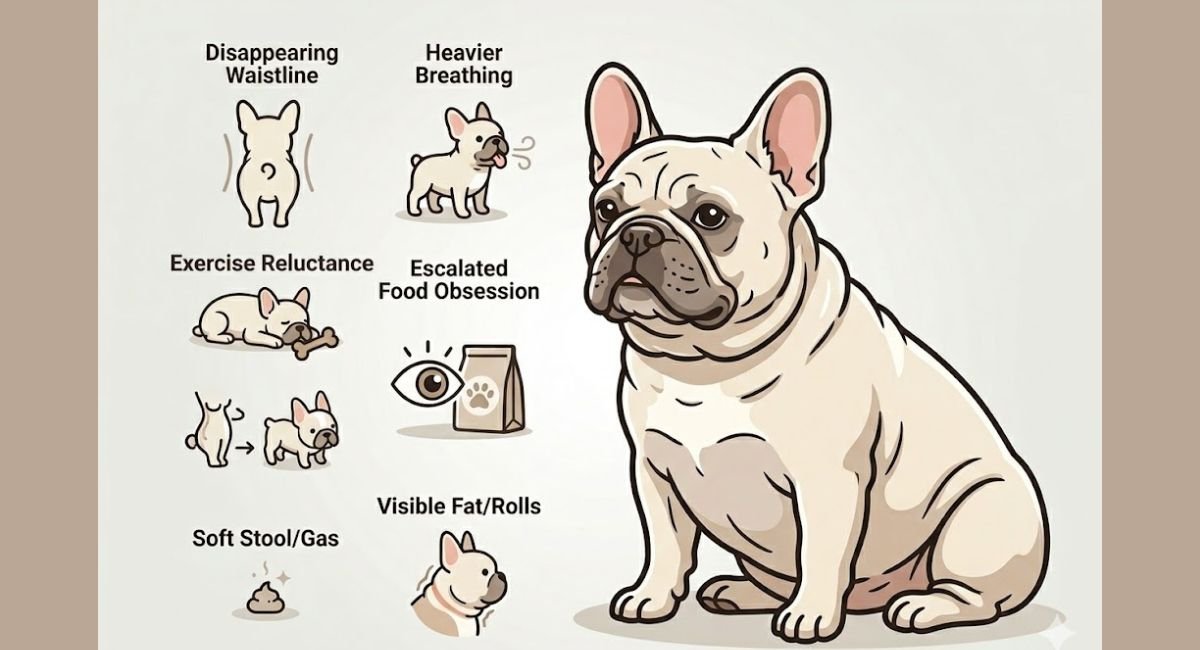
Overfeeding shows up across four areas, body shape, breathing, behavior, and digestion. The earliest signs are the easiest to dismiss, which is why they’re listed first.
1. The Waistline Is Disappearing (Early Sign)
From above, a healthy Frenchie has a clear narrowing behind the ribcage. When that narrowing flattens into a straight line — or worse, bulges outward, fat is being stored along the flanks. This is usually the first visible sign of overfeeding, showing up weeks before the dog looks obviously overweight.
The collar test is another quiet warning. A collar that fit comfortably six months ago and now sits tighter is a small but reliable signal that portions have crept up.
2. Heavier Breathing During Normal Activity (Early Sign)
French Bulldogs already breathe with more effort than most breeds because of Brachycephalic Obstructive Airway Syndrome (BOAS). Overfeeding makes BOAS worse fast. Extra weight compresses the chest cavity and adds fat around the airway tissues, increasing the work required for every breath.
The pattern to watch for: a walk that used to be easy now ends with heavy panting. The snore at night gets louder. Recovery from short play sessions takes longer than it used to. A 2024 UK study published in Scientific Reports directly linked excess weight in brachycephalic breeds to worsened BOAS symptoms and a shorter lifespan.
3. Reluctance to Exercise or Play (Early-to-Mid Sign)
A Frenchie that used to initiate play and now lies still during walk time isn’t always just aging or feeling lazy. Excess weight makes movement uncomfortable. Joint pressure rises, breathing gets harder, and the dog picks rest over activity every time.
This sign trips owners up because Frenchies are already known as a low-energy breed. The right question to ask: has activity dropped against this dog’s normal baseline, not against the breed average?
4. Begging and Food Obsession Have Escalated (Behavioral Sign)
Here’s the counterintuitive part: overfed dogs often beg more than properly fed dogs, not less. Veterinary nutritionists cited by Burns Pet Nutrition explain that consistent overfeeding can dysregulate hunger cues, training the dog to chase food whenever it’s visible rather than respond to actual hunger.
Signs to watch for:
- Sitting by the food bowl outside meal times
- Stealing or scavenging more than before
- Aggressive interest in human food
- Eating very quickly with little chewing
That “starving” stare from a Frenchie doesn’t mean starvation. It usually means the routine has been overcorrected with extras and snacks.
5. Soft Stools, Gas, or Digestive Discomfort (Mid Sign)
Overfeeding overloads the digestive tract. The classic pattern, documented by Burns Pet Nutrition founder John Burns, is normal stool in the morning and soft stool by evening. Excessive flatulence, abdominal gurgling, and intermittent vomiting after meals are also linked to chronic overfeeding, even when the dog still looks okay.
There’s another digestive risk Frenchie owners need to know about: aerophagia. Because of their flat-faced anatomy, French Bulldogs gulp down air while eating, especially when they eat too fast or from a deep bowl. That trapped air leads to gas, discomfort, and in serious cases, a life-threatening condition called Gastric Dilatation-Volvulus (GDV or “bloat”). Using a slow-feeder bowl or a tilted/wide shallow bowl helps a Frenchie eat at a safer pace and cuts air intake significantly.
If a Frenchie ever appears restless, paces while hunched over, and attempts to vomit without success, that’s an emergency. GDV requires an immediate vet visit. No home remedy works.
6. Visible Fat Deposits and Rolls (Late Sign)
By the time fat is clearly visible, rolls around the neck, a thick “saddle” along the spine, a sagging belly that doesn’t tuck, overfeeding has been happening for months. At this stage the Frenchie sits in the BCS 7–9 range, which veterinary research links to a measurable drop in lifespan plus higher rates of arthritis, diabetes, heart disease, and pancreatitis.
VCA Animal Hospitals reports that overweight dogs live nearly 1.8 years less on average than their healthy-weight counterparts. For a breed already facing a shortened lifespan from brachycephalic anatomy, that loss hits hard.
6 Signs You are Underfeeding Your Frenchie
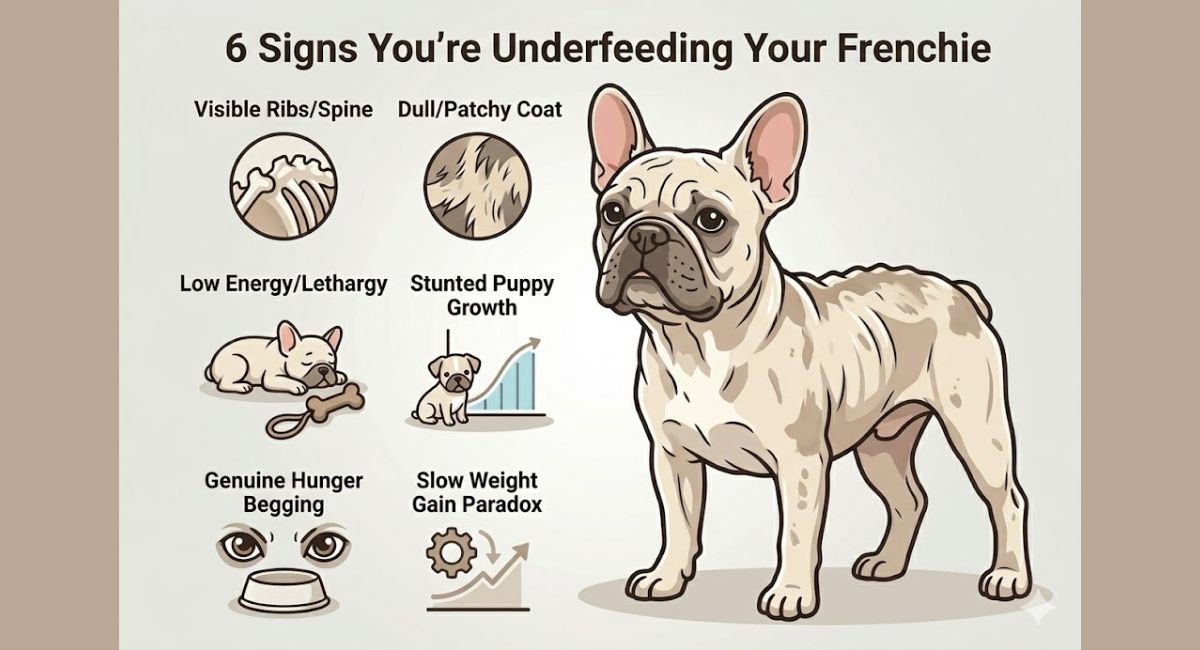
Underfeeding is less common than overfeeding in this breed but more dangerous when it happens. Frenchies don’t have the muscle and fat reserves of larger dogs, so deficiencies show up faster and hit harder. The Humane Society actually classifies chronic, intentional underfeeding as a form of animal cruelty, but accidental underfeeding from generic package guidelines is far more common than most owners realize.
1. Visible Ribs, Spine, or Hip Bones (Visual Sign)
The opposite of the overfed Frenchie. If individual ribs are visible from a distance, not just felt, without the dog being wet or shaved, weight is too low. The same applies to a visible spine or protruding hip bones. A healthy Frenchie has a soft layer of muscle and fat covering the skeleton, never a “skin and bones” outline.
One important exception: the “lanky stage.” Many Frenchies go through a stretch between 7 and 12 months when they look genuinely too skinny. Limbs grow before muscle and fat catch up. If a young Frenchie is in this window, eating normally, and energetic, the lanky look is usually a phase, not a feeding problem.
What’s never normal is seeing the full ribcage at rest in an adult dog.
2. Dull, Brittle, or Patchy Coat (Mid Sign)
A Frenchie’s coat is one of the most honest indicators of nutritional status. When calories or essential nutrients fall short, the body redirects resources away from coat maintenance because skin and hair aren’t survival-critical.
What to watch for:
- A coat that’s lost its shine
- More shedding than the breed’s usual moderate amount
- Patches of thinner fur, especially along the back
- Flaky or dry skin alongside coat changes
These signs often get blamed on allergies or “just the season.” But persistent coat decline without an environmental change is more often a feeding issue, and Frenchies on cheap or unbalanced food show it especially fast.
3. Low Energy or Lethargy (Behavioral Sign)
Underfed Frenchies don’t just slow down, they lose interest. The energy they’d normally spend on play, exploration, or greeting visitors gets conserved for basic survival functions. A young or middle-aged Frenchie that suddenly sleeps significantly more than usual, with no other illness signs, needs both a calorie review and a vet check to rule out underlying medical causes.
4. Stunted Growth in Puppies (Critical Sign)
For puppies, underfeeding has consequences adult dogs don’t face. Bone growth, brain development, and immune system maturation are all calorie-dependent. A French Bulldog puppy under one year that isn’t tracking on the standard growth curve, falling well below 4–8 lb at 8 weeks, or significantly under 16–22 lb at 8 months, needs both a vet visit and a feeding review.
AAFCO growth standards require 22% minimum protein and 8% fat by dry matter for puppy food. Foods below those levels, or correct foods fed in too-small portions, both lead to the same outcome: a smaller, weaker adult dog.
5. Begging That Looks Like Genuine Hunger
Begging from an overfed dog is conditioning. Begging from an underfed dog is physiology. The difference matters but isn’t always obvious.
Signs the begging is real hunger, not habit:
- Eating food immediately and completely, not playing with it
- Looking for food in unusual places (under tables, in trash)
- Frantic eating speed at meals
- Weight loss continuing despite the begging
When begging behavior pairs with measurable weight loss, the calorie target is set too low.
6. The Paradox: Slow Weight Gain Despite Low Food Intake
This one catches many owners off guard. Chronic underfeeding can actually trigger weight gain once normal feeding resumes. The metabolism slows down to conserve energy under restriction, and when food returns to normal levels, the body stores fat more efficiently than before.
That’s why some Frenchies on extended “diet” portions don’t lose weight as expected, and may even gain when portions go up. The fix isn’t more aggressive restriction. It’s correctly calculated daily calories for the dog’s actual weight and activity level, given enough time for metabolism to normalize.
Run your Frenchie’s real daily calorie need based on weight, age, and activity level before you adjust anything.
Daily calorie needs
How many calories does your dog need?
How Do I Know If My Frenchie Is Overweight?
Three checks together give the most reliable answer:
- Rib feel test. Ribs should be felt easily under light pressure. If firm pressure is needed, the dog is likely overweight.
- Waist check from above. A healthy Frenchie has a clear inward curve behind the ribs. No curve, or a bulge outward means excess fat.
- Abdominal tuck from the side. The belly should slope upward toward the hind legs. A flat or sagging belly is a red flag.
If two or three of those checks fail, the Frenchie is in BCS 6–9 territory, and portions need adjusting. A vet appointment makes sense for confirmation, especially before starting any weight-loss plan.
What’s the Ideal Body Condition Score for a French Bulldog?
The ideal BCS for a French Bulldog is 4 or 5 on the standard 1-to-9 scale used by PetMD, Purina, and the Association for Pet Obesity Prevention. At a 4 or 5, ribs are easily felt under a thin layer of fat, a clear waist is visible from above, and there’s a gentle abdominal tuck from the side. Anything 3 or below points to underweight; 6 or above points to overweight. Vets recommend a monthly BCS check at home, it catches drift earlier than the scale does.
How Many Calories Does a French Bulldog Need Per Day?
A typical adult Frenchie weighing 22–26 lb needs 550–600 kcal per day. Highly active Frenchies can need up to 750–825 kcal, while seniors or neutered dogs often need about 30% less, closer to 385–420 kcal for a 22-lb senior. The exact number depends on weight, age, neuter status, and activity. The simplest way to calculate: check the kcal-per-cup on the dog food label, divide by daily target, and split across two meals. Treats stay capped at 10% of the daily total, the well-known 10% treat rule used by every major veterinary nutrition source.
The 5-Minute Weekly Check (overfeeding or underfeeding your Frenchie)
Catching these signs early needs a habit, not a one-time inspection. Here’s a simple routine adapted from veterinary recommendations for Frenchie owners.
Once a week:
- Weigh the Frenchie on the same scale at the same time of day
- Run the hand-on-rib test
- Check the waist tuck from above
- Note any changes in breathing, energy, or stool quality
- Log everything in a notebook or phone app
Once a month:
- Run a full BCS score on the 1–9 scale
- Compare the weight against the previous month
- Photograph the dog from above and the side for visual comparison over time
Most veterinary nutritionists agree that weekly weigh-ins beat monthly vet visits for catching changes early. A swing of more than 5% body weight in either direction within a month is the threshold to act on.
Common Frenchie Feeding Mistakes That Cause Both Problems
Many feeding issues come from the same handful of habits. Watch for these:
- Following the dog food bag exactly. Package ranges are wide and generic. They assume an average dog with average activity, not a brachycephalic breed.
- Feeding one big meal a day. Frenchies have small stomachs and a real bloat (GDV) risk. Two meals daily for adults, three for puppies under 6 months.
- Free-feeding from a bowl left out all day. This trains overeating and makes portion control impossible.
- Ignoring the 10% treat rule. Treats count as calories. A handful of biscuits can blow past the daily allowance fast.
- Using a deep bowl. Brachycephalic snouts struggle with deep bowls. Tilted or shallow bowls are easier on the face and reduce air gulping.
- Adjusting portions without recalculating calories. Eyeballing “a little less” rarely works. The math has to be done from scratch.
When to Call the Vet
These signs warrant a same-week vet appointment, regardless of how the Frenchie looks otherwise:
- Persistent vomiting or diarrhea over 48 hours
- Sudden refusal to eat for more than one day
- Visible spine, hip bones, or full ribcage at rest in an adult
- Heavy breathing at rest (not just after activity)
- Rapid weight change of 5% or more in a month, in either direction
- Stunted growth or weight loss in a puppy
- Any sign of suspected bloat (GDV): restlessness, hunched posture, unsuccessful attempts to vomit, this is an emergency, not a same-week visit
For slower drifts, mild behavioral changes, soft stools, gradual coat dulling, adjusting the feeding plan and rechecking in two weeks is usually the right first step.
The Bottom Line
French Bulldogs are uniquely hard to read because their brachycephalic anatomy, stocky build, and food-driven personalities mask both overfeeding and underfeeding longer than other breeds. The signs are there, disappearing waistlines, heavier breathing, behavioral shifts, dulling coats, digestive irregularities, but they’re often dismissed until they’ve gone too far.
The fix is consistency. Weekly hand-on-rib checks, monthly BCS scoring, and an honest portion recalculation every time the food bag changes will catch problems early enough to fix without a crisis.
Score your Frenchie on the 1–9 BCS scale right now and see exactly where adjustments are needed.
Body condition score
Check your Frenchie’s body condition
Calculate your Frenchie’s exact daily calorie target based on current weight, age, and activity.
Daily calorie needs
How many calories does your dog need?
This guide draws on AAFCO feeding standards, VCA Animal Hospitals, the Association for Pet Obesity Prevention’s BCS protocol, Burns Pet Nutrition, PetMD’s body condition guidelines, a 2024 Scientific Reports study on brachycephalic breed longevity, and current veterinary nutrition research. Always consult a veterinarian when significant weight changes, persistent digestive issues, or coat decline are observed in a French Bulldog.

Auston is the founder of Frenchie Nova and a longtime French Bulldog owner. He writes practical, research-backed guides on Frenchie care, feeding, and health. Not a veterinarian — always consult your vet for medical concerns.