

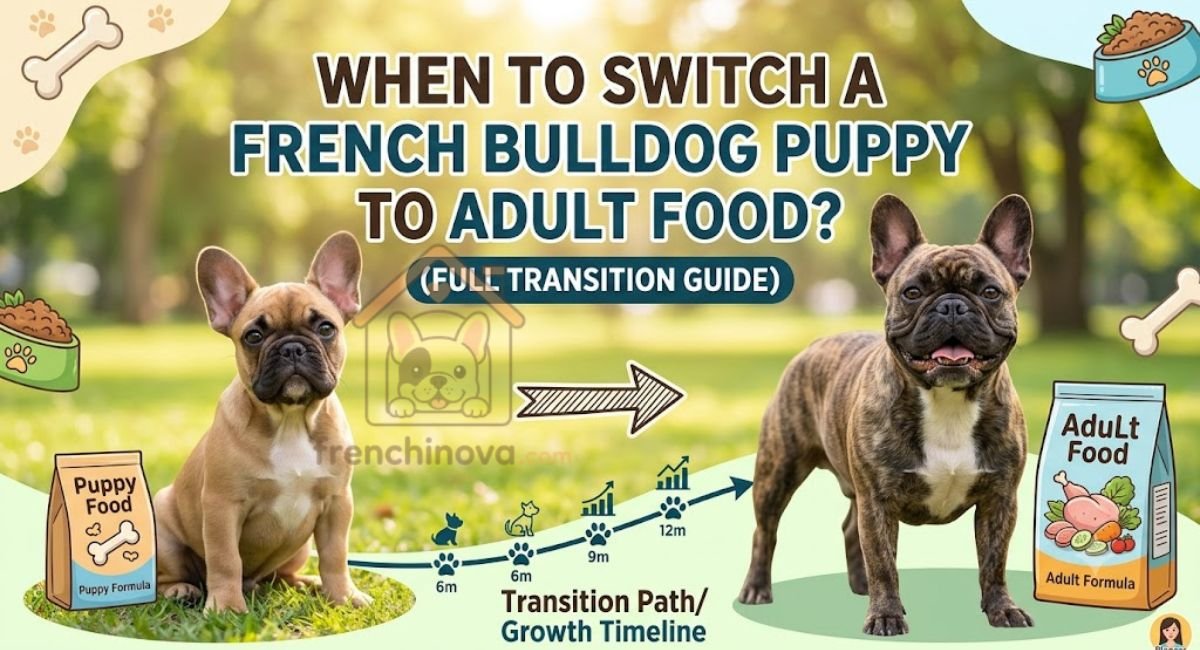
Somewhere around your Frenchie’s first birthday, a question creeps in: Is it time to switch off puppy food? It feels like it should be simple, but the bag doesn’t say, the breeder’s advice was vague, and switching at the wrong time, too early or too late, can actually work against your dog’s health.
Here’s the reassuring part. The timing isn’t a mystery once you know what to look for, and the switch itself is straightforward when done gradually. This guide French Bulldog Puppy to Adult Food covers exactly when to make the change for a French Bulldog, the signs your dog is ready, a week-by-week transition plan, how feeding changes as they become an adult, and the mistakes that trip owners up.
By the end, you’ll know precisely how to move your Frenchie into adulthood without a single upset stomach.
Table of Contents
When Should a French Bulldog Switch to Adult Food?
For most French Bulldogs, the switch occurs between 9 and 12 months of age, with 12 months being the most common target. Some Frenchies are ready a little earlier, others a little later, and that range is completely normal.
The reason small breeds like Frenchies switch around the one-year mark, rather than the 18 to 24 months a giant breed needs, comes down to growth speed. Small dogs sprint to maturity. A French Bulldog typically reaches full skeletal height and most of its adult weight by 10 to 12 months, while a Labrador or Bernese Mountain Dog is still filling out well past that. Fewer dogs to grow means a faster finish line.
A useful rule of thumb from the wider canine-nutrition world: most dogs are ready for adult food once they’ve reached roughly 75 to 85% of their full adult size. For a Frenchie heading toward the breed’s typical 20 to 28 pounds, that lines up neatly with that 9-to-12-month window.
Why Timing Actually Matters
This is not fussiness, there’s real nutrition behind getting the timing right, because puppy food and adult food are built for two different jobs.
Switch too early, and you cut off the extra calories, protein, and carefully balanced calcium your Frenchie still needs to finish growing. Puppy formulas are calorie- and nutrient-dense for a reason; pulling them too soon risks nutritional gaps right when the body is still building bone and muscle.
Switch too late and you run into the opposite problem. Puppy food is much higher in fat and calories than adult food. Once growth slows, those surplus calories stop fueling development and begin to be stored as body fat. In a breed already prone to obesity, and all the joint strain, breathing difficulty, and heart risk that come with it, staying on puppy food too long is a genuine hazard.
Getting the switch right is really about matching the food to the body’s changing needs at exactly the moment those needs change.
Signs Your Frenchie Is Ready for Adult Food
Age is a guide, but your individual dog gives clearer signals. Look for these signs that the transition window has arrived:
- Growth has plateaued. Your Frenchie has stopped getting taller, and their frame looks filled out.
- Weight has stabilized. The steady puppy weight gain has leveled off around the adult range.
- Energy has mellowed. That frantic puppy zoom-energy settles into a calmer adult baseline, meaning fewer calories are needed.
- They’re leaving food behind. Some pups naturally start eating a little less as growth slows, a sign their calorie needs are dropping.
If your Frenchie is hitting these markers around 9 to 12 months, it’s time. If you’re unsure, your vet can confirm based on body condition at a routine check-up.
How to Transition: A Week-by-Week Plan (French Bulldog Puppy to Adult Food)
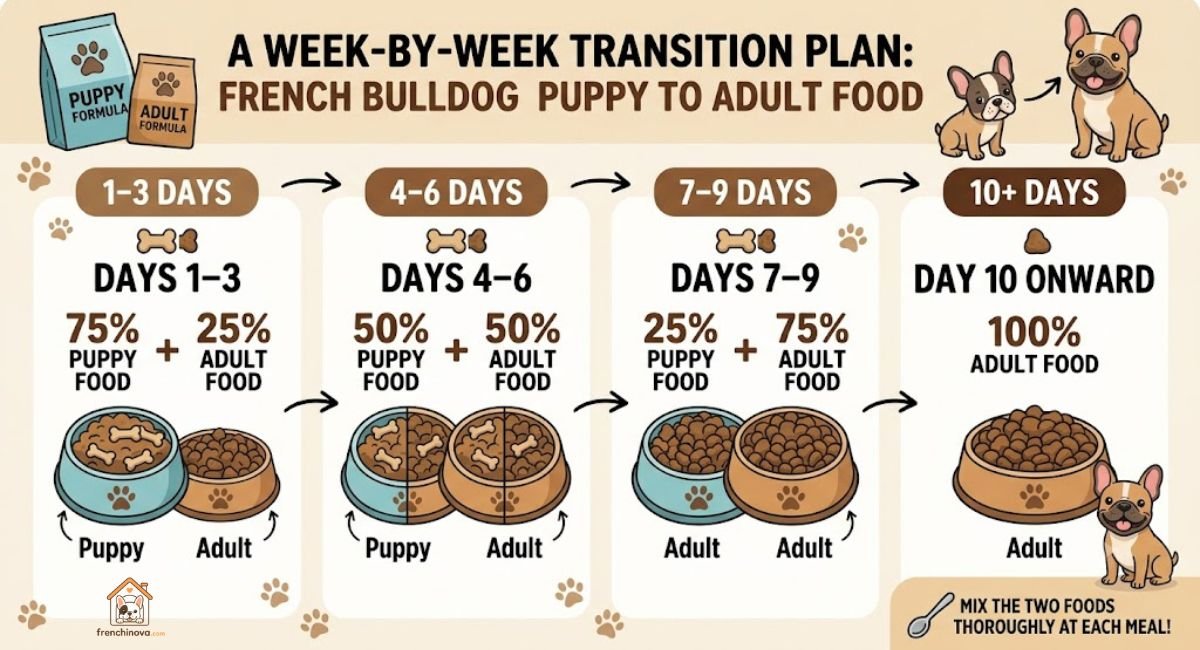
Never switch foods cold turkey, a sudden change is one of the most reliable ways to trigger the loose stool and stomach upset Frenchies are already prone to. Spread the change over about 7 to 10 days, gradually shifting the ratio. Here’s the standard approach:
- Days 1–3: 75% puppy food + 25% adult food
- Days 4–6: 50% puppy food + 50% adult food
- Days 7–9: 25% puppy food + 75% adult food
- Day 10 onward: 100% adult food
Mix the two foods thoroughly at each meal rather than serving them side by side, a clever Frenchie will happily eat the familiar food and leave the new stuff behind otherwise. Watch the stools as you go: firm means carry on, loose means slow down and hold the current ratio an extra day or two before progressing. For a Frenchie with a sensitive stomach, there’s no harm in stretching the whole process to two weeks.
What if the transition goes wrong?
Even with a careful plan, some Frenchies protest the change. Two issues come up most often. The first is loose stool or gas, almost always a sign that you are moving too fast. Drop back to the previous ratio, hold it for several days until stools firm up, then resume more slowly. The second is refusing the new food entirely. Frenchies can be stubborn, so if your dog picks around the adult kibble, try warming the meal slightly to boost the aroma, mixing in a spoonful of the same brand’s wet food, or slowing the ratio shift so the new taste creeps in more gradually.
If your puppy stops eating altogether for more than a day, or shows vomiting or lethargy, pause the transition and call your vet, that’s beyond normal fussiness.
Choosing the Right Adult Food for a Frenchie
The transition is also a chance to lock in a quality adult diet, and the same breed-specific rules that guided puppy food still apply. Frenchies do best on a clear, named protein source, chicken, turkey, lamb, salmon, sitting at the top of the ingredient list, not a vague “meat meal.” Steer clear of the common allergens this breed reacts to, like corn, wheat, and soy, along with artificial colors, flavors, and preservatives.
Beyond protein, look for an adult formula that supports the things Frenchies struggle with: omega-3 fatty acids for skin and coat, controlled fat levels to protect against pancreatitis and weight gain, and ideally added support for joints and digestion. Whatever you choose, check for the AAFCO statement confirming the food is “complete and balanced” for adult maintenance, that’s your guarantee it meets an adult dog’s full nutritional needs.
Many owners simply move to the adult version of the same brand they trusted for puppyhood, which also makes the transition flavor-wise a little smoother.
What Changes When Your Frenchie Becomes an Adult
The food isn’t the only thing that shifts at the one-year mark. Adulthood brings a few feeding changes worth planning for.
Meal Frequency Drops
Most adult Frenchies move from three puppy meals a day down to two, one morning, one evening. Some owners keep three smaller meals going because the breed digests modest portions more comfortably, and that’s perfectly fine.
Portions Settle
Adult Frenchies generally eat somewhere around 1 to 1.5 cups of quality food per day, split across their meals, though this varies with size and activity. The calorie guideline for the breed is roughly 25 to 30 calories per pound of body weight per day, active dogs at the higher end, couch-loving Frenchies at the lower.
Daily calorie needs
How many calories does your dog need?
Portion Control Becomes Critical
This is the big one. With growth finished and energy mellowing, an adult Frenchie’s biggest dietary risk is weight gain. Measure meals properly, count treats toward the daily total, and resist the begging. If your dog was recently neutered, calorie needs often dip further, so keep an eye on the waistline in the months afterward.
Food Quality Stillatters
Adulthood isn’t a reason to drop standards. Look for a high-quality adult formula with a clear protein source, support for digestion and joints, and none of the artificial fillers or common allergens this breed reacts to.
A Quick Look Further Ahead: Senior Years
It helps to know what comes next. Frenchies are generally considered seniors around 8 years old, and their needs shift again at that stage. Older dogs tend to slow down and burn fewer calories, so the same portion that kept an adult trim can start adding weight. Many seniors do well on a diet with fewer calories, added fiber, and extra omega-3s to support aging joints.
That is a transition for later, handled the same gradual way, but keeping it on your radar means you’ll recognize the signs when your Frenchie’s middle age starts winding down.
Common Mistakes to Avoid
A few predictable slip-ups catch Frenchie owners during the transition:
- Rushing the switch. Skipping the gradual ratio plan almost guarantees digestive upset.
- Switching on the calendar alone. A date is a guide; your dog’s growth and body condition are the real signals.
- Overfeeding adult portions. Adult food has fewer calories per cup, but that doesn’t mean piling it higher. Follow adult portions, not puppy habits.
- Ignoring a sensitive stomach. If your Frenchie reacts, slow down and pick an easily digestible adult formula rather than pushing through.
- Free-feeding the new adult. Leaving a full bowl out all day undoes portion control and feeds straight into the breed’s obesity tendency.
At what age should a French Bulldog stop eating puppy food?
Most French Bulldogs move off puppy food between 9 and 12 months, with 12 months being a common target. They’ve usually reached full height and most of their adult weight by then. Confirm with your vet if you’re unsure.
Can I switch my Frenchie to adult food at 6 months?
Generally, no, 6 months is too early. At that age, a Frenchie is still doing significant bone and muscle development and needs the extra calories and minerals in puppy food. Switching too soon risks nutritional gaps.
What happens if I keep my adult Frenchie on puppy food too long?
Puppy food is richer in fat and calories, so once growth stops, those extra calories turn into body fat. For an obesity-prone breed, that means added strain on joints, breathing, and the heart. Switch once growth finishes.
How long should the transition take?
After about 7 to 10 days, gradually increase the adult food while decreasing the puppy food. For a Frenchie with a sensitive stomach, stretching it to two weeks is even gentler.
Should I switch my Frenchie to two meals a day right away?
You can ease into it. Many Frenchies move from three meals to two around the time they switch to adult food, but plenty do well staying on three smaller meals, since the breed digests modest portions comfortably. Either works, just keep the daily total controlled.
Can I feed my adult Frenchie an “all life stages” food instead?
Yes. Foods labeled AAFCO “all life stages” are formulated to suit both puppies and adults, so they’re a valid option. Just be mindful of portions, since these foods can run richer than adult-maintenance formulas, and this breed gains weight easily.
The Bottom Line
Switching your French Bulldog from puppy to adult food comes down to reading the right signals and making the change slowly. Aim for the 9-to-12-month window, watch for plateaued growth and stabilized weight, and transition over a week or so by gradually shifting the ratio. From there, drop to two meals a day, settle into adult portions, and make portion control your top priority, because for this breed, the years after puppyhood are when the weight quietly creeps on.
Get this transition right, and you set your Frenchie up for a healthy, well-fed adulthood. As always, your vet is the best source for timing and food recommendations tailored to your individual dog.
For complete feeding guidance, see our French Bulldog puppy diet guide, our feeding chart, and our guide to food types.
This article is for general educational purposes and isn’t a substitute for veterinary advice. Consult your veterinarian about the right timing and adult food for your individual French Bulldog.

Auston is the founder of Frenchie Nova and a longtime French Bulldog owner. He writes practical, research-backed guides on Frenchie care, feeding, and health. Not a veterinarian — always consult your vet for medical concerns.