


Most new Frenchie owners walk into a breeder’s home expecting a low-maintenance lap dog. Three weeks later, the shoes are destroyed, the couch has been claimed, and the realization lands: this small dog has a very large personality.
That gap between expectation and reality drives more Frenchie surrenders than almost any other factor. The breed isn’t difficult, but it isn’t what most people picture, either. Frenchie temperament is a layered mix of deep affection, real stubbornness, surprising emotional sensitivity, and an adaptability that few breeds genuinely match.
This guide walks through every key trait that actually shapes daily life with a French Bulldog, the lovable ones, the challenging ones, and the ones most breed profiles quietly skip.
Table of Contents
Quick Breed Overview
| Trait | Detail |
| Height | 11–13 inches |
| Weight | Under 28 pounds |
| Lifespan | 10–12 years |
| Temperament | Friendly, affectionate, fun-loving, stubborn |
| Good for families? | Yes, with supervision for young children |
| Good with other pets? | Generally yes, with early socialization |
| Barking level | Low |
| Energy level | Moderate, short bursts, not a jogging partner |
| Trainability | Moderate, food-motivated but stubborn |
| AKC Group | Non-Sporting |
What Shapes Frenchie Temperament? A Brief History
Understanding where the breed came from explains almost everything about how it behaves today.
The Frenchie traces back to 19th-century England, where lace makers in Nottingham selectively bred a smaller, gentler version of the English Bulldog as a lap companion. When the Industrial Revolution displaced many of those workers, they crossed the Channel into France, bringing their miniature Bulldogs with them.
In France, the breed was further refined with likely terrier and Pug crosses and quickly became fashionable across Paris. Famous artists, including Edgar Degas and Henri de Toulouse-Lautrec, featured dogs resembling French Bulldogs in their paintings.
By the late 1800s, wealthy Americans visiting Europe had fallen for the breed and brought them home. The American Kennel Club officially recognized the French Bulldog in 1898, and the French Bulldog Club of America, the first breed-exclusive club in the world, was founded in 1897.
That history matters because Frenchies were never bred to work, hunt, or guard. Every generation of selective breeding pushed them in one direction: toward humans. That’s why their personality is shaped the way it is.
Frenchie Temperament: The 7 Core Traits Explained
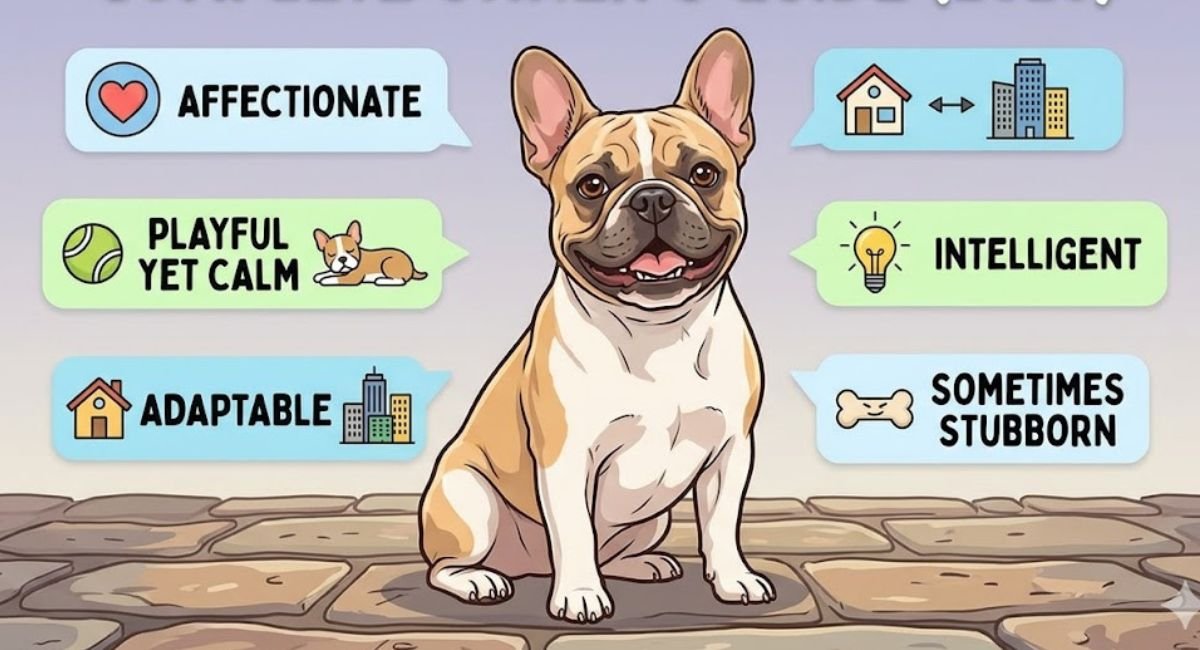
1. Deeply Affectionate: The “Velcro Dog” Effect
French Bulldogs are textbook “Velcro dogs”, they want to be close to their humans at all times.
This isn’t an exaggeration. A Frenchie doesn’t simply enjoy company, they require it. They follow their owner from room to room. They position themselves on their feet during work hours. They sleep pressed against their person whenever allowed.
For someone who wants a deeply bonded companion, this trait is the dream. For someone who travels frequently or works 10-hour days with no plan for the dog, it’s the first serious challenge to solve.
The clinginess traces back to the breed’s history as a companion animal, but it’s amplified by the breed’s well-documented tendency toward separation anxiety. Signs include destructive chewing, excessive vocalization, and house accidents, none of which reflect a “bad dog,” just a lonely one.
What helps: Gradual alone-time training from puppyhood, puzzle feeders, a consistent daily routine, and, for owners out long hours, doggy daycare or a midday dog walker.
2. Playful But Not High-Energy
The Frenchie temperament often gets misread as lazy. What’s actually happening is something more specific: a dog that plays in short, enthusiastic bursts and then happily recharges on the sofa.
Frenchies enjoy fetch, tug-of-war, and indoor play. What they don’t tolerate well is prolonged exercise in hot or humid weather. Their brachycephalic (flat-faced) anatomy makes breathing less efficient than long-nosed breeds, and overexertion in heat can escalate into a medical emergency fast.
Two 15-minute walks a day in cool or moderate weather are usually enough to keep a Frenchie in solid condition. In summer, early morning or late evening walks are strongly preferred.
3. Stubborn: An Honest Assessment
French Bulldogs carry big personalities in compact bodies. They’re stubborn enough to need more training than most breeds, but they’re also people-pleasers at heart.
Both sides of that statement matter.
The stubbornness shows up most often as selective hearing. Frenchies are smart enough to understand what’s being asked. They simply weigh whether it’s worth the effort. When the answer is no, they sit, stare, and wait their owner out with the patience of a chess grandmaster.
The fix is consistency, short training sessions, and, most importantly, food. Frenchies are almost universally food-motivated. A high-value treat in hand changes the entire dynamic. Harsh corrections or raised voices do the opposite: the dog shuts down, sulks, and becomes much harder to reach.
Puppy obedience classes are strongly recommended for first-time Frenchie owners. The earlier good habits get established, the easier the adult years become.
4. Sociable, With People, Kids, and Other Pets
Frenchies are social dogs by design. They carry low prey drive and tend to get along well with other dogs, cats, and even some small animals. Early socialization and careful supervision during introductions still matter, play between any two pets can escalate without warning.
With children, Frenchies are generally patient and gentle. The caution to flag is physical: Frenchies are compact, but they aren’t indestructible. The breed is prone to back and hip issues, so rough play with very young children needs adult supervision.
With strangers, most Frenchies are friendly rather than aloof. They aren’t suspicious dogs by nature, which makes them poor guard dogs, but excellent social companions.
One nuance: in multi-pet households, some Frenchies develop jealousy over attention. That isn’t aggression, it’s insecurity. Consistent rules, equal attention, and early socialization manage it well.
5. Alert, A Watchdog, Not a Guard Dog
Frenchies aren’t yappy, but they’ll bark to flag a stranger at the door. The breed has a mildly territorial streak, and that’s where the job ends. No one should expect them to be a guard dog.
The Frenchie’s low-bark tendency is one of the most practical traits for apartment and city living. Unlike terriers or many toy breeds that fire off at every sound, Frenchies are selective. When one barks, it usually means something.
Combined with their compact size and human attachment, that alert nature makes them surprisingly effective at signaling unusual activity, even if they lack the physical presence to do anything about it.
6. Sensitive, Emotions Run Deep
This is the trait new owners underestimate most.
Frenchies are emotionally perceptive. They pick up on household tension, shifts in mood, and, critically, tone of voice. A sharp reprimand that rolls off a Labrador can leave a Frenchie sulking for an hour.
That sensitivity isn’t a weakness. It means they’re highly attuned companions who respond directly to how they’re treated. It also means consistent, positive reinforcement isn’t just a suggestion, it’s the only training approach that works reliably with this breed.
7. Adaptable, The Rare Breed That Genuinely Fits Anywhere
Frenchies thrive in studio apartments in Manhattan and on farms in the countryside. The adaptability is real, not marketing.
They don’t need a yard. They don’t need a jogging partner. They need access to moderate exercise, consistent companionship, and a temperature-controlled environment.
That last point isn’t negotiable. Frenchies don’t tolerate extreme heat or cold. Air conditioning in warm climates is a health requirement, not a luxury.
Are French Bulldogs Good for Families?
Yes, with a few important caveats.
French Bulldogs fit family life well. They’re patient and agreeable with kids, but children need to learn appropriate handling first. Frenchies are small and prone to back and hip issues, which means injuries from rough play can be genuinely serious.
The breed tends to do best in families with children aged 6 and older, not because Frenchies dislike toddlers, but because younger children are harder to coach on gentle handling. With proper supervision and age-appropriate guidance for kids, Frenchies and children make an excellent match.
Male vs. Female Frenchie Temperament: Is There a Difference?
Male French Bulldogs tend to be more active, bold, and confident than females. They’re often more stubborn and take longer to mature emotionally. Males generally prefer playtime over cuddle time.
Female French Bulldogs tend to be calmer and more affectionate. They lean toward cuddling rather than rough play. Both sexes are friendly dogs, but females are often described as slightly sweeter in disposition.
That said, individual personality varies more than gender. A well-socialized male Frenchie from a reputable breeder will have far more in common with a well-socialized female than either will share with a poorly socialized dog of either sex.
Most vets recommend spaying or neutering, which can also soften some of the more dominant or territorial tendencies seen in unaltered dogs.
Frenchie Temperament and Training: What Actually Works
Training a Frenchie isn’t difficult, it just demands the right approach.
What works:
- Short sessions (5–10 minutes): attention spans aren’t long
- High-value food rewards: chicken, cheese, or commercial training treats
- Consistency: the same rules, every day, from every person in the household
- Positive reinforcement only: punishment shuts the dog down
- Early socialization: exposure to people, animals, sounds, and environments before 16 weeks builds a calmer, more confident adult
What doesn’t work:
- Repeated commands with no reward: the dog learns to ignore
- Harsh corrections: they sulk and disengage
- Long, repetitive sessions: boredom sets in fast
- Expecting instant results: patience is essential, especially in the first year
Frenchies respond particularly well to clicker training. The marker is precise, and the reward delivery is fast, a combination that suits their intelligence and short attention span perfectly.
Common Frenchie Behavioral Issues (and How to Handle Them)
Separation Anxiety
The most common behavioral issue in the breed. Manage it through gradual desensitization, short departures slowly extended over time. Keep departures and arrivals low-key. Dramatic goodbyes train the dog to dread them.
Destructive Chewing
Almost always a sign of boredom or anxiety, not aggression. Indestructible toys matter for this breed, those compact bulldog jaws shred lesser options fast. Puzzle feeders and durable chew toys give the dog the right outlet.
Stubbornness During Training
Address it with shorter sessions, better rewards, and more patience. Never punish — it backfires every time with this breed.
Resource Guarding
Some Frenchies become possessive over food, toys, or a specific person. “Trade” exercises, swapping the guarded item for a higher-value treat, work well in mild cases. Professional guidance helps when guarding behavior is severe.
Frenchie Temperament: Is This the Right Dog for You?
A few honest questions to sit with:
- Is someone home most of the day, or is there a solid plan for time alone?
- Can patience be sustained through a stubborn training phase?
- Does a dog that follows everywhere and wants constant closeness sound appealing, or overwhelming?
- Are the ongoing health costs of a brachycephalic breed sustainable long-term?
- Is air conditioning available in warm months?
If most of those answers are yes, Frenchie temperament is very likely a match for the household.
If the first answer is “I’m away 10+ hours a day with no plan,” that gap needs to be solved before any Frenchie comes home. This isn’t a breed that does well in isolation.
Final Thought
Frenchie temperament sums up in a single sentence: they’re companion dogs that take the word companion seriously.
They’re affectionate to the point of clinginess, playful without being exhausting, stubborn in ways that respond to the right approach, and adaptable to almost any living situation. When matched with an owner who genuinely understands what they’re signing up for, the bond becomes one of the most rewarding in the dog world.
The breed doesn’t ask for a lot of space, a lot of exercise, or a lot of experience. What it asks for is time, consistency, and a real commitment to being present.
For the right owner, that trade pays off every single day.
Note: This article is intended for general informational purposes only. For health, training, or behavioral concerns specific to an individual dog, always consult a licensed veterinarian or certified canine behaviorist.

Auston is the founder of Frenchie Nova and a longtime French Bulldog owner. He writes practical, research-backed guides on Frenchie care, feeding, and health. Not a veterinarian — always consult your vet for medical concerns.