


Most new Frenchie owners measure that first bowl of food with a mix of guesswork and hope. The bag gives a vague range, the breeder said one thing, the internet says five others, and the puppy, of course, acts starving no matter what. A clear chart cuts through all of it.
This feeding chart breaks down exactly how much to give a French Bulldog puppy feeding chart at each stage, by both age and weight, plus how to read your puppy’s body instead of just the cup. Print it, screenshot it, stick it on the fridge, it’s built to be the thing you actually glance at before each meal.
Table of Contents
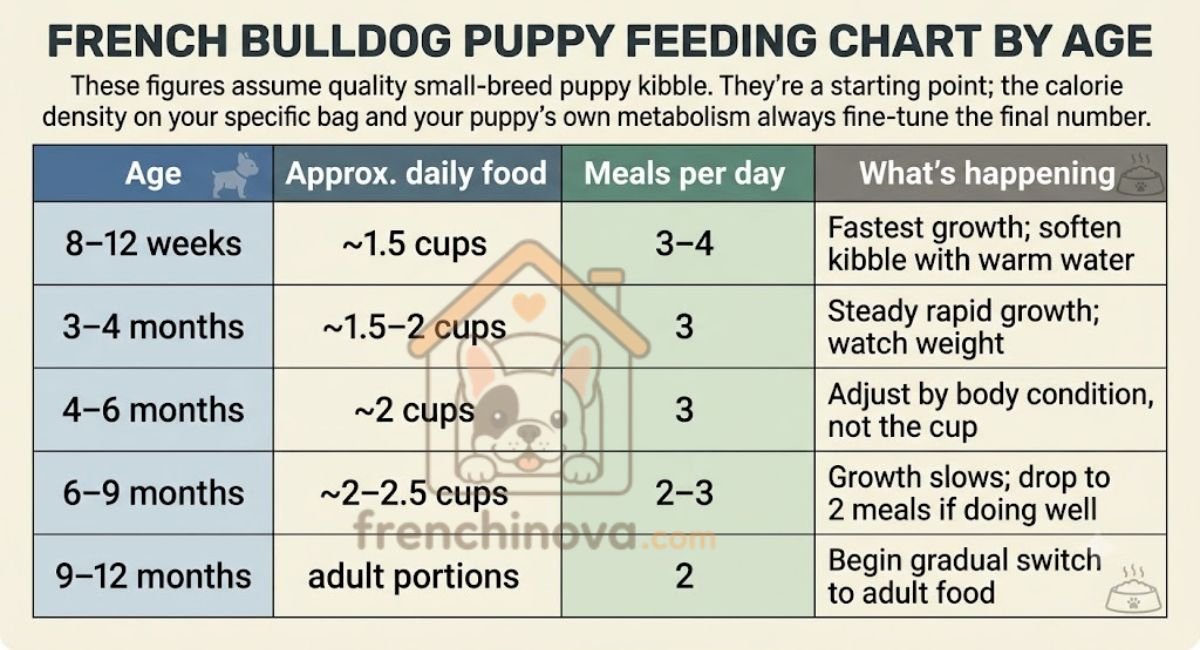
French Bulldog Puppy Feeding Chart by Age
These figures assume quality small-breed puppy kibble. They’re a starting point, the calorie density on your specific bag and your puppy’s own metabolism always fine-tune the final number.
| Age | Approx. daily food | Meals per day | What’s happening |
| 8–12 weeks | ~1.5 cups | 3–4 | Fastest growth; soften kibble with warm water |
| 3–4 months | ~1.5–2 cups | 3 | Steady rapid growth; watch weight |
| 4–6 months | ~2 cups | 3 | Adjust by body condition, not the cup |
| 6–9 months | ~2–2.5 cups | 2–3 | Growth slows; drop to 2 meals if doing well |
| 9–12 months | adult portions | 2 | Begin gradual switch to adult food |
French Bulldog Puppy Feeding Chart by Weight
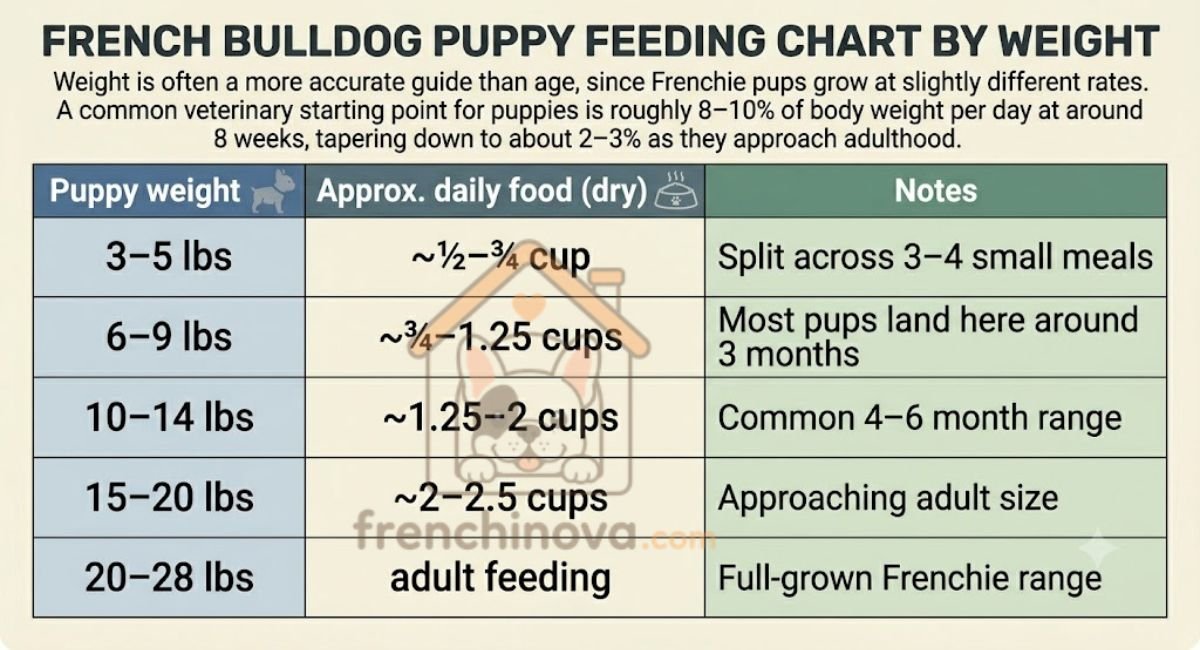
Weight is often a more accurate guide than age, since Frenchie pups grow at slightly different rates. A common veterinary starting point for puppies is roughly 8–10% of body weight per day at around 8 weeks, tapering down to about 2–3% as they approach adulthood.
| Puppy weight | Approx. daily food (dry) | Notes |
| 3–5 lbs | ~½–¾ cup | Split across 3–4 small meals |
| 6–9 lbs | ~¾–1.25 cups | Most pups land here around 3 months |
| 10–14 lbs | ~1.25–2 cups | Common 4–6 month range |
| 15–20 lbs | ~2–2.5 cups | Approaching adult size |
| 20–28 lbs | adult feeding | Full-grown Frenchie range |
For reference, a healthy adult French Bulldog weighs between 20 and 28 pounds and finishes most growth at 9 to 12 months, per American Kennel Club breed standards. If your puppy is tracking well above or below these ranges, that’s a conversation for your vet rather than a reason to drastically change portions on your own.
How Many Grams and Calories Is a “Cup,” Really?
Here’s the catch with any cup-based chart: a cup is a volume, not a fixed amount of food. Kibble density varies a lot between brands, so two different foods filling the same cup can deliver very different calories. As a rough anchor, a level US cup of small-breed puppy kibble usually weighs around 100 to 120 grams and carries somewhere between 350 and 450 calories, depending on the formula.
That range matters because French Bulldog puppies need roughly 25 to 30 calories per pound of body weight per day during active growth. So a 7-pound pup needs in the ballpark of 175 to 210 calories daily, which, with a calorie-dense food, can be less than a full cup. When in doubt, check the calories-per-cup figure printed on your bag (often listed as “kcal/cup”) and let that number, not the cup itself, guide the portion. Weighing food on a cheap kitchen scale is the most accurate approach of all.
How to Use the Chart the Right Way
A chart gives you a number. Your puppy’s body tells you if it’s the right one. The single best habit any Frenchie owner can build is the body condition check:
- Looking down from above: a healthy puppy shows a slight waist behind the ribs.
- Hands on the ribs: light pressure should let you feel the ribs, like the back of your hand. If you have to press hard, ease back on food. If ribs are sharply visible, add a little.
Do this check weekly. Cups and calorie densities vary so much between brands that the body condition score beats any printed chart every time.
Why Frenchie Puppies Eat So Often
Those 3–4 daily meals aren’t just convenience. French Bulldogs are a small-breed, brachycephalic dog with a fast metabolism, and young pups can burn through energy fast enough to risk hypoglycemia, a blood sugar drop that’s dangerous in small puppies. Frequent small meals keep blood sugar steady and are far gentler on a Frenchie’s famously sensitive stomach than one or two big servings.
Around six months, growth slows, and you can move to two or three meals a day. Plenty of owners keep three meals going well past that point simply because the breed digests smaller portions more comfortably.
What If Your Puppy Won’t Eat, or Eats Too Fast?
Two opposite problems trip up Frenchie owners, and both have simple fixes.
The picky eater.
Frenchies can be dramatic about plain kibble. If your pup turns up its nose, try mixing in a spoonful of wet food from the same brand, stirred until uniform so they can’t pick out only the tasty bits. Warming the food slightly or softening kibble with warm water also boosts the smell and appeal. What you want to avoid is the cycle of swapping foods every few days, that teaches a puppy to hold out for something better and can upset their stomach.
The speed eater.
Other Frenchies inhale their food, which is risky in a flat-faced breed that already gulps air when eating. A slow-feeder bowl with built-in ridges, or simply spreading kibble across a flat tray, forces them to slow down. This cuts the gas, the gulping, and the post-meal stomach gurgles that come with eating too fast.
If a puppy suddenly refuses food for more than a day, skips multiple meals, or seems lethargic, that’s not pickiness, call your vet, since small pups can decline quickly.
A Quick Word on Food Type
The cup figures above are for dry kibble. Fresh, gently cooked, raw, and wet diets are measured by weight or by the brand’s own guide, not in cups, so don’t transfer these numbers directly. Whatever you feed, make sure it carries the AAFCO “for Growth” or “All Life Stages” statement so it’s complete and balanced for a growing puppy.
How much should a 3-month-old French Bulldog puppy eat?
A French Bulldog puppy around 3 months typically eats about 1.5 to 2 cups of quality puppy kibble a day, split into three meals. Most pups this age weigh 6 to 9 pounds, adjust the amount to your puppy’s actual weight and body condition rather than age alone.
How do I know if I’m feeding too much?
The clearest sign is body condition. If you can’t easily feel your puppy’s ribs under light pressure, or the waist behind the ribs disappears when you look from above, you’re likely overfeeding. Trim portions slightly and recheck in a week. Frenchies gain weight fast, so catching it early matters.
When should a French Bulldog puppy switch to two meals a day?
Most Frenchies can move from three meals to two around six months of age, once growth slows. There’s no harm in keeping three smaller meals longer, though, many owners do, because the breed digests smaller portions more comfortably.
Should I free-feed my Frenchie puppy?
No. Leaving food out all day makes portion control nearly impossible and feeds right into the breed’s tendency toward obesity. Scheduled meals also make potty training far easier, since what goes in on a routine comes out on a routine.
How much should I feed by weight instead of age?
Weight is often the more accurate guide. Start at roughly 8–10% of body weight per day at around 8 weeks, tapering toward 2–3% as your puppy approaches adult size. Use the weight chart above as your reference point.
The Bottom Line
Start with the chart, then let your puppy’s waistline and rib check do the fine-tuning. Three to four small meals a day until six months, a slow taper after that, and a gradual switch to adult food between 9 and 12 months, that’s the rhythm that keeps a Frenchie growing well without tipping into the obesity the breed is prone to.
Because diet is so central to a French Bulldog’s lifelong health, run your specific plan past your veterinarian, especially if your puppy’s weight is tracking outside these ranges. For full nutritional guidance, see our complete French Bulldog puppy diet guide. This chart is informational and not a substitute for veterinary advice. Last updated: 2026.

Auston is the founder of Frenchie Nova and a longtime French Bulldog owner. He writes practical, research-backed guides on Frenchie care, feeding, and health. Not a veterinarian — always consult your vet for medical concerns.