

Most people start raw feeding, hear the numbers “80/10/10,” and assume that’s the whole story. Then the stools go sideways, the puppy seems off, and suddenly those three tidy numbers feel like a code nobody fully explained. The truth is, raw dog food ratios aren’t complicated once you understand what each part does, and what happens when one slips out of balance.
This guide Raw dog food ratios explained simply: the 80/10/10 muscle, bone, and organ breakdown, what each part does, and how to fix common feeding mistakes fast. breaks down the muscle, bone, and organ split the way an experienced raw feeder would explain it over coffee: plainly, with the reasoning behind every percentage and the warning signs that tell you when to adjust.
Table of Contents
What Are Raw Dog Food Ratios?
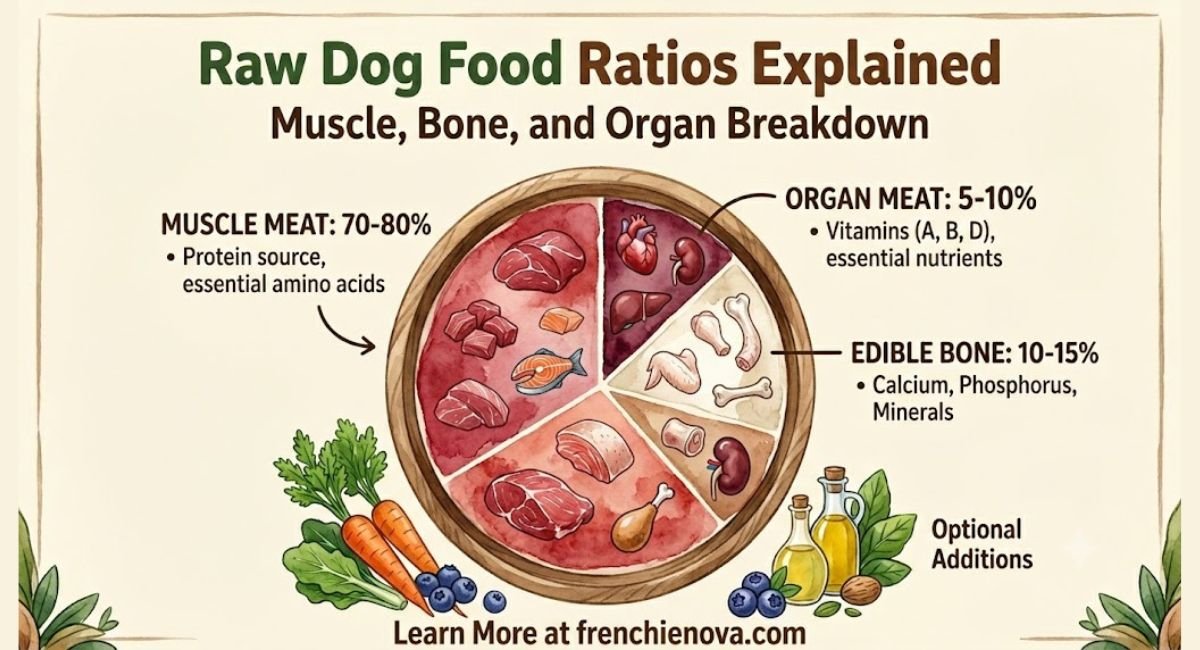
Raw dog food ratios describe how much muscle meat, bone, and organ make up a dog’s daily intake. The most common starting point is the 80/10/10 rule, 80% muscle meat, 10% raw edible bone, and 10% organ meat. That organ slice splits again: 5% liver and 5% other secreting organs like kidney or spleen.
This framework comes from Prey Model Raw (PMR) feeding, which aims to mirror the proportions of a whole prey animal, the way a wild canine would eat. It isn’t a strict daily formula. Balance happens over a week or two of varied meals, not in a single bowl.
One thing worth saying early: these are starting guidelines, not rigid laws. Veterinarian Ian Billinghurst, who coined the BARF approach in 1993, designed his version specifically to allow flexibility. Your dog’s stool, energy, and coat tell you whether the numbers need tweaking.
Raw feeding made easy
Calculate raw food portions for your dog
The 80% Muscle Meat Breakdown
Muscle meat is the foundation. It supplies protein, amino acids, iron, B vitamins, and the fat dogs use for energy. Beef, chicken, turkey, bison, venison, these all count.
Here’s the gap most beginners fall into: muscle meat isn’t just the obvious cuts of “meat.” Heart, tongue, lung, gizzards, and green tripe all count as muscle meat, not organ. Heart is a muscular organ, so it lives in the 80% bucket, not the 10% one. Confusing heart for an organ is one of the most common reasons people accidentally overfeed organ and end up with loose stools.
A practical way to think about it: if it’s a chunk of moving tissue (a muscle), it’s muscle meat. If it secretes something (liver, kidney, spleen, pancreas), it’s an organ.
The 10% Bone Breakdown, and Why It Varies
Raw edible bone provides calcium and phosphorus, the two minerals that keep a dog’s skeleton and teeth strong. Ground bone or soft, edible bones like chicken wings, necks, and feet work well. Weight-bearing bones from large animals, beef or buffalo femurs, should be avoided, since they can crack teeth.
Now the part competitors rarely explain clearly: bone content depends entirely on the cut. A chicken wing is roughly 46% bone, a chicken neck around 36%. So if a recipe calls for 10% bone in a 16-ounce day, you don’t add 1.6 ounces of “a bone”, you’d feed roughly 4 ounces of chicken wing to hit that bone target, then make up the rest with muscle meat and organ.
Get bone wrong, and the dog tells you fast. Too much bone leads to hard, white, crumbly stools and constipation. Too little leaves the diet short on calcium, which is especially risky for growing puppies whose skeletons depend on it.
The 10% Organ Breakdown (5% Liver + 5% Other) Raw Dog Food Ratios Explained
Organs are the multivitamin of the raw bowl, small in volume, huge in nutrient density. The 10% organ portion splits into two halves.
5% liver delivers vitamin A, copper, folate, and B12. It’s non-negotiable in a raw diet because almost nothing else supplies vitamin A in the same concentration. But more isn’t better here. Feeding far above 5% liver can push toward vitamin A toxicity over time, since liver is so rich in it. That’s why the cap matters as much as the minimum.
5% other secreting organ usually means kidney, spleen, or pancreas. Rotating these adds variety in minerals and enzymes. Pancreas, for instance, is naturally rich in digestive enzymes, handy for dogs with sensitive stomachs.
How Much Liver Should a Dog Eat?
Liver should make up about 5% of the total diet, half of the organ portion. For a dog eating 16 ounces a day, that’s roughly 0.8 ounces of liver. Dogs sensitive to organ meat can start as low as 2% liver and still get enough vitamin A. The key is introducing it slowly; a big slab of liver on day one almost always causes loose, dark stools.
What Happens If You Feed Too Much Bone or Organ?
This is where reading your dog becomes a real skill, and it’s the gap most ratio guides skip. The stool is the cheapest diagnostic tool a raw feeder has.
Hard, dry, white or chalky stools, and straining, usually mean too much bone. The fix is to lower bone and nudge up muscle meat. Loose, dark, or runny stools often mean too much organ, especially liver, which is high in blood and very rich. Pull organ back, let things settle, then reintroduce slowly. Yellow or pale stool can simply mean a poultry-heavy week, while very dark stool can come from red meat or blood-rich organs like spleen.
The goal is a firm, compact stool. When the ratios are right, that’s exactly what shows up in the yard.
Why the Ratios Work: Calcium and Phosphorus
Underneath the percentages sits one quiet relationship doing most of the heavy lifting: the calcium-to-phosphorus ratio. Ideally, it sits near 1:1, with a slight lean toward calcium. Muscle meat and organs are high in phosphorus; bone is the main calcium source. That’s the real reason an all-meat diet fails, it’s loaded with phosphorus and starved of calcium, which can cause serious skeletal problems, particularly in young, growing dogs. The bone in the diet isn’t just for chewing. It’s the calcium counterweight that keeps the whole system balanced.
PMR vs BARF: Two Different Ratio Systems
Both models feed raw, but the numbers differ. Prey Model Raw (the 80/10/10 split) sticks to meat, bone, and organ only. The BARF model, Biologically Appropriate Raw Food, adds plant matter: a typical BARF breakdown runs 70% muscle meat, 10% raw edible bone, 5% liver, 5% other organ, 7% vegetables, 2% seeds or nuts, and 1% fruit.
Neither is “correct” by default. PMR keeps things simple and ancestral; BARF leaves room for produce and supplements. The right choice depends on the dog and the owner’s comfort level.
Do Puppies Need Different Ratios?
Yes, and this trips up a lot of new raw feeders. Growing puppies often need a slightly higher bone percentage for the extra calcium their developing skeletons demand, and they eat a far bigger share of their body weight than adults. An adult dog typically eats around 2–3% of body weight daily, while puppies can need much more, adjusted as they grow.
Because their bones are forming, getting the calcium-phosphorus balance right matters even more for puppies than for adults. When in doubt with a puppy, a veterinarian or canine nutritionist is worth the call.
Make the Math Easy: Free Raw Feeding Calculators
Here’s the honest part: doing these percentages by hand, meal after meal, gets tedious fast. That’s exactly why the team at Frenchienova.com built a set of free, mobile-friendly dog calculators to handle the arithmetic for you.
The Raw Dog Food Calculator takes your dog’s weight and turns it into exact daily amounts of muscle meat, bone, liver, and other organs, so the 80/10/10 split becomes real ounces instead of guesswork.
Raw feeding made easy
Calculate raw food portions for your dog
Pair it with the Dog Calorie Calculator to confirm you’re feeding the right total amount for your dog’s age and activity level. Got a growing pup?
Daily calorie needs
How many calories does your dog need?
The Puppy Weight Calculator helps you plan portions as they grow.
Puppy growth tracker
Predict your puppy’s adult weight
The Dog Age Calculator helps you adjust feeding as your dog moves from puppy to adult to senior. All of them are free and built for everyday dog owners, not just experts.
Dog years to human years
Convert your dog’s age accurately
Putting It All Together
Raw dog food ratios come down to a simple foundation: 80% muscle meat, 10% bone, 10% organ, with that organ slice split evenly between liver and another secreting organ. Remember that heart counts as muscle, bone content shifts with the cut, and liver has a ceiling as well as a floor. Watch the stool, lean on the calcium-phosphorus logic, and adjust slowly. Get those pieces right, and the rest of raw feeding falls into place.
One last note: raw feeding touches your dog’s long-term health, so it’s always worth running a new diet plan past your veterinarian or a qualified canine nutritionist, especially for puppies, seniors, or dogs with existing health conditions.
Hands-on raw-feeding research experience, drawing on established frameworks from Prey Model Raw and BARF feeding guidelines.

Auston is the founder of Frenchie Nova and a longtime French Bulldog owner. He writes practical, research-backed guides on Frenchie care, feeding, and health. Not a veterinarian — always consult your vet for medical concerns.