


Switching a Frenchie to raw food sounds simple until the questions pile up. How much bone? Is chicken safe for a breed this prone to allergies? What about the salmonella warnings? Most beginner guides either oversell raw feeding or skip the parts that actually trip people up. This raw dog food diet for French bulldogs guide walks through the whole thing, the models, the portions, the real risks, and the breed-specific quirks that make feeding a French Bulldog different from feeding any other dog.
Table of Contents
What Is a Raw Dog Food Diet for French Bulldogs?
A raw dog food diet means feeding uncooked animal ingredients, such as muscle meat, raw edible bone, and organs, instead of cooked kibble or canned food. The idea is to mirror what a dog’s body evolved to digest. For a French Bulldog, the principle is the same as any breed; the portions and ingredient choices are what change.
Two models dominate raw feeding, and beginners should know the difference before buying anything.
The 80/10/10 (Prey Model) Approach
The 80/10/10 model breaks a dog’s intake into 80% muscle meat, 10% raw edible bone, and 10% organ, with half of that organ portion (5%) coming from liver and the other 5% from other secreting organs like kidney or spleen. It’s built to replicate the rough makeup of a whole prey animal.
This ratio is a starting point, not a rigid law. Some dogs need slightly less bone if stools turn chalky. On its own, a plain 80/10/10 mix usually isn’t considered nutritionally complete, so many raw feeders aim for “balance over time” by rotating proteins throughout the week.
The BARF Model (Biologically Appropriate Raw Food)
BARF keeps the meat-bone-organ base but adds plant matter. A common BARF breakdown runs closer to 70% muscle meat, 10% bone, 10% organ, and 10% vegetables, fruit, and other whole foods like seeds or a source of omega-3.
For an allergy-prone breed, BARF’s flexibility can help, it leaves room to add fish oil for skin and coat or fiber for digestion. Either model can work for a Frenchie. The choice comes down to how much the owner wants to assemble versus buy pre-balanced.
Commercial vs. Homemade Raw
Beginners generally have two routes. Pre-made commercial raw (frozen or freeze-dried) takes the guesswork out and, in many cases, has been treated with high-pressure processing (HPP) to reduce pathogens. Homemade raw gives full control over ingredients but demands careful formulation to avoid nutritional gaps. Most first-timers start with a complete commercial raw and graduate to homemade later.
Why a Raw Diet Matters for an Allergy-Prone Breed
French Bulldogs come with a well-documented set of sensitivities, touchy digestion, skin issues, and frequent reactions to common kibble ingredients. That’s the problem many owners are trying to solve when they look at raw.
Raw diets remove a lot of the usual suspects: starchy carbohydrates, grains, legumes, and artificial additives that show up in processed food. Owners who switch often report a shinier coat, firmer stools, cleaner teeth, and steadier energy. It’s worth being honest here, though: these benefits are widely reported by owners but have not been firmly established by controlled scientific studies. Raw feeding can absolutely suit a Frenchie, just go in with realistic expectations rather than miracle ones.
The breed angle matters in one more way. French Bulldogs gulp their food and are prone to bloat, and their flat faces make eating fast genuinely risky. A slow feeder or smaller, more frequent portions help regardless of which diet you land on.
How to Start Raw Feeding a French Bulldog (Step by Step)
The biggest beginner mistake is switching everything at once. A measured rollout protects a sensitive Frenchie gut and makes problems easy to spot.
Step 1: Calculate the Right Daily Portion
Adult dogs eat roughly 2–3% of their ideal body weight in raw food per day. Feed closer to 2% for a Frenchie that needs to lose weight, and toward 3% for a highly active one. Most adult French Bulldogs sit at an ideal weight of about 20–30 pounds, so daily intake usually lands somewhere around 6 to 13 ounces, but the exact number depends on the individual dog.
Run the math on ideal weight, not current weight, especially if the dog is already carrying extra pounds. The breed gains weight easily, and overfeeding raw is just as possible as overfeeding kibble.
Raw feeding made easy
Calculate raw food portions for your dog
Step 2: Pick a Single Starter Protein
Start with one novel or gentle protein for the first week or two, not a five-meat medley. Because Frenchies often react to poultry, many owners begin with something like beef or a novel protein rather than chicken. A single protein makes it obvious whether a reaction is the food or just the transition.
Step 3: Transition Gradually Over 7–14 Days
Some dogs handle a clean overnight switch; sensitive Frenchies usually don’t. Replace a portion of the old food with raw and increase it every few days while watching the stool. Loose stools mean slow down; firm stools mean keep going. Add new proteins one at a time, a week apart, once the base is settled.
Common Mistakes to Avoid When Feeding a Frenchie Raw
A few errors show up again and again with beginners, and most are easy to sidestep once named.
Feeding too much bone is the classic one, it causes constipation and hard, white stools. Skipping organ meat is another; liver and other organs carry vitamins the muscle meat doesn’t, and leaving them out creates slow nutritional gaps. Beginners also tend to feed a single protein forever, which limits the nutrient range a varied rotation provides.
On the safety side, two mistakes carry real weight. Letting raw food sit out invites bacterial growth, and feeding cooked bones, ever, risks splintering and internal injury. Bones go in raw or not at all.
The last common slip is ignoring the breed’s calorie math. French Bulldogs need roughly 25–30 calories per pound of body weight a day as adults, and they’re masters at looking hungry. Measure portions; don’t eyeball them.
Daily calorie needs
How many calories does your dog need?
Is Raw Feeding Safe? What the Research Actually Says
This is the part beginner guides usually dodge, and it deserves a straight answer. The American Veterinary Medical Association discourages feeding cats and dogs any animal-source protein that hasn’t first been processed to eliminate pathogens, citing risks of Salmonella, Campylobacter, Listeria, E. coli, and others, both to pets and to the humans handling the food.
That’s a real position from a real authority, and it shouldn’t be waved away. The counterpoint raw advocates raise is also fair, dry kibble has been recalled for the same pathogens many times, and the relative risk between raw and processed food isn’t cleanly settled in the literature.
The practical takeaway for a Frenchie owner sits in the middle. Risk drops sharply with sensible habits: buy from reputable sources, favor commercial raw treated with HPP, store and thaw raw in sealed containers, wash hands and surfaces, and keep raw food away from immune-compromised people in the household. A vet, ideally one comfortable with raw feeding, should be part of the decision, especially for puppies, seniors, or dogs with existing health issues.
Raw Feeding a French Bulldog: Quick-Start Tips
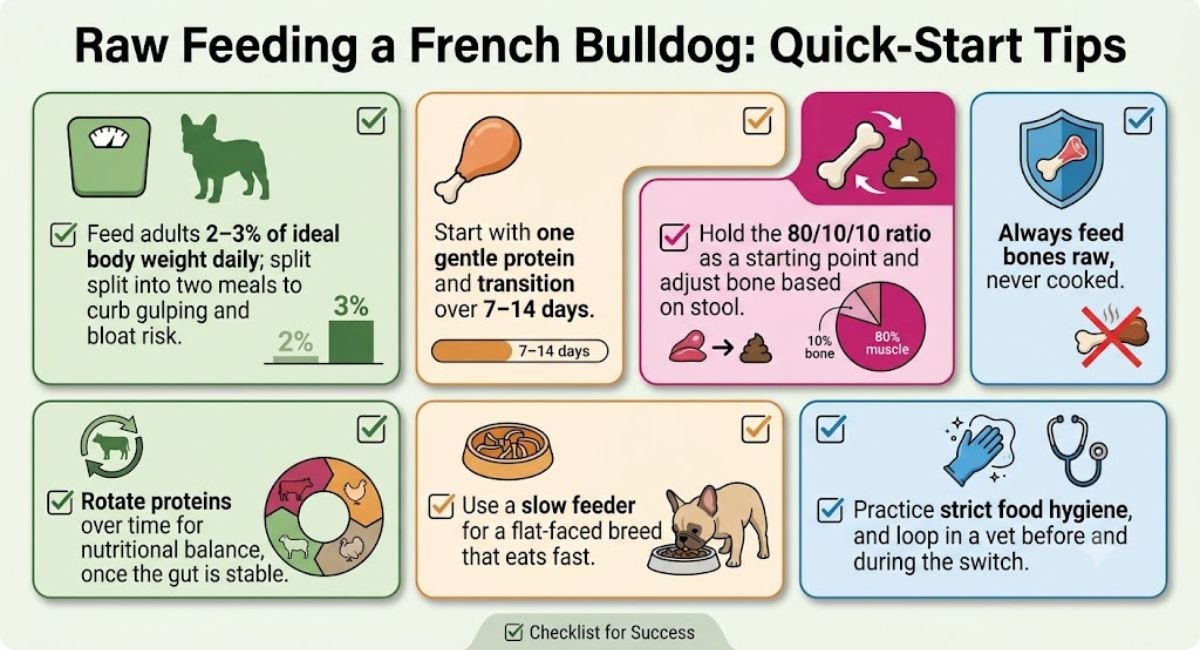
A short checklist to keep handy once the decision is made:
- Feed adults 2–3% of ideal body weight daily; split into two meals to curb gulping and bloat risk
- Start with one gentle protein and transition over 7–14 days
- Hold the 80/10/10 ratio as a starting point and adjust bone based on stool
- Always feed bones raw, never cooked
- Rotate proteins over time for nutritional balance, once the gut is stable
- Use a slow feeder for a flat-faced breed that eats fast
- Practice strict food hygiene, and loop in a vet before and during the switch
Raw feeding isn’t right for every Frenchie or every household, but for an owner willing to learn the ratios, respect the safety rules, and watch their dog closely, it’s a manageable way to take control of a sensitive breed’s diet. Start with the calculator below to get the daily portion right, then explore the model and allergy guides linked throughout to build a plan that fits your dog.
Raw feeding made easy
Calculate raw food portions for your dog
This guide draws on raw feeding resources and veterinary sources, including the American Veterinary Medical Association (AVMA), FEDIAF feeding guidelines, and current information on the BARF and prey-model approaches. Reported benefits of raw feeding are largely anecdotal and not yet confirmed by controlled studies. Always consult a veterinarian before changing a French Bulldog’s diet, especially for puppies, seniors, or dogs with existing health conditions.

Auston is the founder of Frenchie Nova and a longtime French Bulldog owner. He writes practical, research-backed guides on Frenchie care, feeding, and health. Not a veterinarian — always consult your vet for medical concerns.