


Walk down any pet store aisle, and the choice is genuinely overwhelming, kibble, fresh, raw, grain-free, breed-specific, a dozen brands all stamped “best.” For a Frenchie owner, it’s even trickier, because these little bat-eared dogs come with a stomach that’s easily upset, a tendency toward food allergies, and an appetite that never quits. The good news: feeding a growing French Bulldog puppy well isn’t complicated once the noise is stripped away.
This guide Find the best diet for a growing French Bulldog puppy, what to feed, how much, how often, and the Frenchie-specific issues every owner should plan for. covers what to actually look for in the food, how much and how often to feed by age, and the breed-specific quirks that trip up first-time Frenchie owners.
Table of Contents
What “Best” Actually Means for a Frenchie Puppy
Before any brand name, one thing matters more than the rest: the food must be complete and balanced for growth. Check the label for an AAFCO nutritional adequacy statement that says the food is formulated “for Growth” or “for All Life Stages.” That single line means the food meets the baseline nutrient needs of a growing puppy, and a food without it, no matter how premium it looks, isn’t a standalone diet.
From there, a strong puppy diet for a Frenchie has a few hallmarks: a named, high-quality protein as the first ingredient (chicken, turkey, lamb, or fish), roughly 22–30% protein to fuel rapid muscle and bone growth, healthy fats including omega-3s like DHA for brain development, and no cheap fillers, artificial colors, or vague “meat by-product” padding. Because Frenchies have small mouths, small-breed kibble (or kibble softened with warm water for younger pups) goes down far easier.
Energy needs during the growth phase are the highest of any life stage except nursing mothers, so a puppy formula is calorie-dense on purpose. That’s exactly why feeding an adult formula too early shortchanges a growing pup.
Best Diet for a Growing French Bulldog Puppy



The Calcium-Phosphorus Balance Most Owners Miss
Here’s something most feeding guides skip, and it matters. A growing puppy needs calcium and phosphorus in a specific ratio, not just “more is better.” Too little calcium leads to weak bones; too much throws off the ratio and can actually raise the risk of skeletal deformities.
The practical takeaway is simple: a quality commercial puppy food labeled for growth already has this balance dialed in. Owners should never add calcium or phosphorus supplements on top of a complete commercial diet, doing so does more harm than good. This is also a big reason vets are cautious about homemade and raw diets for puppies: balancing these minerals correctly at home is genuinely hard, and getting it wrong during the growth window has lasting consequences.



How Much to Feed a Growing French Bulldog Puppy
Portion size depends on age, current weight, and the specific food’s calorie density, so the label’s feeding guide is always the starting point. As a rough reference, many Frenchie puppies eat around 1 to 1.5 cups of quality puppy food per day, split across meals, but the right number for one pup can be wrong for another.
The smarter approach is to feed to body condition, not a fixed cup count. You should be able to feel the ribs under a thin layer and see a slight waist from above. If the puppy is rounding out with no waistline, ease back; if ribs are sharply visible, bump it up. Reassess every couple of weeks as the puppy grows.
Knowing roughly where a Frenchie is headed as an adult makes portioning far easier, feeding toward a target weight beats guessing. A quick estimate from current age and weight gives a solid anchor.
“Estimate My Frenchie’s Adult Weight”
Puppy growth tracker
Predict your puppy’s adult weight
How Often to Feed by Age
A Frenchie puppy’s stomach is tiny, and they burn energy fast, so frequent, measured meals beat one big bowl. Here’s the typical schedule as a pup grows:
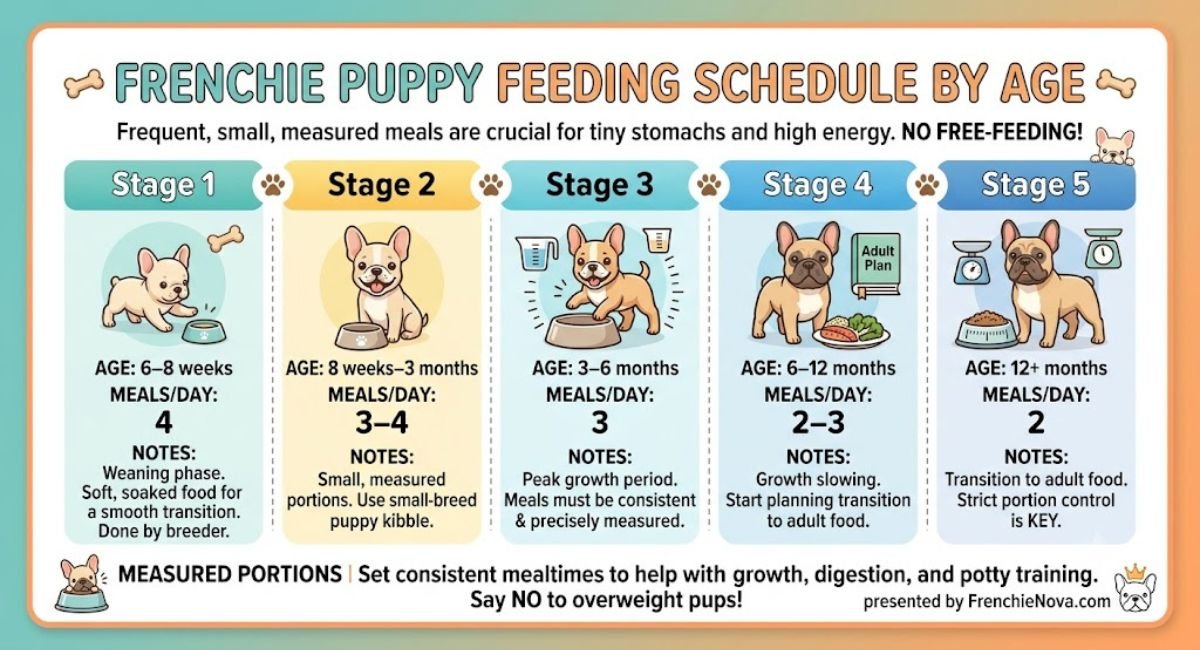
| Age | Meals per Day | Notes |
| 6–8 weeks | 4 (weaning) | Soft/soaked food; weaning usually done by the breeder |
| 8 weeks–3 months | 3–4 | Small, measured portions; small-breed puppy kibble |
| 3–6 months | 3 | Peak growth, keep meals consistent and measured |
| 6–12 months | 2–3 | Growth slowing; begin planning the adult transition |
| 12+ months | 2 | Adult schedule; portion control becomes key |
Measured is the operative word. Frenchies will happily eat everything in front of them, and then some, so free-feeding is a fast track to an overweight puppy. Set consistent mealtimes, it helps with growth, digestion, and potty training all at once.
Dog years to human years
Convert your dog’s age accurately
Frenchie-Specific Feeding Issues to Plan For
French Bulldogs come with a few quirks rooted in their anatomy and genetics, and the diet should account for them.
They’re prone to allergies and sensitive stomachs. Many Frenchies react to common proteins like chicken or grains. If a puppy has chronic loose stools, itchy skin, or ear issues, a limited-ingredient or novel-protein food (discussed with a vet) often helps. Always switch foods gradually over 7 to 10 days to avoid digestive upset.
Their flat faces make eating messy and risky
Brachycephalic dogs tend to gulp air while eating, which can contribute to gas and, in worse cases, bloat. A shallow, wide, or tilted bowl lets a Frenchie scoop food against a surface instead of burying its whole muzzle, and a slow-feeder bowl helps pups that inhale their meals.
Obesity is the breed’s biggest diet danger
Extra weight strains an already-compromised respiratory system and the joints and spine. Keep treats to no more than about 10% of daily calories, and count them as part of the day’s food, not extras.
When to Switch from Puppy Food to Adult Food
French Bulldogs generally reach maturity around 9 to 12 months, and that’s the window to begin transitioning to adult food, ideally once skeletal growth is wrapping up, and on a timeline your vet confirms. Some Frenchies do better staying on puppy food closer to the 12-month mark. Make the switch gradually over 7 to 10 days, mixing increasing amounts of the new food into the old, to keep that sensitive stomach happy.
Want to check whether your Frenchie is tracking toward a healthy adult size before making the switch? It takes seconds.
Daily calorie needs
How many calories does your dog need?
What is the best food for a French Bulldog puppy?
The best food is any complete, balanced puppy formula (AAFCO-labeled “for Growth” or “All Life Stages”) with a named meat as the first ingredient, around 22–30% protein, and no cheap fillers. Small-breed puppy formulas suit a Frenchie’s small mouth. Vet-recommended commercial options are generally the safest bet for growing pups.
How much should I feed my Frenchie puppy?
Most Frenchie puppies eat about 1 to 1.5 cups a day split into 3–4 meals, but the right amount depends on age, weight, and the food’s calorie density. Use the label as a starting point and adjust to body condition, you should be able to feel the ribs and see a slight waist.
Can French Bulldog puppies eat a raw or homemade diet?
Most vets advise against raw or homemade diets for puppies. Their immune systems are still developing, and balancing nutrients, especially calcium and phosphorus, is very hard to get right at home. If you want to go this route, talk to your vet first.
Raw feeding made easy
Calculate raw food portions for your dog
Should I give my Frenchie puppy calcium supplements?
No. A complete commercial puppy food already has the correct calcium-to-phosphorus balance. Adding supplements can disrupt that ratio and increase the risk of skeletal problems during growth.
The Bottom Line
The best diet for a growing French Bulldog puppy isn’t about chasing the trendiest bag, it’s about a complete, balanced, growth-formulated food with quality protein, the right calcium-phosphorus balance built in, and portions matched to the puppy’s body condition rather than a fixed scoop. Add frequent measured meals, a Frenchie-friendly bowl, and treats kept in check, and most of the breed’s diet pitfalls take care of themselves. Feed for where the puppy is headed, weigh in regularly, and lean on your vet for the calls that matter.
Puppy growth tracker
Predict your puppy’s adult weight
Dog years to human years
Convert your dog’s age accurately
Daily calorie needs
How many calories does your dog need?
Raw feeding made easy
Calculate raw food portions for your dog
This article is for general educational purposes and isn’t a substitute for veterinary advice. Before changing your puppy’s diet or starting any supplement, consult a licensed veterinarian, especially for a breed as allergy- and weight-prone as the French Bulldog.

Auston is the founder of Frenchie Nova and a longtime French Bulldog owner. He writes practical, research-backed guides on Frenchie care, feeding, and health. Not a veterinarian — always consult your vet for medical concerns.