


On a hot summer day, few things look more tempting than a juicy slice of watermelon, and your Frenchie clearly agrees, judging by the stare. So, can French Bulldogs have watermelon?
Yes, watermelon is a safe, hydrating, and genuinely healthy treat for French Bulldogs, as long as you prepare it properly. It’s mostly water, low in calories, and packed with vitamins, which makes it close to a perfect warm-weather snack for the breed. The one thing that trips owners up is the prep: the seeds and rind need to go.
This guide covers whether watermelon is safe, its benefits, the risks to avoid, and exactly how to serve it to your Frenchie.
Table of Contents
Can French Bulldogs Eat Watermelon? The Short Answer
Yes. Watermelon flesh is safe for French Bulldogs to eat in moderation, it’s non-toxic and a favorite hot-weather treat. The crucial caveat is preparation: you must remove the seeds and the rind first. The fleshy pink part is the only bit your Frenchie should eat.
Served right, watermelon is hydrating and refreshing, which is especially valuable for a brachycephalic breed that struggles in the heat. Just keep it to a treat-sized portion, since even healthy fruit carries natural sugar.
Read our guide Are Blueberries Bad for Dogs?
Why Watermelon Is Good for French Bulldogs
Watermelon isn’t just safe, it brings real benefits to the bowl. For a breed with heat sensitivity, weight tendencies, and a history of pancreatitis risk, watermelon’s profile makes it one of the more genuinely useful fruits to offer.
Watermelon offers real benefits for French Bulldogs, it’s over 90% water (great for a heat-sensitive breed), only about 50 calories per cup (weight-friendly), fat-free (lower pancreatitis risk), and packed with vitamin A, B6, C, and potassium.
Hydration
Watermelon is more than 90% water, making it one of the most hydrating fruits you can share with your dog.
- Brachycephalic breeds like the Frenchie cool down less efficiently because their compressed airways make panting, their main heat-regulation tool, harder work.
- This raises their risk of overheating, especially during summer walks or humid weather.
- A few frozen watermelon cubes can offer a refreshing, hydrating boost on a hot day, but it’s a bonus alongside fresh water, never a replacement for it.
Low in Calories
At only about 50 calories per cup, watermelon is a light treat that won’t derail a weight-prone Frenchie’s daily calorie budget.
- French Bulldogs gain weight easily due to their lower activity tolerance and compact, stocky build, and extra pounds add real strain to their joints and breathing.
- A small handful of watermelon cubes costs far less than a commercial treat, which can run 20-40+ calories per piece.
- This makes it a smart training reward you can use more liberally without worrying about calorie creep.
Rich in Vitamins
Watermelon isn’t just water and sugar, it carries a useful vitamin profile.
- Vitamin A supports eye health and immune function.
- Vitamin B6 plays a role in metabolism and nervous system function.
- Vitamin C contributes to immune support, though dogs synthesize their own, so this is a modest bonus rather than a dietary requirement.
- Potassium supports muscle function and healthy fluid balance.
- These nutrients don’t replace a complete diet, but they add genuine value compared to empty-calorie treats.
No Fat or Cholesterol
Watermelon is naturally fat-free, which matters more for a French Bulldog than for most breeds.
- Frenchies are considered a breed at elevated risk for pancreatitis, a painful and potentially serious inflammation of the pancreas that’s strongly linked to high-fat food intake.
- Fat-free treats like watermelon avoid adding that risk, unlike fatty table scraps or rich commercial treats.
- This makes watermelon a safer “free” treat option for owners who want to reward their dog frequently without the fat load of typical snacks.
Watermelon earns its place as more than just a safe treat, it actively works in your Frenchie’s favor. The hydration helps offset heat intolerance, the low-calorie count supports weight management, and the fat-free profile sidesteps the pancreatitis risk this breed is prone to. Combined with a light vitamin boost, it’s an easy, low-stakes treat to keep in rotation, especially in warmer months.
read our guide Are Cucumbers Safe for French Bulldogs?
Watermelon Risks for French Bulldogs: What to Watch For
Watermelon is safe when prepared correctly, but a few preparation steps aren’t optional, skipping them turns a healthy treat into a genuine hazard.
Watermelon is safe when prepared correctly. Remove all seeds, cut away the rind completely, and keep portions small due to natural sugar content. Skip processed versions like candied watermelon or juice, and never feed anything containing xylitol.
Seeds: Remove Them All
Watermelon seeds pose a real risk, not just a minor annoyance.
- Seeds can cause an intestinal blockage, which is a serious and potentially life-threatening risk in a small breed like the Frenchie, whose digestive tract has less room to work with.
- Always pick out every seed before serving, even if it feels tedious, a few missed seeds in a large chunk is how accidents happen.
- Seedless watermelon is the easier, safer route for regular feeding, since it removes the risk entirely without extra prep work each time.
- If your dog does swallow a few seeds accidentally, small amounts usually pass without issue, but watch for vomiting, lethargy, or straining, which can signal a blockage.
Read our guide can french bulldog eat potaotes
Rind: Never Feed It
The rind is arguably the bigger risk of the two, and it’s easy to overlook.
- The tough, fibrous rind is a choking hazard on its own, especially for a flat-faced breed that doesn’t chew thoroughly.
- It’s also difficult to digest, which can lead to gastrointestinal upset or, in more serious cases, an intestinal obstruction requiring veterinary intervention.
- Cut the flesh cleanly away from the rind before serving, and discard the rind entirely, don’t let your dog scavenge a discarded rind from the counter or trash.
- This applies to the white part just under the skin too, not just the dark green outer layer.
Sugar Content
Watermelon is mostly water, but the sugar it does contain still matters for certain dogs.
- Natural sugar is fine in moderation for most healthy dogs, but it’s still a reason to keep portions small rather than treating watermelon as an unlimited snack.
- Diabetic or sugar-sensitive Frenchies should approach watermelon with caution, since even natural sugars can affect blood glucose levels.
- Check with your vet before feeding watermelon to a diabetic dog, they can advise on whether it’s appropriate and, if so, how much.
- Overweight dogs on a calorie-controlled diet should also keep portions modest, even though watermelon is low-calorie overall.
Skip Processed Versions
Only fresh, plain watermelon is safe, anything processed changes the equation.
- Avoid candied watermelon, which is loaded with added sugar and sometimes artificial coloring or flavoring.
- Skip watermelon juice or watermelon-flavored products, which often contain added sugar and lack the fiber that helps offset it in the whole fruit.
- Check ingredient labels carefully for xylitol, a sugar substitute found in some “sugar-free” or diet products. It’s highly toxic to dogs and can cause a rapid, dangerous drop in blood sugar even in small amounts.
- When in doubt, stick to fresh watermelon you’ve cut yourself, so you know exactly what your dog is getting.
The risks with watermelon aren’t about the fruit itself, they’re about prep. Seeds and rind are the two hazards that turn a safe treat into a trip to the vet, so a few extra minutes of cutting and de-seeding is non-negotiable. Beyond that, moderate portions and sticking to fresh, plain watermelon keep this treat firmly in the “safe and beneficial” category for most Frenchies.
How Much Watermelon Can a Frenchie Eat? (French Bulldogs Have Watermelon)
The 10% rule applies: treats, watermelon included, should stay under 10% of your Frenchie’s daily calories. For a small breed, that means a few small, seedless, rind-free chunks per sitting, not a big bowl.
Start with a small piece the first time to make sure it agrees with your dog, since the water and sugar content can loosen stools if a Frenchie eats too much at once. Build up to a modest regular treat from there.
How to Serve Watermelon to Your Frenchie
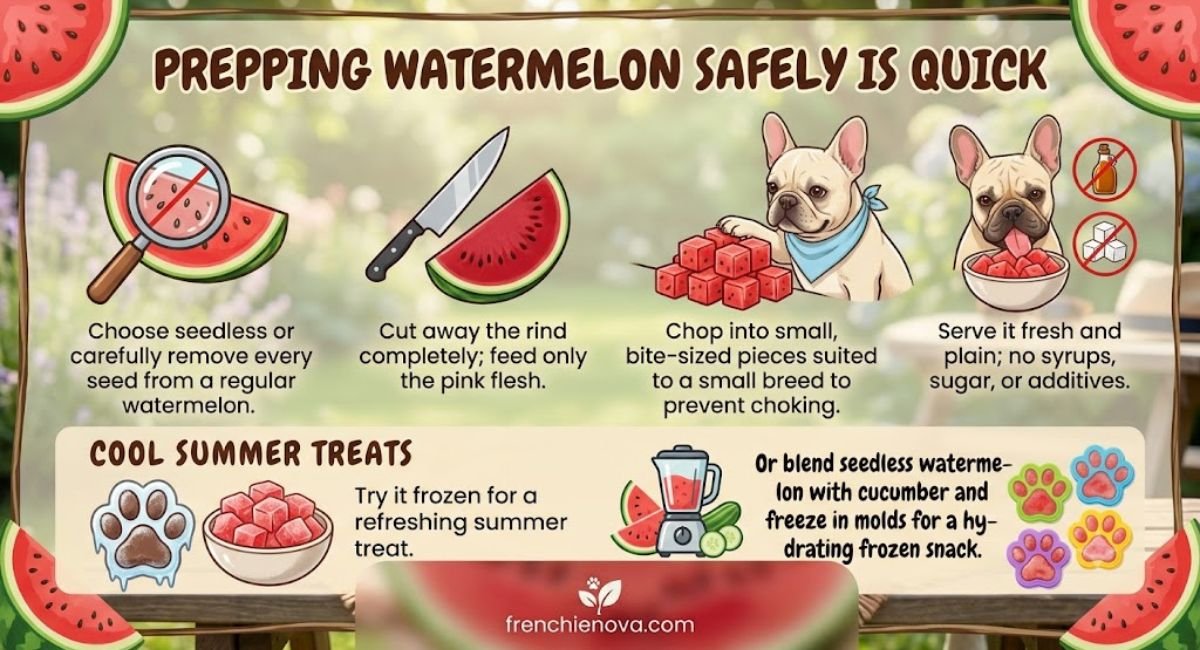
Prepping watermelon safely is quick:
- Choose seedless, or carefully remove every seed from a regular watermelon.
- Cut away the rind completely, feed only the pink flesh.
- Chop into small, bite-sized pieces suited to a small breed, to prevent choking.
- Serve it fresh and plain, no syrups, sugar, or additives.
- Try it frozen for a refreshing summer treat, or blend seedless watermelon with cucumber and freeze in molds for a hydrating frozen snack.
Is watermelon safe for French Bulldogs?
Yes, the flesh is safe and hydrating in moderation, but you must remove all seeds and the rind first. The seeds can cause blockages, and the rind is a choking and digestive hazard.
Can French Bulldogs eat watermelon seeds or rind?
No. Seeds can cause an intestinal blockage and the rind can cause choking or gastrointestinal upset. Only the seedless pink flesh is safe to feed.
Can French Bulldog puppies have watermelon?
Yes, in small amounts. Remove seeds and rind, cut the flesh into tiny pieces, and offer just a little at a time alongside a complete puppy diet.
How much watermelon can my Frenchie eat?
A few small, seedless, rind-free chunks per sitting is plenty for a small breed. Keep it within the 10% treat limit and start small, as too much can loosen stools.
The Bottom Line
Watermelon is a refreshing, healthy treat for French Bulldogs, hydrating, low in calories, and full of beneficial vitamins, which makes it ideal for cooling off a heat-sensitive breed in summer. The golden rule is preparation: always remove every seed and the entire rind, feed only the pink flesh, cut it into small pieces, and keep the portion modest because of the natural sugar.
Served plain and in moderation, watermelon is one of the most enjoyable warm-weather snacks you can share with your Frenchie. Introduce it gradually, and check with your vet first if your dog has diabetes or sugar sensitivities.
For more safe and unsafe foods, see our full guide on what foods French Bulldogs can eat and our complete French Bulldog puppy diet guide.
This article is for general educational purposes and isn’t a substitute for veterinary advice. Consult your veterinarian before adding new foods to your dog’s diet, especially if they have a health condition.

Auston is the founder of Frenchie Nova and a longtime French Bulldog owner. He writes practical, research-backed guides on Frenchie care, feeding, and health. Not a veterinarian — always consult your vet for medical concerns.