

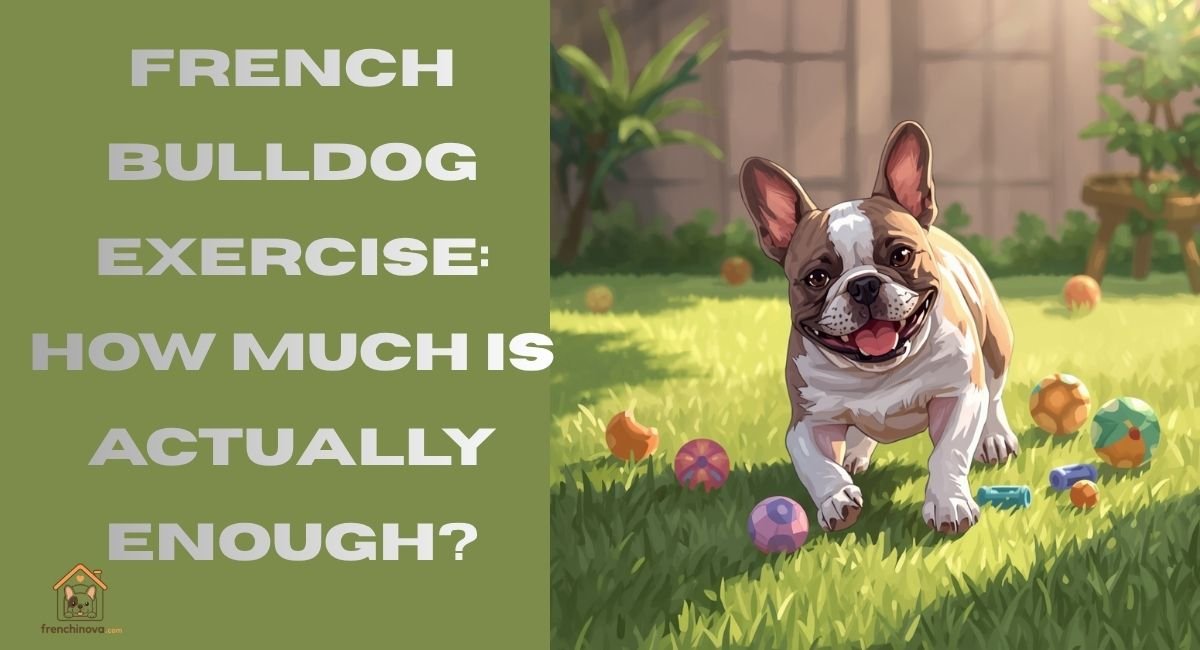
A well-meaning new Frenchie owner walks their puppy like a Labrador on day one, long route, brisk pace, midday sun. Twenty minutes in, the dog is panting hard enough to scare the whole household. That same scenario plays out in living rooms every weekend.
French Bulldogs are misunderstood athletes. They look sturdy. They’ve got the personality of a much bigger dog. But the flat face, compact body, and brachycephalic airway mean exercise has to work differently than it does for any other breed.
Get it right, and the Frenchie stays healthy, lean, and content. Get it wrong, and the consequences can land in an emergency vet’s office. This guide breaks down exactly how much a French bulldog exercise needs, what works best, and how to adjust the routine by age, all anchored in vet-backed guidelines.
Table of Contents
How Much Exercise Does a French Bulldog Actually Need?
The short answer: less than most owners assume.
For most healthy adult Frenchies, vets and breed experts recommend 30 to 60 minutes of low-impact activity per day. That time works best split across two shorter sessions, a morning walk and an evening one, rather than crammed into a single long outing.
The exact number shifts dog to dog. Some Frenchies are couch potatoes by nature. Others surprise their owners with how much energy they bring to the day. Both fall well within normal. What doesn’t fall within normal is high-intensity, prolonged, or heat-heavy exercise.
French Bulldogs belong to the brachycephalic breed group, which means the skull structure compresses the airway. Breathing gets harder during exertion or in warm weather, and that’s not a quirk to push through. It’s a genuine physical limitation that shapes every exercise decision an owner makes.
French Bulldog Exercise by Age
| Age Stage | Daily Exercise | Best Activities | What to Avoid |
| Puppy (under 12 months) | 5 min per month of age | Short walks, indoor play, sniffing | Jumping, rough play, long walks |
| Adult (1–7 years) | 30–60 minutes | Structured walks, fetch, training | Jogging, midday heat, forced runs |
| Senior (7+ years) | Adjust to the dog | Gentle strolls, light play | Any high-impact activity |
Puppies (Under 12 Months)
Most vets follow a simple rule for Frenchie puppies: 5 minutes of exercise per month of age, up to twice a day.
So a 3-month-old puppy walks for around 15 minutes per session. A 5-month-old, around 25 minutes.
Short walks, indoor play, and gentle exploration suit this stage best. High-impact activities — jumping, rough play, long distances — stay off the table because growing joints are still forming. Damage at this age tends to surface as mobility problems much later in life.
Mental stimulation pulls just as much weight as physical activity for Frenchie pups. Sniff walks, puzzle feeders, and basic training sessions tire them out gently without straining their bodies.
Adult French Bulldogs (1–7 Years)
This is the sweet spot, the stage where a consistent routine really pays off.
Aim for 30 to 60 minutes of daily activity, split across two walks with optional indoor play in between. A 15 to 20-minute morning stroll, followed by the same in the evening, covers the base. Short play sessions throughout the day add enrichment without overloading the system.
Signs the routine is working: a healthy weight, calm behavior at home, and a dog that settles easily after a walk. Restlessness, destructive chewing, or steady weight gain usually points to under-exercise.
Senior French Bulldogs (7+ Years)
As Frenchies age, energy levels naturally drop — and the routine needs to drop with them.
Shorter walks at a gentler pace work best. The goal shifts from “step count” to “joint mobility.” If stiffness, reluctance to walk, or labored breathing shows up, a vet check comes before continuing the current routine.
The Best Types of Exercise for French Bulldogs
Not all exercise is created equal for this breed. The activities below match Frenchie anatomy best.
Leisurely Walks
Short, slow-paced walks on flat ground are the gold standard for Frenchie fitness. A harness beats a collar every time, collars press directly on the trachea, which is genuinely risky for brachycephalic breeds.
Indoor Play
Games of fetch down a hallway, gentle tug-of-war, or hide-and-seek with treats deliver solid physical and mental stimulation without heat exposure or overexertion.
Sniff Walks
A walk with plenty of time for sniffing and exploring tires a Frenchie out in the best possible way. Sniffing activates the brain and burns more energy than most owners realize, sometimes more than the walking itself.
Trick Training
Short training sessions, teaching a new command or revisiting an old one, count as mental exercise and mild physical activity at the same time. Frenchies respond well to positive reinforcement, and training time strengthens the bond between dog and owner.
A Note on Swimming
Swimming gets suggested often as low-impact exercise. With French Bulldogs, it needs real caution. Their front-heavy body structure makes them poor natural swimmers, they sink faster than most breeds. Any water play has to be closely supervised, in very shallow water only, ideally with a dog life jacket.
What to Avoid During French Bulldog Exercise
Hot or Humid Weather
This is the most important warning in any French Bulldog exercise guide. Frenchies overheat faster than almost any other breed. Stick to early morning or late evening walks on warm days. Signs of heat exhaustion, excessive drooling, heavy panting, stumbling, glazed eyes, mean stop immediately, move to a cool area, and offer water in small sips.
Forced Running or Jogging
Running pushes most Frenchies past their respiratory limit fast. A brisk walk is generally the upper limit of what the breed can handle safely.
Back-to-Back Exercise Without Rest
Recovery time matters. Pushing from one activity to another without breaks ignores how the breed actually breathes. Frenchies need time between exertions to regulate their breathing and bring their temperature back down.
High-Impact Activities
Jumping on and off furniture, rough play with much larger dogs, or full agility-style obstacle courses put real stress on joints and airways. Keep these minimal — especially for puppies and seniors, where the long-term cost shows up later.
Signs You’ve Found the Right Balance
A well-exercised French Bulldog shows it. Here’s what a good routine looks like in practice:
- Healthy weight: not underweight, not overweight
- Calm at home: settles easily after walks
- Good muscle tone: without looking exhausted
- Enthusiastic about outings: no signs of dread or distress
- Normal breathing recovery: pants ease within minutes of stopping
💡 Tip: If heavy panting lingers more than a few minutes after stopping, the session was probably too intense. Adjust the next one, shorter, slower, or in cooler conditions.
A Simple Daily French Bulldog Exercise Routine
Here’s a realistic daily structure that works for most adult Frenchies:
| Time | Activity | Duration | Notes |
| Morning | Gentle walk | 15–20 mins | Flat ground, harness on |
| Midday | Indoor play / enrichment | 10–15 mins | Puzzle toys, light training |
| Evening | Leisurely walk + sniff time | 15–20 mins | Cool weather preferred |
Total active time: roughly 40–55 minutes. Enough to manage weight, keep the mind engaged, and keep the Frenchie content — without pushing past the physical limits the breed carries.
Final Thought
French Bulldog exercise doesn’t have to be complicated. It needs to be consistent, low-impact, and weather-aware. A walk in the morning, a walk in the evening, and a little play and mental stimulation in between, that’s enough for most Frenchies to live a healthy, happy life.
The most important thing is reading the individual dog. Their signals are clear once an owner learns to listen. When a Frenchie is done, they’ll show it. And when they’re ready to go again, they’ll show that too.
Note: This article is intended for general informational purposes only. Always consult a licensed veterinarian for breed-specific exercise advice tailored to a dog’s individual health needs.

Auston is the founder of Frenchie Nova and a longtime French Bulldog owner. He writes practical, research-backed guides on Frenchie care, feeding, and health. Not a veterinarian — always consult your vet for medical concerns.