


A Frenchie’s first year often catches new owners off guard. Most breed guides end the puppy section at “vaccinate and socialize,” the adult section at “feed and exercise,” and the senior section at “watch for issues.” Useful, but not actionable. What every owner actually needs is a stage-by-stage roadmap, what changes physically, what changes emotionally, what to feed, what to watch for, and what to bring up at the vet.
This guide breaks down all six French Bulldog life stages, puppy, adolescent, young adult, mature adult, senior, and geriatric, with timelines, weight targets, calorie ranges, behavioral patterns, and the warning signs that matter most.
Table of Contents
Why French Bulldog Life Stages Matter
A Frenchie’s care needs aren’t stable across their life. The right food at 4 months would cause weight gain at 4 years. The right activity level at 3 years would strain joints at 9. The right vet schedule at age 1 would miss serious issues at age 8. Each stage has different physical, nutritional, behavioral, and medical priorities, and missing the transition between stages is one of the most common care mistakes in this breed.
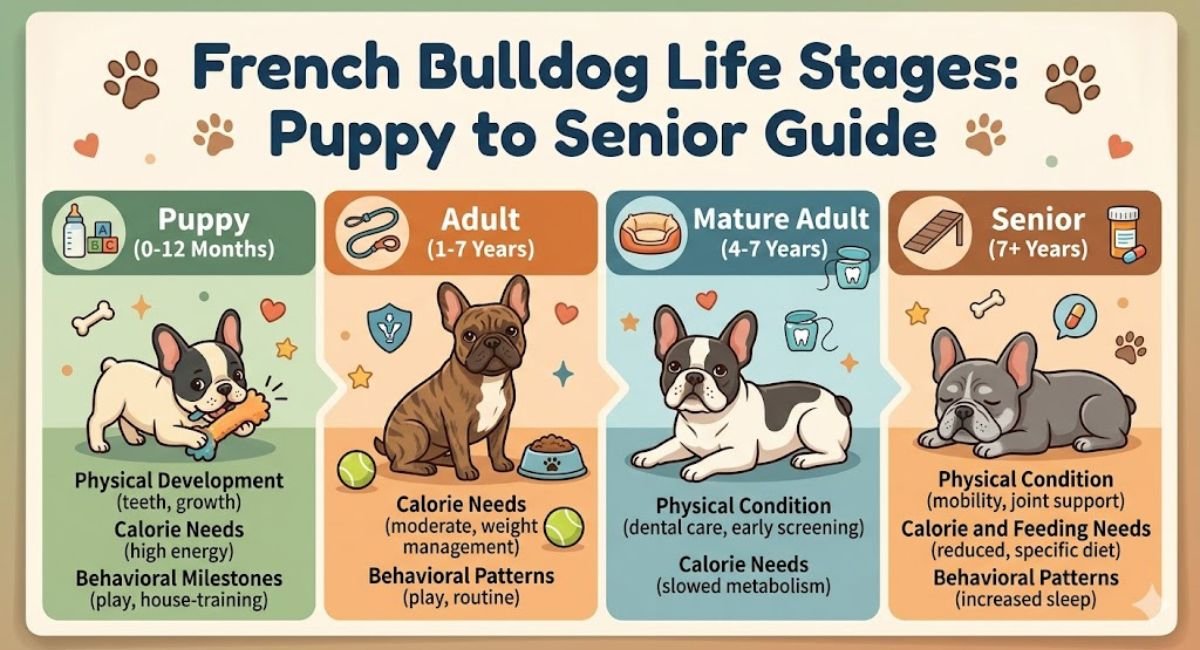
The framework most veterinary nutritionists and the American Veterinary Medical Association (AVMA) use breaks Frenchie life into six distinct stages:
- Puppy (0–12 months): rapid growth, socialization, development
- Adolescent (8–18 months): sexual maturity, behavior testing, calorie adjustment
- Young Adult (1.5–4 years): peak physical condition, stable patterns
- Mature Adult (4–7 years): slight slowing, emerging health monitoring
- Senior (7–10 years): official senior status, care intensifies
- Geriatric (10+ years): quality-of-life focus, comfort-first care
For context on how these ages compare to human years, the How Old Is My Dog in Human Years guide covers the science-backed conversion (a Frenchie at 1 year is roughly 15 in human years, and at 2 years roughly 24, after which each dog year adds about 4 human years). The Life Expectancy guide breaks down what a realistic lifespan looks like for the breed.
Dog years to human years
Convert your dog’s age accurately
Stage 1: Puppy (0–12 Months)
The puppy stage is the shortest in time but the most transformative. Bone structure, brain development, immune function, social temperament, and lifelong eating habits all get set here.
Physical Development
A Frenchie puppy goes through a dramatic change in 12 months:
- Birth–4 weeks: Eyes and ears closed, fully dependent on mother’s milk
- 4–8 weeks: Walking begins, weaning starts, first solid food
- 8–12 weeks: Adoption-ready stage, vaccinations begin
- 3–6 months: Rapid growth, teething (full set of 42 adult teeth in by 6 months), ear positioning settles
- 6–9 months: Growth slows, sexual maturity begins
- 9–12 months: Adult size approached, growth tapers off
Most Frenchies reach roughly 80% of their adult weight by 6 months and full adult size between 12 and 14 months. For approximate weight expectations:
| Age | Male Weight | Female Weight |
| 1 month | 4–7 lb | 3–6 lb |
| 3 months | 8–13 lb | 7–12 lb |
| 6 months | 17–22 lb | 13–20 lb |
| 9 months | 19–26 lb | 16–22 lb |
| 12 months | 20–28 lb | 17–24 lb |
A useful rule of thumb that pet weight calculators rely on: a Frenchie’s 4-month weight roughly doubles to estimate adult size. For the precise month-by-month math, the Puppy Weight Calculator handles it.
Calorie and Feeding Needs
Frenchie puppies need significantly more calories per pound of body weight than adults, about 50 to 60 calories per pound during peak growth, dropping to 35–45 per pound by 9 months.
- 8–12 weeks: 3–4 meals daily, around 1.5 cups of puppy food
- 3–6 months: 3 meals daily, gradually larger portions
- 6–12 months: 2–3 meals daily, transitioning toward adult portions
The food itself should meet AAFCO growth standards: minimum 22% protein and 8% fat by dry matter. For more on stage-by-stage calorie needs, see the Puppy vs Adult vs Senior Calorie Needs guide.
Behavioral Development
This is the socialization window. Between 3 and 16 weeks, a Frenchie’s lifelong attitudes toward people, other dogs, sounds, and environments are formed. Limited or negative socialization here often creates anxiety, reactivity, or fearfulness that lasts for life.
Key priorities:
- Expose the puppy to varied environments, sounds, and people
- Introduce gentle handling (paws, ears, mouth) for future vet visits
- Begin basic obedience (sit, stay, come) using positive reinforcement
- Establish a feeding and bathroom schedule
What to Watch For
Concerning signs in the puppy stage:
- Severe lethargy or refusal to eat
- Persistent vomiting or diarrhea
- Heavy breathing at rest (not just after play)
- Failure to grow at expected weight milestones
- Limping or visible discomfort
Vet Schedule
- 6, 9, 12, and 16 weeks: Vaccination series
- 6 months: Spay/neuter consultation (timing matters, see the Neutered Dog Calorie Needs article)
- 12 months: First annual wellness exam
Stage 2: Adolescent (8–18 Months)
The adolescent stage is the most overlooked in breed guides, and arguably the most difficult. It overlaps with the late puppy phase and stretches into early adulthood.
Physical Development
Adolescence brings sexual maturity (around 6–9 months in Frenchies), the final growth spurts, and the establishment of adult muscle tone. Most Frenchies reach their full adult weight between 12 and 14 months, though some keep gaining muscle until age 2.
Calorie and Feeding Needs
This is the transition window from puppy food to adult food. The shift typically happens between 9 and 12 months, done gradually over 7–10 days by mixing increasing amounts of adult food into the puppy formula.
After the switch, daily calories drop noticeably, a 22-lb adolescent Frenchie might go from 700 kcal/day as a puppy to 550 kcal/day as a young adult. Continuing to feed puppy portions past the transition is one of the most common causes of post-adolescent weight gain.
Behavioral Development
The adolescent stage is famously difficult because puppy training “regressions” appear:
- Testing previously learned commands
- Selective listening
- Increased independence
- Sometimes mild reactivity or fearfulness re-emerges
This is normal. Consistency matters more than correction. Reinforce the basics, keep routines stable, and avoid introducing major new training stressors during this window.
What to Watch For
- Sudden behavior changes (aggression, severe anxiety)
- Limping or stiffness (an early sign of joint or spine issues common in the breed)
- Recurring skin or ear infections (often early allergy signs)
- Changes in appetite that don’t resolve in a few days
Vet Schedule
- 6–9 months: Spay or neuter (timing affects lifelong calorie needs)
- 12 months: Annual exam, transition to adult food discussion
- 12–14 months: Baseline weight and BCS established
Stage 3: Young Adult (1.5–4 Years)
This is the easiest stage to navigate and the longest peak-condition phase. Personality is fully formed. Physical health is at its strongest. Energy levels are predictable.
When Do Frenchies Calm Down?
Most Frenchies start visibly calming down between 2 and 3 years old, with the biggest shift in the 18-month to 24-month window. The full-blown couch-companion personality usually settles in by age 4. Owners who feel like their adolescent Frenchie will “never relax” can take heart: the shift comes, and it’s usually sudden enough to notice.
Physical Condition
A healthy young adult Frenchie should be muscular, alert, and energetic within breed limits. Adult weight typically falls between 17 and 28 pounds, with females on the lower end and males higher. The body should show a clear waist when viewed from above and a slight tuck behind the ribcage when viewed from the side.
For body condition scoring, the BCS Calculator gives an objective measurement, and the Overfeeding/Underfeeding Signs guide covers what to watch for.
Calorie and Feeding Needs
Most young adult Frenchies need 25–30 calories per pound of body weight, typically landing at:
- Sedentary Frenchie (22 lb): ~475–500 kcal/day
- Moderately active Frenchie (22 lb): ~550–600 kcal/day
- More active Frenchie (22 lb): ~625–700 kcal/day
Run the math for a specific dog with the Dog Calorie Calculator. For deeper context on how activity level changes these numbers, see the Activity Level guide.
Daily calorie needs
How many calories does your dog need?
Behavioral Patterns
By age 2, most Frenchies have settled into their adult personality:
- Affectionate and people-focused
- Moderate energy, with peaks of playfulness
- Stable temperament around familiar people, dogs, and environments
- Strong attachment to routine
This is the best window for advanced training, social experiences, and bonding routines that will carry through later stages.
What to Watch For
- Unexplained weight gain (early sign of post-neuter metabolic change or thyroid issues)
- Recurring skin issues (allergies often fully manifest by age 2–3)
- Breathing changes during exercise (early BOAS progression)
- Subtle limping or reluctance to jump
Vet Schedule
- Annual wellness exams with weight and BCS check
- Dental cleaning every 1–2 years
- BOAS assessment if any breathing changes are noticed
Stage 4: Mature Adult (4–7 Years)
The mature adult stage is when subtle changes begin. Energy levels dip slightly. Recovery from exercise takes a bit longer. Health monitoring becomes more important even when nothing looks wrong.
Physical Condition
Most Frenchies hold their adult weight through this stage but become more prone to gradual weight gain if calorie intake isn’t adjusted for slightly lower activity. The first gray hairs around the muzzle may appear toward the end of this stage.
Breed-specific joint issues also start surfacing more clearly here. Research has documented hip dysplasia in roughly 29.8% of French Bulldogs and patellar luxation in about 5.1%, both higher than the average dog population. IVDD becomes a real concern around this age range, too, especially in dogs with the screw-tail genetics common in the breed.
Calorie and Feeding Needs
Calorie needs stay similar to young adulthood, but the activity multiplier often shifts from 1.6 to 1.4 as natural slowing begins. For a 22-lb Frenchie, this might mean dropping from 600 kcal/day to 540 kcal/day, a small change that prevents the slow weight creep many owners miss.
This is also the right window to consider proactive joint supplementation. Veterinarians often recommend starting glucosamine HCl, chondroitin sulfate, and omega-3 EPA/DHA around age 5, earlier if the dog shows any stiffness. Green-lipped mussel and MSM are common add-ons. The goal is prevention, not treatment.
Behavioral Patterns
- More predictable routines preferred
- Slightly less interest in vigorous play
- Strong bonding with familiar people
- Often more “settled” and easier to live with than younger adults
What to Watch For
This stage is when breed-specific issues often start surfacing:
- BOAS symptoms (snoring, exercise intolerance, heat sensitivity)
- Joint or spinal issues (reluctance to jump, slight limp)
- Eye changes (cloudiness can begin around age 6, often harmless nuclear sclerosis, but worth a vet check)
- Skin allergies (often worsen with age)
- Dental disease (without regular cleanings)
Vet Schedule
- Annual exams continue
- Baseline bloodwork at age 5
- Dental cleaning every 1–2 years
- BOAS assessment recommended around age 5–6
Stage 5: Senior (7–10 Years)
A Frenchie officially becomes a senior around age 7, earlier than many other medium breeds. This isn’t a sudden change, it’s a gradual shift in physical capability, nutritional needs, and health monitoring priorities.
Physical Condition
Visible changes during this stage:
- Graying around the muzzle and face
- Slight cloudiness in eyes (often nuclear sclerosis, a normal aging change)
- Reduced muscle mass if calorie intake or protein levels drop
- Slower recovery from activity
- Possible joint stiffness, especially after rest
Some Frenchies still appear young and active at 7–8. Others show significant aging by then. Both are normal, genetics and lifelong care quality matter enormously here.
Calorie and Feeding Needs
Senior Frenchies typically need 20–25 calories per pound, a drop of about 20% from young adult levels. The MER multiplier shifts to 1.1–1.4 × RER. For a 22-lb senior, this means roughly 450–500 kcal/day depending on activity.
Nutrient priorities shift too:
- Higher quality protein (around 28–32% by dry matter) to maintain muscle mass
- Omega-3 fatty acids for joint and cognitive support
- Glucosamine and chondroitin for cartilage maintenance
- Reduced sodium and phosphorus to ease kidney workload
The transition from adult to senior food usually happens between age 7 and 8.
Behavioral Patterns
- Lower overall energy, longer naps
- Preference for routine and quiet environments
- Often becomes more “clingy” or seeks more affection
- Reduced tolerance for chaos, new pets, or major changes
What to Watch For
Senior Frenchies need closer monitoring for:
- Cancer signs (lumps, sudden weight loss, appetite changes)
- Heart disease (coughing, exercise intolerance, fainting)
- Cognitive changes (disorientation, changes in sleep patterns, early signs of Canine Cognitive Dysfunction, the canine equivalent of dementia)
- Joint and mobility issues
- Cushing’s disease, hypothyroidism, and other endocrine conditions
Vet Schedule
- Twice-yearly wellness exams (not annual)
- Annual bloodwork minimum
- Senior-specific dental assessments
- Joint and BOAS evaluations at each visit
Stage 6: Geriatric (10+ Years)
Reaching age 10 is a notable milestone for a Frenchie, past the median lifespan documented in the 2024 Scientific Reports study from the Royal Veterinary College. Dogs in this stage need quality-of-life care, not aggressive intervention.
Physical Condition
Significant aging is usually visible:
- Decreased muscle mass
- More noticeable joint stiffness
- Reduced vision and hearing
- Longer recovery from any physical effort
- More dental or mouth issues
Calorie and Feeding Needs
Calorie needs stay low (around 20 kcal per pound or less), but protein quality matters more than ever. Muscle loss accelerates in geriatric dogs without adequate protein.
Many vets recommend smaller, more frequent meals (2–3 per day) for easier digestion. Wet food or softened kibble may be needed if dental issues are present.
Behavioral Patterns
- Long periods of rest, shorter activity bursts
- Strong preference for routine and the same people
- May become more dependent on caregivers
- Sleep patterns may shift (more day sleeping, occasional nighttime wakefulness)
Canine Cognitive Dysfunction becomes more common in this stage. Signs include staring at walls, pacing at night, confusion in familiar spaces, and forgetting previously learned cues. The condition can’t be reversed, but vets can prescribe supplements and medications that slow the decline noticeably.
What to Watch For
Quality-of-life signs matter more than disease screening at this stage:
- Pain levels (limping, reluctance to move, vocalization)
- Appetite and hydration
- Bathroom habits
- Engagement with family
- Comfort during sleep
Vet Schedule
- Twice-yearly wellness exams continue
- More frequent visits if conditions develop
- Quality-of-life conversations should be ongoing
- Pain management becomes a priority
Quick Reference: Life Stage Comparison
| Stage | Age | Daily Calories (22-lb Frenchie) | Meals/Day | Key Focus |
| Puppy | 0–12 months | 500–700 kcal | 3–4 | Growth, socialization |
| Adolescent | 8–18 months | 550–650 kcal | 2–3 | Food transition, training |
| Young Adult | 1.5–4 years | 550–600 kcal | 2 | Maintenance, peak condition |
| Mature Adult | 4–7 years | 500–600 kcal | 2 | Health monitoring begins |
| Senior | 7–10 years | 450–500 kcal | 2 | Twice-yearly vet visits |
| Geriatric | 10+ years | 400–450 kcal | 2–3 small | Quality-of-life care |
Transitions Between Stages: Don’t Miss These
The transitions between stages are where most care mistakes happen. Watch for these specific triggers:
Puppy → Adolescent (around 9 months): Spay/neuter, beginning to slow growth, time to consider food transition. Calorie needs start dropping.
Adolescent → Young Adult (12–14 months): Switch from puppy food to adult food over 7–10 days. Recalculate daily calorie target based on actual adult weight and activity.
Young Adult → Mature Adult (around 4 years): Establish baseline bloodwork. Slight activity multiplier reduction. Watch for early BOAS signs. Consider starting preventive joint supplements (glucosamine, chondroitin, omega-3).
Mature Adult → Senior (around 7 years): Switch to twice-yearly vet visits. Consider senior-specific food formulation. Adjust calories down by 15–20%.
Senior → Geriatric (around 10 years): Shift focus from prevention to quality of life. Reassess all medications, food, and activity for comfort.
Body condition score
Check your Frenchie’s body condition
Frenchie-Specific Stage Considerations
A few breed-specific notes that apply across all stages:
Brachycephalic anatomy stays consistent. BOAS doesn’t develop later, it’s there from birth. What changes is how severely it affects the dog as weight, age, and other conditions stack on top.
Weight management is the constant. Across every stage, leaner Frenchies live longer, breathe better, and move more comfortably. The 2024 Scientific Reports study from the Royal Veterinary College documented that leaner Frenchies lived nearly 1.8 years longer than overweight ones.
Heat sensitivity never goes away. A 2-year-old Frenchie and a 9-year-old Frenchie both need climate control. Summer care matters at every stage.
Early choices shape later stages. A Frenchie who maintains a healthy weight from puppyhood typically has fewer joint, breathing, and cardiac issues as a senior. Stage-specific care isn’t isolated, it stacks across the lifetime.
The Bottom Line
A French Bulldog’s life isn’t one long stage, it’s six distinct phases, each with its own physical demands, nutritional needs, behavioral patterns, and monitoring priorities. The owners who navigate Frenchie aging best are the ones who adjust care at each transition rather than treating their dog the same way at 9 months as at 9 years.
For the math behind each stage’s calorie needs, the Dog Calorie Calculator handles the calculations. For weight tracking during puppyhood, the Puppy Weight Calculator gives month-by-month projections. For age-to-human conversions, the Dog Age Calculator keeps the timeline clear. And for ongoing body condition checks at every stage, the BCS Calculator keeps the numbers honest.
One thing worth holding onto: every stage of a Frenchie’s life has its own quiet joys. The puppy curiosity, the adolescent goofiness, the adult bond, the senior calm, the geriatric tenderness. The goal isn’t to slow the timeline down — it’s to be fully present and prepared at each step.
Dog years to human years
Convert your dog’s age accurately
Daily calorie needs
How many calories does your dog need?
Puppy growth tracker
Predict your puppy’s adult weight
Body condition score
Check your Frenchie’s body condition
This pillar guide draws on hands-on French Bulldog ownership and current data from the American Veterinary Medical Association (AVMA), American Animal Hospital Association (AAHA), American Kennel Club (AKC), the Royal Veterinary College’s VetCompass program, the 2024 Scientific Reports French Bulldog longevity study led by the Dogs Trust, the Orthopedic Foundation for Animals (OFA), AAFCO feeding standards, and current veterinary nutrition research on brachycephalic breeds. Always consult a veterinarian for individualized care guidance at each life stage transition.

Auston is the founder of Frenchie Nova and a longtime French Bulldog owner. He writes practical, research-backed guides on Frenchie care, feeding, and health. Not a veterinarian — always consult your vet for medical concerns.