


Scroll through puppy listings, and the Frenchton stops the thumb every time. It’s got the squishy charm of a French Bulldog with a slightly sportier, more expressive face. No surprise it’s one of the most searched designer mixes around. But behind the adorable photos sit real questions every responsible buyer should ask before falling in love.
What exactly is a Frenchton? Are these puppies healthier than purebred Frenchies, like the marketing often claims? What do they cost, how big do they get, and what do they need to thrive? This guide walks through the temperament, health, size, care, and buying considerations for Frenchton puppies, the honest version, not the sales pitch, so the decision comes from facts, not just cuteness.
💡 Disclosure: this article contains affiliate links. If you buy through them, we may earn a small commission at no extra cost to you.
Table of Contents
A Short Answer About Frenchton
A Frenchton is a French Bulldog × Boston Terrier mix, a small, sturdy companion dog typically weighing 15–25 lbs with an 11–15 year lifespan. Reputable breeders generally charge $1,500–$5,500 per puppy. Like both parent breeds, Frenchtons are brachycephalic and need heat management, moderate exercise, and a health-tested breeder, they are not automatically “healthier” than a purebred Frenchie.
What Is a Frenchton?
A Frenchton is a cross between a French Bulldog and a Boston Terrier. It’s a designer or hybrid dog, sometimes also called a Faux Frenchbo, Froston, or Frenchbo. Because it’s a mix rather than a purebred, it isn’t recognized as an official breed by registries like the American Kennel Club.
The pairing is popular for a specific reason: breeders often hope to blend the French Bulldog’s compact, affectionate nature with the Boston Terrier’s slightly longer muzzle and lankier build. The idea is a dog with Frenchie charm and, potentially, a little more breathing room, literally.
What Frenchton Puppies Look Like
Frenchton puppies are a genetic grab bag, since they can lean toward either parent or land somewhere in between. Most share the stocky, muscular little body, the big bat ears, and the soulful eyes that both parent breeds are known for.
The most notable difference from a purebred Frenchie is often the snout. Many Frenchtons inherit a slightly longer muzzle from the Boston Terrier side, which gives them a marginally less flat face. Coats are short and smooth, and colors vary widely, brindle, white, black, fawn, cream, and combinations like the Boston’s tuxedo markings all show up. Each litter, and often each puppy, is a little different.
Frenchton Temperament and Personality
This is where the Frenchton really wins people over. Both parent breeds are famously people-oriented, and Frenchtons tend to be affectionate, playful, and deeply attached to their families. They’re known as friendly companions who love being part of the action and often do well with children and other pets.
They’ve got a fun, slightly clownish streak, playful bursts of energy followed by long, devoted cuddle sessions. They thrive on company and don’t love being left alone for long stretches, so they suit households where someone is around for much of the day. With early socialization and gentle, consistent training, they grow into well-rounded, sociable dogs.
Frenchton Health and Lifespan
Here’s where honesty matters most, because the marketing often oversells it. The common claim is that crossing a Frenchie with a Boston Terrier produces a healthier dog through “hybrid vigor,” especially around breathing. There’s a kernel of truth, a slightly longer muzzle can mean somewhat easier breathing than a very flat-faced Frenchie, but it’s far from guaranteed.
Frenchtons are still a brachycephalic-leaning mix. A puppy can inherit a flat face, and the breathing challenges that come with it, along with other issues common to both parent breeds: eye problems, allergies and skin sensitivities, joint concerns, and heat intolerance.
The numbers tell a mixed story. Lifespan estimates vary noticeably by source, typically clustering between 12 and 15 years, with some sources citing a slightly wider 11 to 15 year range. That’s generally reported as a bit longer than the typical French Bulldog lifespan, though a few sources are more conservative, putting the average closer to 10–12 years. The spread itself is a useful data point: it reflects how much individual breeding and care affect outcomes, not a guaranteed edge over either parent breed.
On the health-risk side, a large-scale UK study of purebred French Bulldogs offers the best hard numbers available, even though it isn’t Frenchton-specific. Researchers who tracked over 2,000 French Bulldogs found that nearly three-quarters had at least one of a set of common health issues, skin problems affecting close to 18% of dogs, ear infections affecting around 14%, with lower rates of diarrhea and conjunctivitis. Because a Frenchton carries a meaningful share of French Bulldog genetics, this prevalence data is a reasonable proxy for the kind of risk a Frenchton puppy could inherit, it’s just not guaranteed to transfer at the same rate.
A mix is not automatically healthier than a purebred. The takeaway: don’t buy on a health promise alone. Choose a breeder who health-tests both parents, and have any specific concerns about a puppy evaluated by a veterinarian rather than relying on a seller’s claims.
Frenchton vs. French Bulldog vs. Boston Terrier
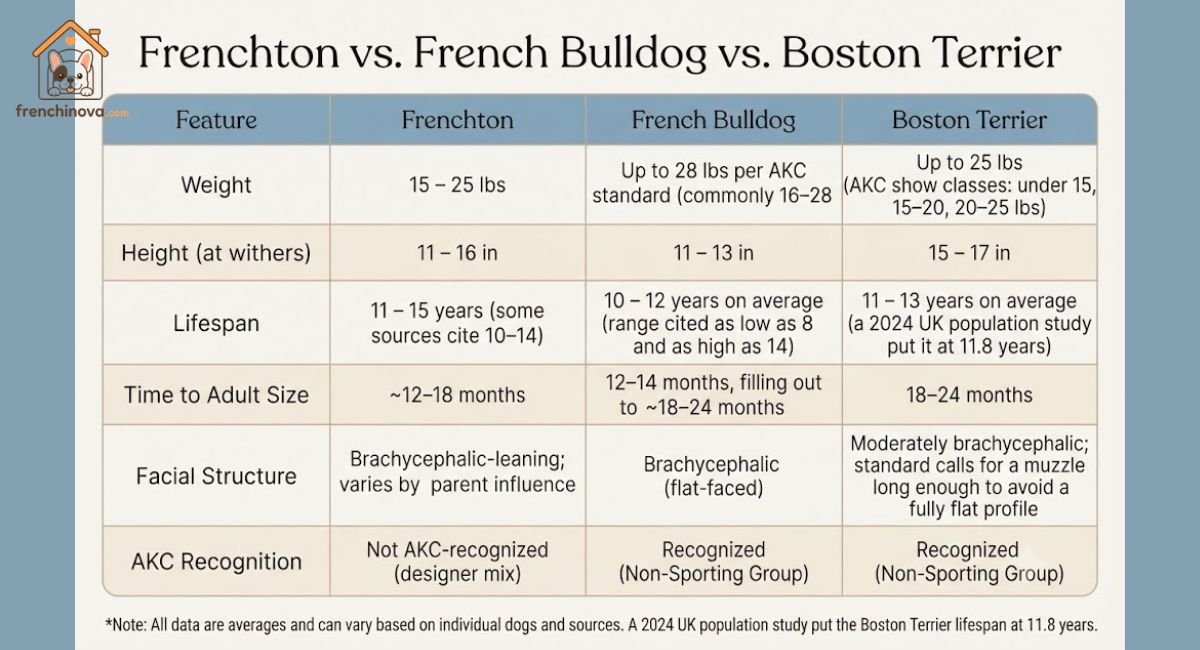
| Frenchton | French Bulldog | Boston Terrier | |
| Weight | 15 – 25 lbs | Up to 28 lbs per AKC standard (commonly 16–28 lbs) | Up to 25 lbs (AKC show classes: under 15, 15–20, 20–25 lbs) |
| Height (at withers) | 11 – 16 in | 11 – 13 in | 15 – 17 in |
| Lifespan | 11 – 15 years (some sources cite 10–14) | 10 – 12 years on average (range cited as low as 8 and as high as 14) | 11 – 13 years on average (a 2024 UK population study put it at 11.8 years) |
| Time to Adult Size | ~12–18 months | 12–14 months, filling out to ~18–24 months | 18–24 months |
| Facial Structure | Brachycephalic-leaning; varies by parent influence | Brachycephalic (flat-faced) | Moderately brachycephalic; standard calls for a muzzle long enough to avoid a fully flat profile |
| AKC Recognition | Not AKC-recognized (designer mix) | Recognized (Non-Sporting Group) | Recognized (Non-Sporting Group) |
Frenchton figures are typical ranges from breed-info sources, since the cross has no official kennel-club standard.
Size, Growth, and What to Expect
Frenchtons are small-to-medium dogs, generally landing somewhere between their two parent breeds in size, typically a sturdy, compact dog rather than a delicate one. Exact adult size varies with which parent a puppy takes after, so a breeder’s honest estimate based on the parents is the best guide.
Like most small breeds, Frenchtons reach close to their adult size within the first year, filling out in muscle as they mature. Most reach roughly 90–95% of their adult size by 12 months, with the remaining fill-in happening gradually up to about 18 months.
Frenchton Growth Chart (Average Weight & Height by Age)
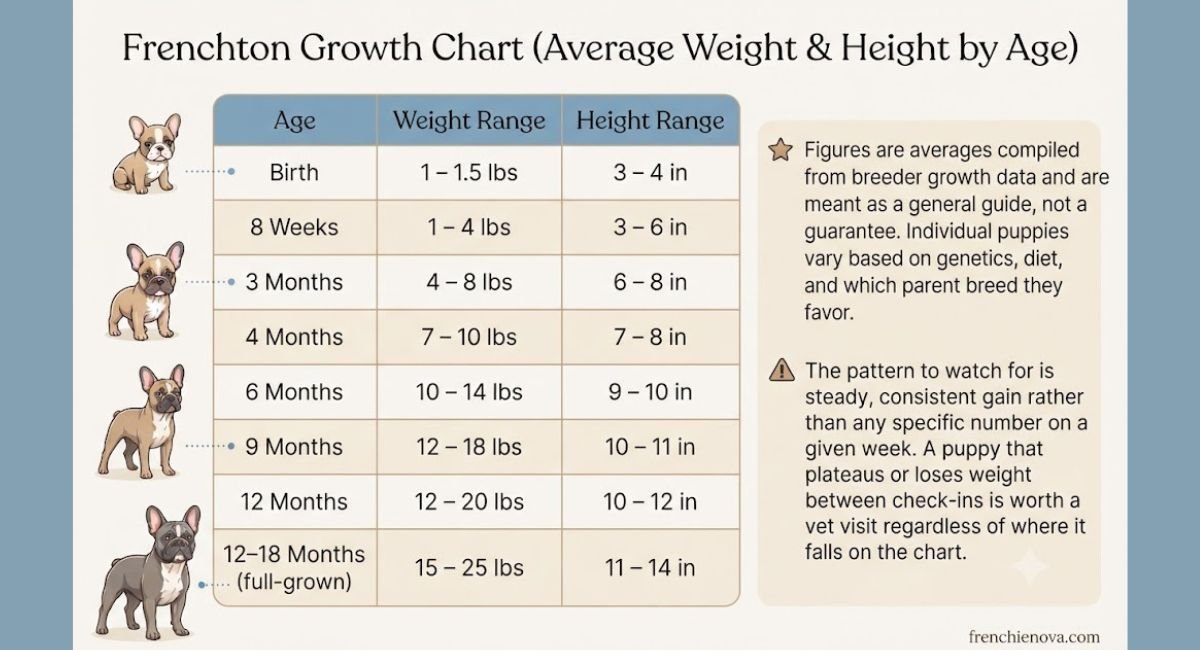
| Age | Weight Range | Height Range |
| Birth | 1 – 1.5 lbs | 3 – 4 in |
| 8 Weeks | 1 – 4 lbs | 3 – 6 in |
| 3 Months | 4 – 8 lbs | 6 – 8 in |
| 4 Months | 7 – 10 lbs | 7 – 8 in |
| 6 Months | 10 – 14 lbs | 9 – 10 in |
| 9 Months | 12 – 18 lbs | 10 – 11 in |
| 12 Months | 12 – 20 lbs | 10 – 12 in |
| 12–18 Months (full-grown) | 15 – 25 lbs | 11 – 16 in |
Figures are averages compiled from breeder growth data and are meant as a general guide, not a guarantee. Individual puppies vary based on genetics, diet, and which parent breed they favor. This is why the full-grown height range here is wider than any single breeder’s chart: it accounts for the spread across different sources.
The pattern to watch for is steady, consistent gain rather than any specific number on a given week. A puppy that plateaus or loses weight between check-ins is worth a vet visit regardless of where it falls on the chart.
Caring for a Frenchton Puppy
Frenchtons aren’t high-maintenance, but they do have specific needs.
- Exercise. Moderate is the word. They enjoy play and short walks but tire and overheat quickly, so intense or lengthy exercise, especially in heat, is a no. Mental enrichment and gentle play suit them best.
- Heat sensitivity. Like both parents, they struggle in hot weather. Cool spaces, fresh water, and avoiding midday heat are non-negotiable safety measures.
- Grooming. The short coat is easy, regular brushing handles shedding. Any facial wrinkles and the tail area need routine cleaning, just like a purebred Frenchie.
- Training. Smart but a touch stubborn, Frenchtons respond best to short, positive, reward-based sessions. Early socialization shapes a confident adult.
- Feeding. A measured, quality diet keeps weight in check, since the breed loves food and gains easily, and a flat-ish face benefits from a bowl designed for easier eating.
Gear a Frenchton Puppy Needs
A Frenchton’s flat-leaning face and stocky build mean its gear overlaps almost entirely with what suits a French Bulldog. A few essentials cover the basics. A well-fitted harness rather than a collar protects a potentially sensitive airway. A supportive, appropriately sized Frenchie dog bed gives growing joints a good place to rest. A shallow or slow-feeder Frenchie dog bowl helps with the gulping and gas that both parent breeds are prone to. And because Frenchtons feel the cold with their short coats, seasonal layers from the main French Bulldog clothes guide keep them comfortable through chilly weather. Buying for the breed’s quirks from day one saves a lot of trial and error.

- Orthopedic Support: Our orthopedic cat sofa is designed to give your pet unparalleled support for a deep, dreamy sleep. …
- Enhanced Comfort: The 4-sided bolster design promotes ultimate comfort and security, offering your pet a variety of cozy…
- Waterproof & Easy Care: The cover features a laminated waterproof layer that helps protect against spills and accidents….

- Medium slow feeder dog bowl – helps slow down eating up to 10X; this SLOWEST level feeder is best for very fast eaters a…
- Holds 2 cups of dry or wet dog food – this very deep dog bowl has our most challenging puzzle feeder maze design and can…
- Mindful mealtime – encourages slower eating and longer engagement, helping pups enjoy every bite while making mealtime m…
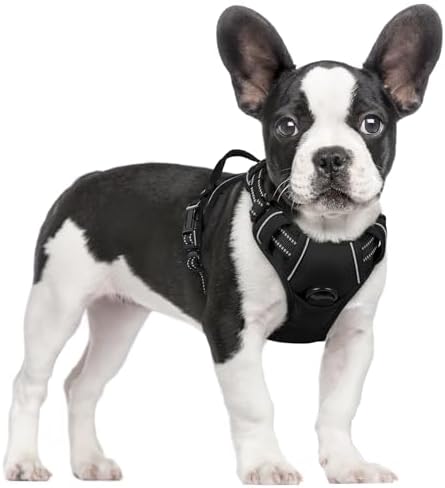
- Small Dog Harness – Recommended Breeds: Small Dogs, such as Beagle, Dachshund, Corgi, Pug, Puggle, Terrier, etc. Please …
- No Pull, No Choke – Our non-pulling dog harness is specially designed with 2 metal leash rings for safer dog walks. Use …
- Easy to Use – This hassle-free overhead harness is easy to put on and take off with its 2 fast-release buckles. Slide th…

- PERFECT FIT FOR ALL DOGS: Kuoser dog winter coat comes in 7 sizes to fit breeds like French Bulldogs, Labrador, Golden r…
- WEATHERPROOF: Our dog jacket is made of windproof and waterproof polyester to protect your furry friend from bad weather…
- REVERSIBLE & ADJUSTABLE: With easy-to-use magic stickers around the neck and belly, the Kuoser dog coat is reversible fo…
Buying a Frenchton Puppy: Cost and Finding a Breeder
Frenchton puppy prices vary widely depending on location, lineage, and breeder reputation, and they can run high given the breed’s popularity. That demand, unfortunately, attracts irresponsible breeders and puppy mills, so vetting matters.
What to budget for a puppy
From a reputable breeder, expect a Frenchton puppy to typically run somewhere between $1,500 and $5,500, with many falling in the $2,000–$5,000 range depending on coat color, markings, and the parents’ health-testing credentials. Rare or in-demand colors like merle can push prices toward the higher end, but rarity alone isn’t a reason to pay more, it doesn’t correlate with health. Prices well below that range, especially anything under $1,000–$1,500, are worth treating as a red flag rather than a bargain, since it often signals skipped health testing or poor breeding conditions.
Ongoing costs add up fast
Beyond the purchase price, plan for monthly food costs in the neighborhood of $50–75, and pet insurance in the range of $50–80 a month. Premiums for brachycephalic breeds tend to run higher because of the elevated airway and surgical risk. Routine vet visits, dental care, and preventive medication are recurring costs on top of that. If BOAS (airway) correction surgery is ever needed, that alone can run $2,000–5,000. Taken together, total lifetime ownership costs for a Frenchton are commonly estimated at $20,000–$40,000, a number worth sitting with before falling for a cute photo.
Frenchton Cost Breakdown
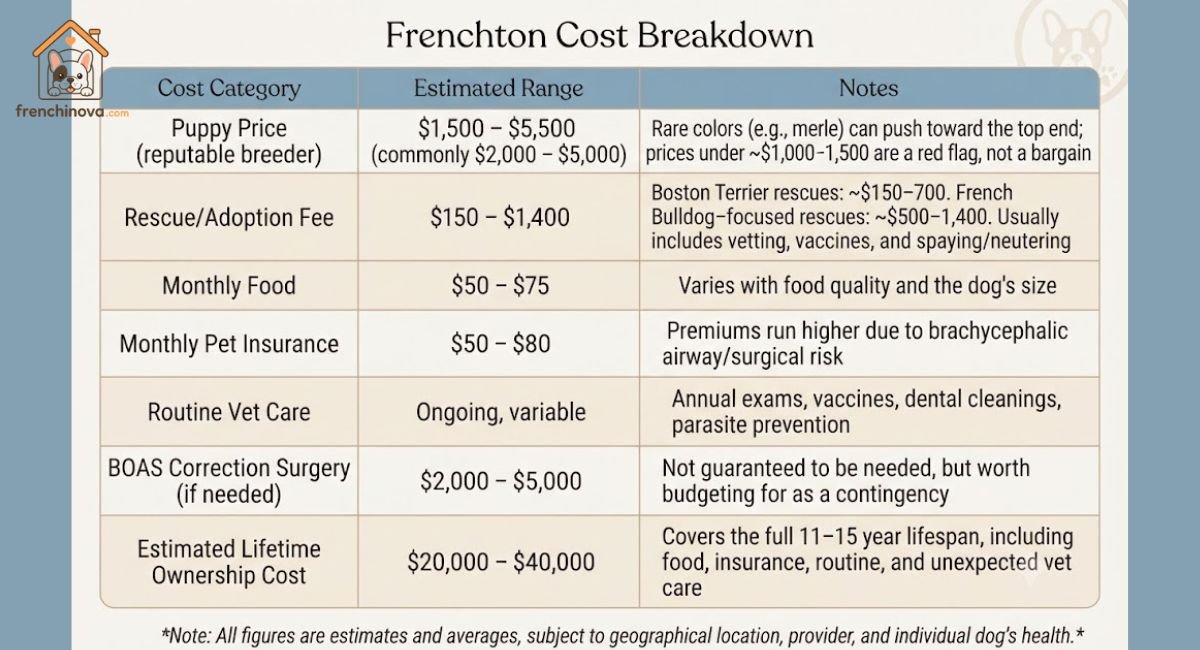
| Cost Category | Estimated Range | Notes |
| Puppy Price (reputable breeder) | $1,500 – $5,500 (commonly $2,000–$5,000) | Rare colors (e.g., merle) can push toward the top end; prices under ~$1,000–1,500 are a red flag, not a bargain |
| Rescue / Adoption Fee | $150 – $1,400 | Boston Terrier rescues: ~$150–700. French Bulldog–focused rescues: ~$500–1,400. Usually includes vetting, vaccines, and spaying/neutering |
| Monthly Food | $50 – $75 | Varies with food quality and the dog’s size |
| Monthly Pet Insurance | $50 – $80 | Premiums run higher due to brachycephalic airway/surgical risk |
| Routine Vet Care | Ongoing, variable | Annual exams, vaccines, dental cleanings, parasite prevention |
| BOAS Correction Surgery (if needed) | $2,000 – $5,000 | Not guaranteed to be needed, but worth budgeting for as a contingency |
| Estimated Lifetime Ownership Cost | $20,000 – $40,000 | Covers the full 11–15 year estimated lifespan, including food, insurance, and both routine and unexpected vet care |
What a responsible breeder looks like
Look for a breeder who health-tests both parent dogs, lets you see the puppy’s living conditions, provides health records and a contract, and asks questions rather than just taking a deposit. Steer clear of anyone who pressures a quick sale, won’t show the parents, or markets purely on rare colors or “guaranteed healthy” promises.
Adoption is worth exploring
Because Frenchtons blend two breeds with active rescue networks, breed-specific and mixed-breed rescues sometimes have Frenchtons or close look-alikes available. Adoption fees are dramatically lower than breeder prices. Boston Terrier rescues charge commonly somewhere in the $150–700 range, and French Bulldog-focused rescues more like $500–1,400, generally covering vetting, vaccines, and spay/neuter that’s already been done. It’s a meaningfully cheaper and, for many dogs, a life-saving path to ownership.
Is a Frenchton Right for You?
A Frenchton suits someone who wants an affectionate, playful companion and can offer plenty of company, a temperature-controlled home, and a calm approach to exercise. They’re less ideal for people away from home all day, those wanting a jogging or hiking partner, or anyone in a consistently hot climate without good cooling. Match the dog to the lifestyle honestly, and a Frenchton becomes a devoted, joyful member of the family.
Are Frenchtons hypoallergenic?
No. Frenchtons have a short coat and shed moderately year-round, so they aren’t considered hypoallergenic despite the low-shed appearance.
Do Frenchtons bark a lot?
Generally not, both parent breeds tend to be relatively quiet, though individual dogs vary. Some owners report more snoring and snorting than barking, a byproduct of the breed’s flatter face.
Frenchton vs. French Bulldog: Which is better for me?
It depends on priorities. A Frenchton may offer marginally easier breathing and a slightly longer average lifespan, but neither is guaranteed, and both still require a health-focused breeder. A purebred French Bulldog is AKC-recognized, which matters for anyone interested in showing or breed-specific clubs.
Can Frenchtons live in apartments?
Yes, their compact size and moderate exercise needs make them well-suited to apartment living, as long as heat and humidity are managed indoors and walks avoid the hottest part of the day.
The Bottom Line
Frenchton puppies blend the best-loved traits of the French Bulldog and Boston Terrier into a friendly, playful, family-oriented companion, and they’re rightly popular for it. Just buy with clear eyes: the “automatically healthier” claim is overstated, since these dogs still lean brachycephalic and can inherit real health considerations, so health-first breeding and a vet’s input matter more than any sales promise. Set a Frenchton up with the right harness, bed, bowl, and seasonal gear, keep it cool and well-trained, and this charming little mix returns the effort with years of devotion. For the gear side of that setup, the main French Bulldog clothes guide is the place to start.
This article is general information, not veterinary advice. Always consult a licensed veterinarian about the health of a specific puppy.

Auston is the founder of Frenchie Nova and a longtime French Bulldog owner. He writes practical, research-backed guides on Frenchie care, feeding, and health. Not a veterinarian — always consult your vet for medical concerns.