


Anyone typing “pug dog bulldog” into a search bar is usually doing one thing: trying to decide between the most beloved flat-faced breeds before committing to one. They look similar at a glance, squishy faces, compact bodies, big personalities, but Pugs, English Bulldogs, and French Bulldogs are surprisingly different dogs to live with.
This comparison breaks down how the pug, the bulldog, and their French cousin stack up on looks, temperament, health, and daily care, so the choice fits a real lifestyle rather than just a cute photo. They share more than a flat face, including a set of care needs and accessories, but the differences Pug Dog vs Bulldog are exactly what should drive the decision.
A Short And Quick Answer
The Pug is the smallest and most energetic of the three (14–18 lbs), the English Bulldog is the largest and calmest (40–50 lbs), and the French Bulldog sits in the middle in size and temperament (16–28 lbs) while topping the American Kennel Club’s popularity rankings. All three are brachycephalic breeds that need heat management, gentle exercise, and a health-focused breeder.
Table of Contents
At a Glance: Pug vs. Bulldog vs. French Bulldog
| Pug | English Bulldog | French Bulldog | |
| Origin | China, ancient (traced to roughly 400 BC) | England | Nottingham, England → refined in France, 1800s |
| Weight | 14–18 lbs | 40–50 lbs | 16–28 lbs |
| Height | 10–13 in | 14–15 in | 11–13 in |
| Coat & shedding | Short, double coat — sheds the most | Short — moderate shedding | Short, single coat — sheds the least |
| Temperament | Playful, mischievous, high-energy for its size | Calm, dignified, stubborn | Alert, affectionate, adaptable |
| Commonly cited lifespan | 13–15 years | 8–10 years | 10–12 years |
| AKC popularity rank (2025) | No. 38 | No. 10 | No. 1 (4th year running) |
| Typical puppy price (reputable breeder, US) | ~$1,200–$2,000 | ~$1,500–$4,500 | ~$2,000–$4,500+ |
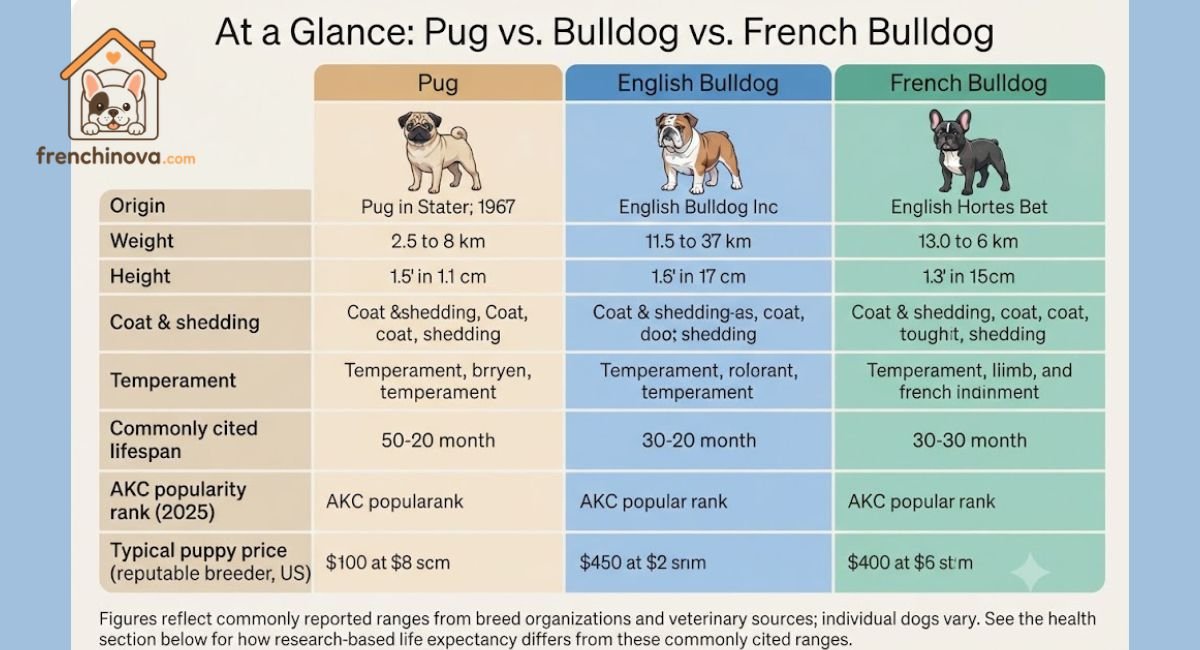
Figures reflect commonly reported ranges from breed organizations and veterinary sources; individual dogs vary. See the health section below for how research-based life expectancy differs from these commonly cited ranges.
Meet the Flat-Faced Favorites
All three breeds are brachycephalic, that’s the technical term for the short-muzzled, flat-faced build they share. It’s the source of their charm and, honestly, the root of most of their care needs.
The Pug is the smallest and oldest of the three, originating in China, known for its curled tail and round, expressive face. Chinese emperors kept pugs and later spread to Europe with Dutch traders. The English Bulldog is a heavyweight, stocky, wrinkly, and calm breed developed in England. The French Bulldog sits in between in size, sporting its trademark bat ears, and has surged to the top of popularity charts: the American Kennel Club’s 2025 registration statistics put the French Bulldog at No. 1 for the fourth year running, ahead of the Labrador Retriever and Golden Retriever, while the English Bulldog ranks No. 10 and the Pug sits at No. 38. Same family of features, three very differently ranked dogs.
Pug Dog vs Bulldog: Appearance and Size
Size is the first big differentiator. A Pug is small and round, typically 14 to 18 pounds and 10 to 13 inches tall, with a tightly curled tail and a fine, double coat that sheds more than people expect. An English Bulldog is the largest, often 40 to 50 pounds and 14 to 15 inches tall, a low, muscular, heavily wrinkled dog that’s wider than it is tall. The French Bulldog lands in the middle, usually 16 to 28 pounds and 11 to 13 inches tall, leaner than the English Bulldog and defined by those upright bat ears.
Wrinkles vary too: the English Bulldog wears the deepest folds, the Pug has lighter facial wrinkling around the muzzle, and the French Bulldog falls somewhere between. Coats are short across all three, though the Pug’s double coat means the most shedding of the group.
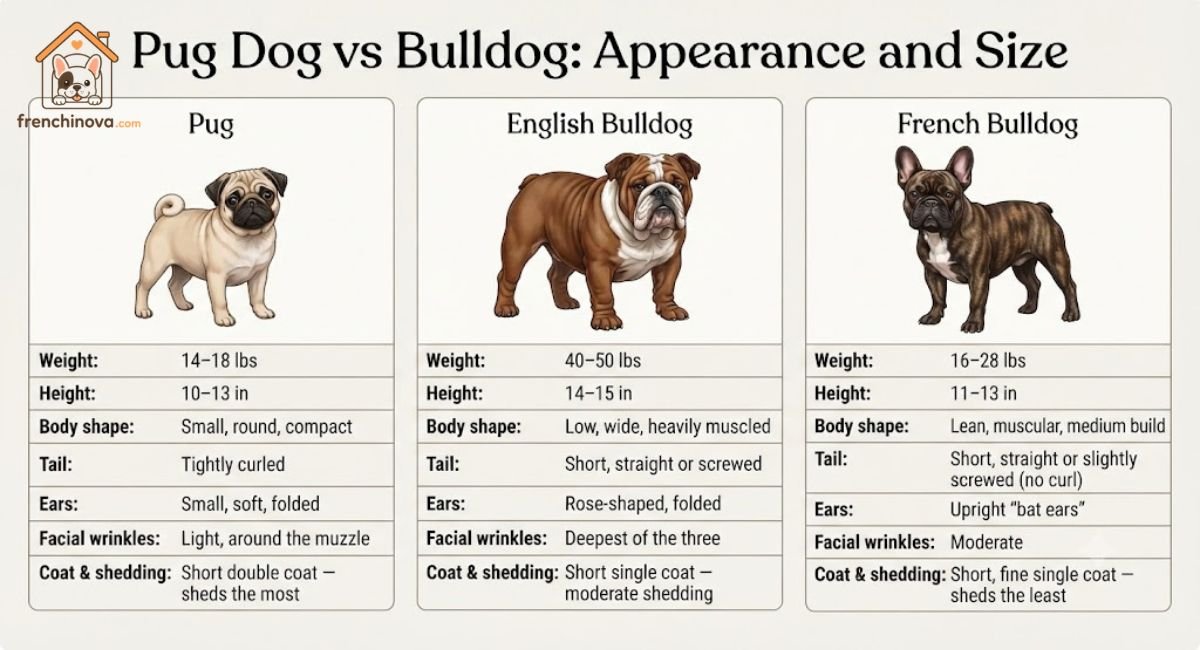
| Pug | English Bulldog | French Bulldog | |
| Weight | 14–18 lbs | 40–50 lbs | 16–28 lbs |
| Height | 10–13 in | 14–15 in | 11–13 in |
| Body shape | Small, round, compact | Low, wide, heavily muscled | Lean, muscular, medium build |
| Tail | Tightly curled | Short, straight or screwed | Short, straight or slightly screwed (no curl) |
| Ears | Small, soft, folded | Rose-shaped, folded | Upright “bat ears” |
| Facial wrinkles | Light, around the muzzle | Deepest of the three | Moderate |
| Coat & shedding | Short double coat — sheds the most | Short single coat — moderate shedding | Short, fine single coat — sheds the least |
Temperament: How They Differ
This is where the choice often gets made. Pugs are playful, mischievous charmers, sociable little clowns that crave attention and entertain the whole household. English Bulldogs are the mellow ones: calm, gentle, dignified, and happy to lounge for much of the day, with a stubborn streak. French Bulldogs strike a middle note, alert, affectionate, and lively, but adaptable and quieter than a Pug.
All three are deeply people-oriented and form strong bonds, so none of them does well left alone for long stretches. For an active, comedic companion, the Pug appeals; for a laid-back couch buddy, the Bulldog; for a balance of fun and calm, the Frenchie.
Shared Health Considerations
Here’s the serious part that applies to all three. Because they’re brachycephalic, Pugs, English Bulldogs, and French Bulldogs share a cluster of health considerations: breathing difficulties, low heat tolerance, exercise intolerance, eye issues, and trouble swimming. The flat face that makes them adorable also narrows the airway.
Breathing risk, by the numbers
The condition behind most of that risk has a name: brachycephalic obstructive airway syndrome, or BOAS. A 2026 study from the Royal Kennel Club, screening more than 4,000 dogs, found BOAS in 15.6% of French Bulldogs tested, 18.9% of English Bulldogs, and 19.8% of Pugs, though the researchers noted these numbers likely undercount the true rate, since dogs are usually only screened when an owner already suspects a problem.
A separate UK study using more objective breathing-function equipment (rather than a vet’s visual grading) found roughly half of dogs across all three breeds showed some degree of BOAS. A large veterinary-records study (VetCompass) put breed-level prevalence at about 19–20% for English Bulldogs and French Bulldogs and 26.5% for Pugs. The numbers move depending on how BOAS is measured, but the pattern holds across every method: all three breeds carry meaningfully elevated breathing risk, and it’s worth asking a breeder whether their dogs have been screened.
Lifespan: what the research says vs. what’s commonly cited
Most breed guides, including this one, cite Pugs at 13–15 years, French Bulldogs at 10–12 years, and English Bulldogs at 8–10 years, reasonable estimates for a dog that reaches adulthood and receives good care. But population-level research tells a more sobering story. A widely cited 2022 study in Scientific Reports, analyzing over 30,000 UK dogs, found the French Bulldog had the lowest life expectancy at birth of any breed studied, at 4.5 years, pulled down heavily by early-life risks like birth complications and puppy mortality.
The same study put the English Bulldog at 7.4 years and the Pug at 7.7 years from birth. A 2024 UK follow-up study (McMillan et al.) found French Bulldogs specifically averaged 9.8 years, compared with 12.7 years for purebred dogs generally. The takeaway for a prospective owner: the “commonly cited” range describes a dog that clears the riskiest early years, and choosing a breeder who health-tests parents materially improves those odds.
There are differences in degree, too. English Bulldogs tend to face the most health challenges day to day, while Pugs and French Bulldogs commonly report fewer chronic issues with good care. But none of these breeds is low-maintenance health-wise, and prospective owners should budget for veterinary care and choose health-focused breeders.
Any specific health question about an individual dog belongs with a licensed veterinarian, this is general information, not medical advice.
Care and Exercise Needs Compared
The care routines rhyme more than they differ. All three need moderate, gentle exercise, short walks and play, never strenuous activity, and absolutely not in the heat. Overheating is a genuine danger for every flat-faced breed, so climate control and water access are essential year-round.
The English Bulldog is the most sedentary and the most prone to weight gain, so portion control matters most there. The Pug is the most energetic and needs the most engagement to stay out of mischief. The French Bulldog wants regular but manageable activity. Across the board, hot weather is the enemy, and cool comfort is the priority.
Grooming Differences
Grooming separates them a bit. The Pug sheds the most thanks to that double coat, so frequent brushing is a must, plus cleaning of its facial wrinkles. The English Bulldog’s deep folds demand the most diligent wrinkle care to prevent skin infections. The French Bulldog needs its folds and tail area cleaned, with less shedding than the Pug. All three benefit from routine nail trims, ear cleaning, and dental care.
What It Costs: Puppy Price and Lifetime Ownership
Price is a real part of the decision, and it varies more than people expect. A Pug puppy from a reputable breeder commonly runs somewhere in the $1,200–$2,000 range. English Bulldog and French Bulldog puppies both typically start around $1,500–$2,500 for standard colors from a responsible breeder, though French Bulldogs with rare colors (blue, lilac, merle) can climb to $5,000–$10,000 or more, since the breed frequently requires artificial insemination and C-section deliveries.
Lifetime costs, including food, routine vet care, and the higher odds of breathing or skin-related treatment, are commonly estimated at $25,000–$60,000 over a French Bulldog’s lifetime and can top $40,000 for an English Bulldog, a number worth budgeting for before, not after, bringing a puppy home.
Which Flat-Faced Breed Is Right for You?
It comes down to energy and size. Choose a Pug for a small, playful, attention-loving companion that brings constant comedy. Choose an English Bulldog for a larger, calm, low-energy couch companion, and a readiness for higher potential vet costs. Choose a French Bulldog for a middle-ground dog: affectionate and fun, but more adaptable and apartment-friendly than the other two. Whichever wins, the commitment to managing a brachycephalic breed’s needs is the same.
Accessories All Three Breeds Share
Despite their differences, the pug, the bulldog, and the French Bulldog need remarkably similar gear, a happy bonus for owners of more than one. A well-fitted harness rather than a collar protects every flat-faced dog’s sensitive airway on walks. Cooling mats and vests are core safety items for all three given their heat sensitivity. A supportive frenchie dog bed (in the right size) cushions joints across the group.
A shallow or slow-feeder frenchie dog bowl eases the gulping and gas common to short-muzzled eaters. And seasonal clothing keeps short-coated dogs comfortable, with the fit principles in the main French Bulldog clothes guide transferring neatly to Pugs and Bulldogs alike. Owners with an English Bulldog will find the dedicated English Bulldog accessories guide covers the larger build specifics.
Common Misconceptions
A few myths deserve clearing up. The idea that these breeds are interchangeable misses how different their energy and size really are. The belief that they’re easy, low-maintenance pets overlooks their real health and heat-management needs. And assuming any of them is a good fit for hot climates or active, outdoorsy lifestyles sets both dog and owner up for trouble. Going in informed makes for a far better match.
Which lives longer, a Pug or a French Bulldog?
Pugs are commonly cited as living a bit longer on average (roughly 13–15 years versus 10–12 years for French Bulldogs), and population-level research backs that direction, though it puts both numbers lower than commonly cited ranges once early-life risk is factored in. Individual health, weight management, and breeder quality matter more than breed alone.
Are Pugs or French Bulldogs cheaper to own?
Pugs are typically the least expensive to buy upfront, with puppies commonly priced lower than French Bulldogs or English Bulldogs. Lifetime costs are harder to compare directly, but French Bulldogs and English Bulldogs tend to run higher due to elevated odds of breathing-related or skin-related veterinary treatment.
Can Pugs, Bulldogs, or French Bulldogs swim?
Generally, no, not safely without supervision and flotation support. Their heavy, front-loaded build and limited breathing capacity make swimming risky for all three breeds; a well-fitted canine life vest is recommended for any water exposure.
Do French Bulldogs or Pugs shed more?
Pugs shed noticeably more than French Bulldogs. The Pug’s double coat sheds year-round, while the French Bulldog’s single, finer coat sheds comparatively little.
Is a Pug or a French Bulldog better for apartment living?
Both suit apartments well, given their small size and moderate exercise needs, though the French Bulldog’s slightly quieter, more adaptable temperament is often cited as an edge for close-quarters living.
The Bottom Line
The pug dog versus bulldog question, with the French Bulldog almost always in the mix, really comes down to size, energy, and care commitment rather than which face is cutest. Pugs bring playful comedy in a small package, English Bulldogs offer calm companionship at a larger size with greater health considerations, and French Bulldogs strike an adaptable middle ground and currently top America’s popularity charts. All three share a flat-faced build that demands heat awareness, gentle exercise, diligent grooming, and health-first breeding.
They also share their gear, so the right harness, bed, bowl, cooling items, and seasonal clothing serve any of them well. Start with the main French bulldog clothes guide for the accessory side, and match the breed to the lifestyle for the rest.
This article is general information, not veterinary advice. Always consult a licensed veterinarian about the health and care of a specific dog.
Sources referenced: American Kennel Club (2025 breed registration statistics); Royal Kennel Club / PLOS One BOAS screening study (2026); VetCompass respiratory disorder prevalence data; Scientific Reports dog life expectancy study (Teng et al., 2022); UK dog longevity follow-up study (McMillan et al., 2024). General care and appearance details align with AKC and PetMD breed profiles.

Auston is the founder of Frenchie Nova and a longtime French Bulldog owner. He writes practical, research-backed guides on Frenchie care, feeding, and health. Not a veterinarian — always consult your vet for medical concerns.