

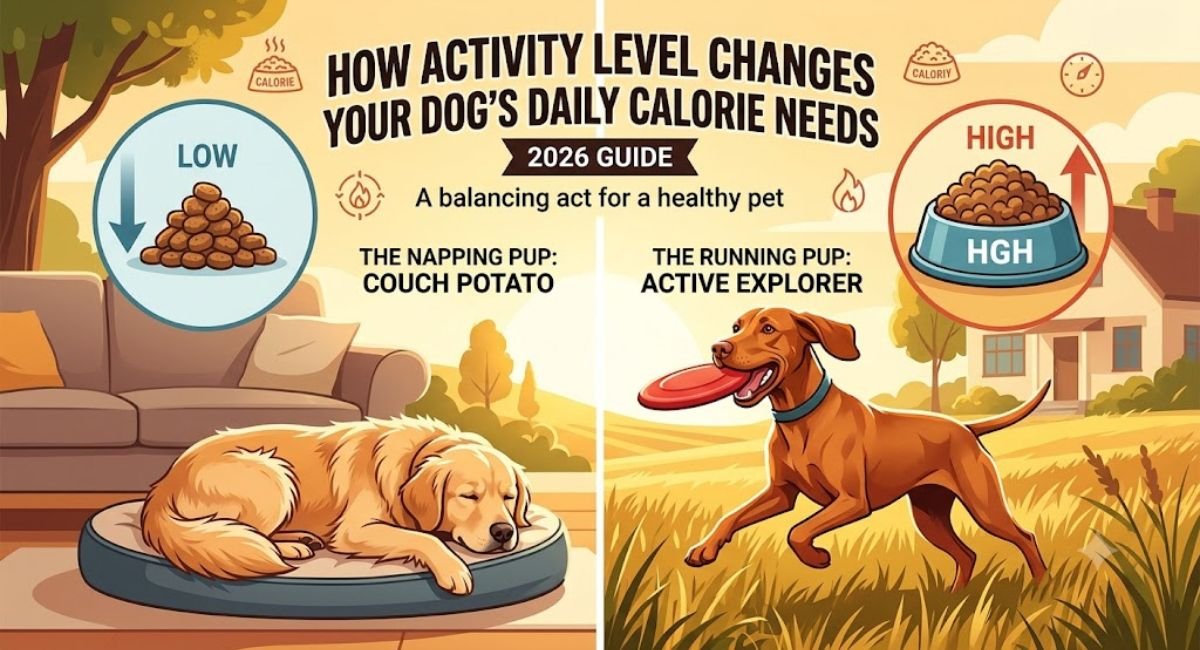
A 22-pound French Bulldog was being fed at the “moderate activity” portion for over a year, except his real-world activity was two short walks and a lot of couch loafing. The mismatch quietly added three pounds before the vet flagged it. That moment is where activity level stops being a vague label and becomes the single most underestimated factor in dog nutrition. If a dog’s portions look right on paper but the body is telling a different story, the activity classification is almost always where the math broke down.
This guide breaks down what activity level really means, how activity level changes a dog’s daily calorie needs in actual numbers, and how owners can honestly classify their own dog.
Table of Contents
The Short Answer: Activity Level Can Double or Halve Calorie Needs
Activity level isn’t a minor tweak in the calorie equation, it’s one of the biggest variables in it. The same 25-pound dog can need:
- 500 kcal/day if sedentary
- 625 kcal/day if moderately active
- 875 kcal/day if highly active
- 1,000+ kcal/day if working or athletic
That’s a two-fold swing on the same dog at the same weight. Get the activity classification wrong, and the portion is wrong before any other adjustment even enters the picture.
How Activity Multipliers Work in Vet Nutrition
The activity adjustment isn’t guesswork, it’s a published multiplier applied to the dog’s Resting Energy Requirement (RER). The standard formula used by the Ohio State University College of Veterinary Medicine, the National Research Council (NRC), and the Association for Pet Obesity Prevention (APOP) is:
Daily Calories = RER × Activity Multiplier, where RER = 70 × (body weight in kg)^0.75.
For a quick mental estimate, veterinarians like Dr. Duncan Houston also use the shortcut version: RER = (30 × body weight in kg) + 70. It lands within a few calories of the full equation for most adult dogs.
Here’s the standard activity multiplier table used by veterinary nutritionists:
| Activity Level | Multiplier | Example Dogs |
| Inactive / weight loss | 1.0 × RER | Recovery, post-surgery, obese |
| Sedentary (neutered) | 1.2 × RER | Low-energy seniors, couch-bound |
| Low activity | 1.4 × RER | One short walk daily |
| Moderate activity (neutered) | 1.6 × RER | Two walks, indoor play |
| Moderate activity (intact) | 1.8 × RER | Active adult, intact |
| High activity | 2.0–3.0 × RER | Running, agility, hiking |
| Working/sporting | 3.0–8.0 × RER | Sled, search & rescue, herding |
Worked example for a 25-lb (11.3 kg) dog: RER = 70 × (11.3)^0.75 = 432 kcal at rest.
- Sedentary (× 1.2): 518 kcal/day
- Moderate (× 1.6): 691 kcal/day
- High activity (× 2.0): 864 kcal/day
The dog hasn’t changed. The portion shifts by almost 350 kcal depending on how the dog actually lives.
Daily calorie needs
How many calories does your dog need?
What Each Activity Level Actually Looks Like (How Activity Level Changes a Dog’s Daily Calorie Needs)
This is the part most blog posts skip. Multipliers only work if the classification is honest, and “moderate” means very different things to different owners. Here’s what each level looks like in real life.
Sedentary (× 1.0–1.2)
Almost no structured exercise. A typical day:
- One short bathroom walk (5–15 minutes)
- Mostly indoor rest and light movement
- Little to no fetch, tug, or play
- Often paired with senior age, recovery, or long-workday apartment living
Typical dogs in this category: senior French Bulldogs, recovering post-surgery dogs, dogs with severe BOAS or joint disease, and apartment dogs whose owners are out 9+ hours daily.
Low Activity (× 1.4)
A slight step up from sedentary. A typical day:
- One 20–30 minute walk on flat ground
- A few minutes of indoor tug or fetch
- Mostly resting between bursts
Typical dogs: many adult Frenchies, indoor companion breeds, dogs with mild mobility issues, and older dogs that still walk daily. NorthPoint Pets notes that most dogs fall into the low-activity bracket even when their owners feel they’re more active than that.
Moderate Activity (× 1.6–1.8)
The middle of the bell curve, where most healthy adult dogs land when classified honestly. A typical day:
- Two 30-minute walks (morning and evening)
- 15–20 minutes of indoor or backyard play
- Occasional weekend outings (park, beach, longer walks)
Typical dogs: healthy mixed breeds, family pets with active routines, and dogs of owners who walk regularly. Most Frenchies that look moderately active actually sit in the low-activity bracket, the math has to be honest.
High Activity (× 2.0–3.0)
Significantly above average. A typical day:
- Two long walks (45+ minutes each)
- Running or jogging alongside an owner
- Agility training, scent work, or structured sessions
- Active off-leash time daily
Typical dogs: Border Collies, Australian Shepherds, Labs in active homes, and agility competitors. A note for owners of high-drive sporting dogs: Wisdom Panel flags Exercise-Induced Collapse (EIC) as a real genetic condition in some Labrador Retrievers, Cocker Spaniels, and a few other breeds. EIC dogs need carefully managed exertion, high calorie demand doesn’t always mean unlimited intensity is safe.
Working / Sporting (× 3.0–8.0)
Calorie needs scale up dramatically. A typical day:
- 4+ hours of intense activity
- Sled pulling, herding livestock, search-and-rescue work
- Competition-level training
- Often paired with cold-weather operation, multiplying the calorie burn further
Typical dogs: sled dogs, working herders, military or police K9s, and top-level agility or flyball athletes. Almost no pet dog belongs here. Sled teams racing in Arctic conditions can need 10,000+ kcal per day, a useful reminder of just how wide this scale really gets.
The Brachycephalic Cap: Frenchies and BOAS Breeds
This is the section every Frenchie article needs, and almost none include. Brachycephalic breeds, French Bulldogs, Pugs, Boston Terriers, English Bulldogs, physically can’t reach the upper activity tiers safely.
Compressed airways limit oxygen intake. Flat faces limit cooling efficiency. A 2024 study in Scientific Reports confirmed that Brachycephalic Obstructive Airway Syndrome (BOAS) restricts how much sustained activity these breeds can tolerate. Pushing a Frenchie into “high activity” territory doesn’t build fitness, it triggers heat stroke, collapse, or a respiratory crisis.
For Frenchies and other BOAS breeds:
- Maximum safe classification: Moderate activity (× 1.6)
- Realistic average: Low activity (× 1.4)
- Common reality: Sedentary to low (× 1.2–1.4) for most adult Frenchies
If a Frenchie genuinely seems to need higher calories, the issue is usually metabolic, a measurement error, or an unnoticed health condition like hypothyroidism — not real high activity. Always recheck the math before adding portions.
Why Neutering Re-Sets the Math
One of the most overlooked moments in a dog’s calorie life is the 8–12 weeks after spaying or neutering. PetMD and the dog calorie calculator both confirm that neutered and spayed dogs need roughly 20–30% fewer calories than intact dogs of the same weight. Hormonal changes lower metabolic rate, reduce roaming behavior, and shift body composition toward fat over muscle.
That’s why veterinary nutrition tables list a separate column for neutered moderate (× 1.6) vs. intact moderate (× 1.8). Skipping that 0.2 adjustment is one of the most common reasons a previously lean dog quietly puts on weight in the year after surgery. Re-running the multiplier within a month of the procedure is one of the simplest wins in a dog’s lifetime calorie plan.
Activity Calorie Burn Chart by Body Weight
Here’s a real-world breakdown of approximate calories burned during specific activities, based on canine energy expenditure research:
| Activity (30 minutes) | 15-lb dog | 25-lb dog | 40-lb dog | 60-lb dog |
| Slow leashed walk | 30 kcal | 50 kcal | 80 kcal | 120 kcal |
| Brisk walk | 50 kcal | 80 kcal | 130 kcal | 195 kcal |
| Off-leash play | 75 kcal | 125 kcal | 200 kcal | 300 kcal |
| Steady jog/run | 100 kcal | 165 kcal | 265 kcal | 400 kcal |
| Swimming (steady) | 90 kcal | 150 kcal | 240 kcal | 360 kcal |
| Agility/training | 80 kcal | 135 kcal | 215 kcal | 325 kcal |
Two takeaways from this chart matter most:
First: a typical 30-minute leashed walk for a 25-lb dog burns roughly 50 kcal, about the same as a single dental chew. The calorie impact of a casual walk is real but often overstated.
Second: true calorie-significant exercise is running, off-leash play, and structured training, not slow neighborhood walks. That’s why most pet dogs land in the low-to-moderate band even when their owners feel they’re “very active.”
Life Stage Shifts the Math Too
Activity level doesn’t live in isolation. Life stage interacts with it in ways that swing daily calorie needs by 30% or more.
- Puppies (under 12 months): need 2–3× more calories per pound than adults. PetMD recommends using a puppy-specific multiplier (often 2.0–3.0 × RER) instead of the adult activity table.
- Adult dogs (1–7 years): the activity table above applies directly.
- Seniors (7+ for medium breeds, 5+ for giant breeds): muscle mass drops, metabolism slows, and the multiplier usually shifts down one full bracket, a moderately active adult often becomes a low-activity senior on the same daily routine.
- Pregnant or nursing dogs: calorie needs can spike to 3–8× RER, especially in the last trimester and during lactation.
Life stage is the variable owners forget to revisit. A dog that was correctly classified at 4 years old is usually misclassified by 8.
Use the Body, Not Just the Scale
Even with the right multiplier, every dog has metabolic individuality. The Pet Nutrition Alliance notes that individual dogs can vary from the predicted calorie value by as much as 50%. That’s why veterinary nutritionists rely on Body Condition Score (BCS), a 1-to-9 visual and hands-on assessment, as the final truth-check on calorie intake.
A quick BCS self-check:
- Ribs should be easy to feel under a thin layer of fat, not buried and not poking out
- The waist should be visible from above
- The abdominal tuck should be clear from the side
If the dog’s BCS is climbing despite a “correct” calorie target, the multiplier is wrong, the food math is wrong, or the metabolism falls outside the average range. APOP recommends targeting 1–2% body weight loss per week for dogs that need to slim down, anything faster risks muscle loss. AskAVet adds a critical reminder: when calculating for an overweight dog, use the target weight, not the current weight, in the RER formula.
Body condition score
Check your Frenchie’s body condition
Seasonal and Weather Adjustments
Dog activity isn’t a constant, it shifts with the seasons in ways that change calorie needs measurably. The concept that matters here is the thermoneutral zone: the temperature range where a dog’s body burns no extra energy heating or cooling itself. Step outside that zone, and calorie demand changes.
Summer heat:
- Activity drops naturally because dogs avoid heat
- Brachycephalic breeds essentially shut down in hot weather
- Calorie needs can drop 10–15% in summer for heat-sensitive breeds
- The common mistake: feeding July portions like March portions, which quietly causes weight gain
Winter cold:
- Cold-weather breeds (Huskies, Malamutes) burn more calories staying warm
- Most small and toy breeds don’t get a winter calorie boost — they spend more time indoors
- Working dogs operating in real cold can need 20–30% more during winter
Spring transitions:
- Activity often spikes as weather improves
- Calorie needs rise temporarily as outdoor routines return
- Watch for over-correction in either direction during transitional weeks
The practical takeaway: revisit the calorie target seasonally, not just annually. A dog that needs 600 kcal in March may legitimately need 510 kcal in July.
What Doesn’t Count as Activity (The Myths)
A few common assumptions inflate the activity classification and quietly cause overfeeding.
Mental stimulation isn’t physical activity. Puzzle feeders, scent work, and training sessions burn some calories, but nowhere near what physical exercise burns. Mental work doesn’t justify a higher multiplier on its own.
Indoor zoomies are short bursts. A 30-second sprint around the living room, however dramatic, doesn’t change calorie needs meaningfully. Sustained activity is what counts.
Standing still on a walk doesn’t burn much. A dog that stops to sniff every two feet on a 30-minute walk is moving for maybe 10 of those minutes. Real active time is shorter than perceived active time.
Being “high-energy” isn’t the same as being highly active. A dog can be excitable, vocal, and demanding without burning many calories. Energy and exertion are two different things.
Treats are calories, not extras. APOP and PetSmart both stress that treats should never exceed 10% of daily intake. Three training treats and a dental chew can easily eat 15% of a small dog’s daily target — that quietly cancels out the multiplier work.
How to Honestly Re-Classify Your Dog
If the activity level was assigned years ago and never revisited, it’s probably wrong. New job, injury, season, age, every life change shifts the math. Here’s the honest re-classification process most veterinary nutritionists recommend.
Step 1: Track 7 days of actual activity. Write down every walk, play session, and exercise burst with rough timing. Memory estimates are unreliable.
Step 2: Add up total active minutes per day. Don’t count time the dog spent resting, sniffing, or standing still. Only real movement.
Step 3: Match the daily total to the level:
- Under 30 active minutes/day → Sedentary or Low
- 30–60 active minutes/day → Low to Moderate
- 60–120 active minutes/day → Moderate
- 2+ hours/day with intensity → High
Step 4: Recalculate the daily calorie target with the corrected multiplier — using target body weight, not current weight, if the dog is overweight.
Step 5: Re-check in 4–6 weeks. Weigh the dog weekly and re-score body condition monthly. If weight is stable and BCS is healthy, the classification is right. If weight drifts in either direction, adjust by 5–10% and re-check.
When to Reclassify (Triggers)
These life events warrant an immediate re-check of the activity level and calorie target:
- Spaying or neutering → metabolism slows 20–30% within 8–12 weeks
- New job or schedule → walking and play routine changes
- Seasonal weather shift → especially summer for heat-sensitive breeds
- Injury or surgery recovery → temporary drop to sedentary
- Senior age transition → typically around age 7 for medium breeds
- Pregnancy or nursing → temporary increase (3–8× RER)
- Move to a new home → different yard, neighborhood, climate
Skipping this re-check is the most common reason a dog’s “correct” portion quietly becomes wrong over time.
The Bottom Line
Activity level is the variable most likely to push a calorie target off by hundreds of calories per day, in either direction. Getting it right means classifying the dog honestly, using target weight not current weight, recalculating seasonally, and confirming the result with body condition score rather than just the scale.
For Frenchies and other brachycephalic breeds specifically, the realistic range is sedentary to moderate in almost all cases. Higher tiers aren’t safe for that anatomy, and pushing them there usually creates problems faster than it solves them.
One last honest disclaimer: even the best multiplier math gives a starting point, not a final answer. Vetcalculators and the Pet Nutrition Alliance both note that individual metabolism can vary by 20–50% from predicted values. The chart gets a dog close. The body tells the truth.
Daily calorie needs
How many calories does your dog need?
Body condition score
Check your Frenchie’s body condition
This guide is based on hands-on French Bulldog ownership and sourced from the National Research Council (2006), Ohio State University College of Veterinary Medicine, AAFCO feeding guidelines, the Association for Pet Obesity Prevention, a 2024 Scientific Reports study on brachycephalic activity tolerance, and current veterinary nutrition research from PetMD, PetPlace, AskAVet, and the Pet Nutrition Alliance. Always consult a veterinarian before significantly increasing or decreasing a dog’s calorie intake, especially around major life changes.

Auston is the founder of Frenchie Nova and a longtime French Bulldog owner. He writes practical, research-backed guides on Frenchie care, feeding, and health. Not a veterinarian — always consult your vet for medical concerns.